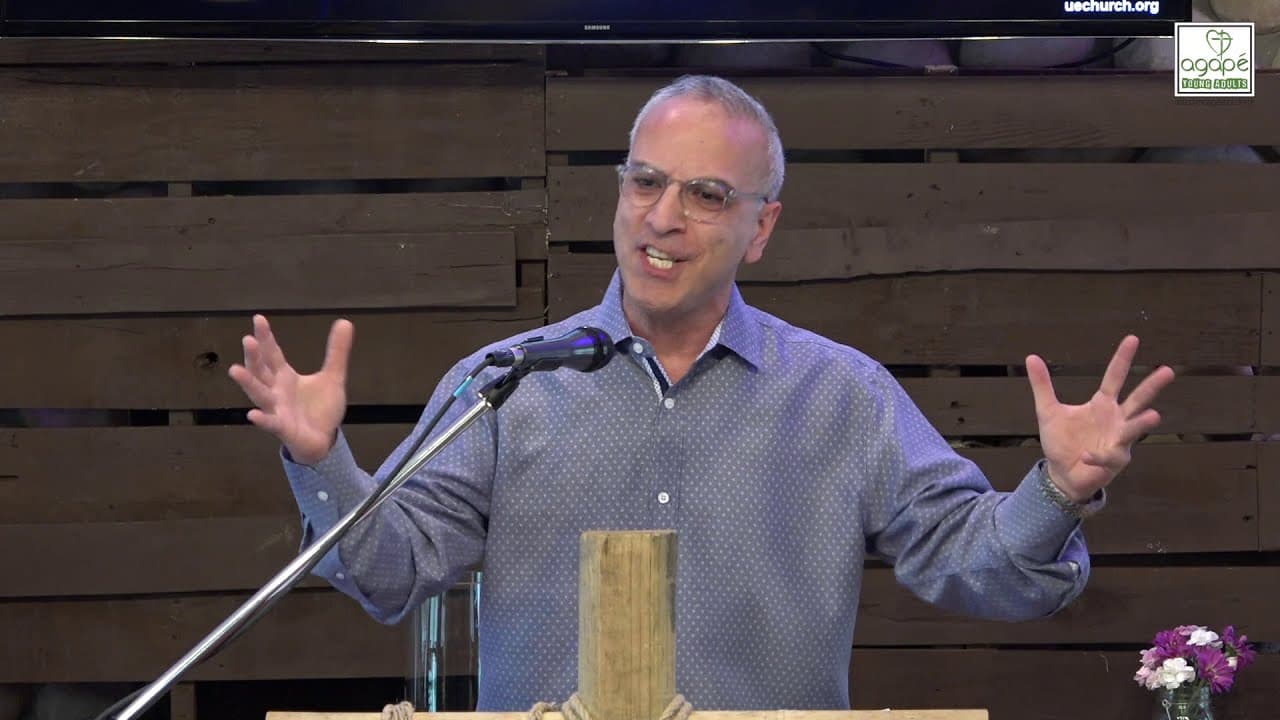
He was young, rich, powerful, humble, and asked the right question. So why did Jesus let him walk away? The answer exposes something in all of us.
You can ask the right question, come to the right person, desire the right thing — and still walk away empty-handed. That is exactly what happened to the rich young ruler in Mark 10:17-27. He ran to Jesus. He knelt. He asked about eternal life. And Jesus let him leave.
Most people read this story as a warning about money. It is that. But it is far more. This is a story about a man who thought he was close to God and discovered he wasn't even in the right conversation. He called Jesus "good teacher" — and that two-word phrase exposed everything. Because if Jesus is only a teacher, goodness doesn't apply. And if Jesus is God, then everything this man was holding onto had to go.
The Man Who Had Everything and Nothing
Look at this man's résumé. Matthew 19 tells us he was young. Luke 18 tells us he was a ruler — not a rabbi, but an administrator of a synagogue, a man of civic and religious authority. And Mark tells us he had great possessions. Young, rich, powerful.
But the list doesn't stop there. He came running to Jesus — urgency. He knelt before Him — humility, at least outwardly. He addressed Him as "good teacher" — respect. He asked about eternal life — the right desire. He didn't ask for more wealth, more prestige, more power. He asked for the one thing his money couldn't buy.
As Pastor Daniel Banna observed, this man would be "a very good and ideal candidate for a son-in-law to many parents. If a daughter comes to her dad today and tells him, 'I think I found the right man,' probably the first question he asks, 'What does he do?'" (watch at 4:14). From every human angle, this man was the total package.
And he knew what he wanted. That alone sets him apart. How many people drift through decades without ever asking the question this man asked? He wasn't confused. He wasn't apathetic. He came running because he sensed that for all his success, something was missing. The Jews understood "eternal life" not merely as living forever but as quality of life — fullness, completeness, the kind of existence that money mocks you for trying to purchase. This man had everything the world advertises as the good life, and it had left him hollow enough to sprint toward a traveling rabbi and fall on his knees in the dirt.
He came to the right person. He asked the right question. He desired the right thing. And he still got it catastrophically wrong.
"Why Do You Call Me Good?" — The Question Behind the Question
Jesus' response has confused people for centuries — and some have twisted it into something it never meant. "Why do you call me good? No one is good but one, that is God." Skeptics and false teachers have seized on this line, claiming Jesus denied His own goodness, His own deity. But read it again. Where does Jesus say He is not good?
He doesn't. He asks a question. And the question is surgical.
This man called Jesus "good teacher." Teacher. That's the ceiling of his theology. He saw Jesus as an authority — but not the authority. A moral guide, perhaps. A wise rabbi, certainly. But not God in the flesh. And Jesus pressed directly on that nerve: If I am only a teacher, why are you calling me good? No one is good but God. So either stop calling me good, or start treating me as God.
This is the fork in the road that every person must face. You can admire Jesus as a moral philosopher. You can respect Him as a prophet. You can quote His teachings at dinner parties. But unless you recognize Him as God Himself — the One who said "Before Abraham was, I AM," the One Thomas called "my Lord and my God" without rebuke — you will leave as empty as this young ruler did.
Jesus proved His goodness repeatedly. In John 8:46, He issued an open challenge: "Can anyone of you prove me guilty of sin?" In John 10, He declared, "I am the good shepherd." He claimed unity with the Father. He accepted worship. As the sermon made devastatingly clear: "If you know Jesus only as a good teacher, if you know Jesus only as a prophet, unless you recognize Jesus as God himself, you can never ever have eternal life" (watch at 7:41).
The rich young ruler's first mistake wasn't loving money. It was underestimating Jesus.
The Impossible Claim: "I've Kept Them All"
Then Jesus does something that must have sounded, to the Pharisees listening nearby, like pure orthodoxy. "You know the commandments," He says, and lists them: do not commit adultery, do not murder, do not steal, do not bear false witness, do not defraud, honor your father and mother. Matthew's account adds the summary commandment: love your neighbor as yourself.
Keep the commandments. That's it? The Pharisees must have been nodding. Finally, a message they could endorse. Salvation by works — their favorite sermon.
But Jesus was not teaching salvation by works. He never had. As Ephesians 2:8-9 makes clear, we are saved by grace through faith, not by works, lest anyone should boast. The righteous shall live by faith. If Jesus was suddenly teaching that commandment-keeping earns eternal life, it would contradict everything He ever said. So what was He doing?
He was setting a trap. And the young man walked straight into it.
"Teacher, all these things I have kept from my youth." Since his Bar Mitzvah at age thirteen, he claimed, he had kept every commandment. Really? Leviticus 18:5 says that the person who obeys God's decrees will live by them. Hypothetically, yes — if anyone could keep every commandment perfectly, they would earn eternal life. The Jews believed this was possible. Some even claimed to have done it.
But it is a hypothesis that has never been fulfilled by any human being who ever lived — except One. That is precisely why Jesus had to die on the cross. If perfect obedience were achievable, Calvary was unnecessary.
This young man's claim reveals how shallow his understanding of God's law really was. He had clearly never absorbed the Sermon on the Mount. He didn't understand that anger is murder in the heart, that lust is adultery in the mind, that God's law reaches past behavior into intention. "I've never robbed a bank, so I'm not a thief. I've never killed somebody, so I'm not a murderer." That is the logic of a man who has measured himself against a standard he has never actually read.
And then comes one of the most tender details in all of Scripture: "Jesus, looking at him, loved him." He loved this man. He loved this sincere, earnest, tragically deceived man. Some scholars have speculated this might have been John Mark himself — the writer of this Gospel — since only the author would know what Jesus felt in that moment. There's no proof, but the detail is striking. Jesus didn't look at this man with contempt. He looked at him with compassion. Because He could see what the man could not: "He's sincere, but he is deceived. You know how many people I talk to, they are sincere, but they are sincerely deceived?" (watch at 21:39).
Sincerity without truth is still deception. And Jesus loved this man too much to let him keep believing the lie.
The One Thing That Exposed Everything
"One thing you lack. Go your way, sell whatever you have, and give to the poor, and you will have treasure in heaven; and come, take up the cross, and follow me."
This was not a general command for all believers to liquidate their assets. The principle cuts deeper than that. Jesus had just heard this man claim he loved his neighbor as himself. Fine. Prove it. Go sell everything and give it to your neighbor. If you truly love others as you love yourself, this should be easy.
It wasn't easy. It was impossible. And that was the point.
"Let me tell you something — you don't love your neighbor as much as yourself. In fact, you love money more than your neighbor. Money is your God. Money is the obstacle that stands before you and eternal life" (watch at 23:28). In one command, Jesus demolished the man's entire self-assessment. He didn't keep the commandments. He never had. The one test that mattered — the one that moved from theory to action — and he failed completely.
Consider the contrast with Zacchaeus in Luke 19. Zacchaeus was also rich — but he was a tax collector, a cheater, a liar, a man who had built his fortune on the backs of the poor. By every moral measurement, he was worse than the young ruler. Yet when the Holy Spirit touched his heart, Zacchaeus stood up and declared, "Here and now, I give half of my possessions to the poor, and if I have cheated anybody, I will pay back four times the amount." Jesus didn't say, "Not enough — I need all of it." He said, "Today salvation has come to this house." Why? Because money was not Zacchaeus's god. He could keep some and still put Christ first. But for the young ruler, money was the god, and partial surrender was no surrender at all.
The question for each of us is not whether we must sell everything. The question is what stands between us and complete allegiance to Christ. Is it money? Position? A relationship? A career? A hobby? "What is the god that holds you between you and eternal life?" Whatever it is, Jesus asks you to crucify it. Carry your cross means die to everything else and follow Him.
The rich young ruler heard the price and walked away sorrowful. Compare that to the Ethiopian eunuch in Acts 8 who, after receiving the Word and being baptized, "went on his way rejoicing." Two men. Two responses. One left sorrowful. One left joyful. The difference was not intelligence or sincerity — it was surrender.
Camels, Needles, and the Only Thing That Makes Salvation Possible
"It is easier for a camel to go through the eye of a needle than for a rich man to enter the kingdom of God." Some commentators have tried to soften this by inventing a small gate in Jerusalem called "the Eye of the Needle" through which a camel could squeeze if you removed its cargo. There was no such gate. That is historical fiction dressed up as scholarship. Jesus meant exactly what He said. A literal camel. A literal needle. Impossible.
The disciples understood this. They were "greatly astonished" — because in Jewish thought, riches were a sign of God's blessing. Abraham was rich. Job was rich. David and Solomon were rich. If the blessed can't be saved, who can? "Who then can be saved?" they asked. And that is precisely the right question.
"With men it is impossible, but not with God; for with God all things are possible." This is not a motivational poster. This is the gospel. Salvation is impossible for any human being on the basis of their own merit — rich or poor, moral or immoral, religious or pagan. It is impossible. And that impossibility is the doorway through which grace enters. If this person trusts in the Lord Jesus Christ and His accomplished work on the cross — not in their own record, not in their own righteousness, not in their commandment-keeping — then even a camel goes through the eye of a needle. That's grace.
And here is one final, uncomfortable observation. If this young man had approached not Jesus but any modern church leader, what would have happened? A young, rich, diligent, morally upright man walks in the door asking about eternal life — and most of us would see opportunity. "He'll be a good member. The ministry needs money. We can't lose him." We'd rush through a sinner's prayer, put him on a committee, and congratulate ourselves on the conversion. As Pastor Daniel Banna put it bluntly: "Raise your hand. Repeat after me. You are saved. Hallelujah. Come, you're a member of our church. And right away, we're going to give you a position on the first committee" (watch at 36:08).
Jesus didn't do that. He told the man the truth, knowing the man would walk away. He valued the man's soul over the man's membership. He would rather lose the rich young ruler to honesty than gain him through compromise.
Believe in the Lord Jesus Christ and you shall be saved — yes, absolutely (Acts 16:31). But make sure there is repentance. Make sure Christ is first and last, the beginning and the end. "If He is not everything, He is nothing."
What to Remember
- You can come to the right person, ask the right question, and still miss eternal life — because knowing about Jesus is not the same as surrendering to Jesus as God.
- Jesus told the rich young ruler to keep the commandments not because obedience earns salvation, but to prove the man could not keep them — exposing his need for grace.
- Sincerity is not the same as truth. This man was sincerely convinced of his own righteousness, and he was sincerely wrong.
- The obstacle between you and God may not be money — it could be anything you refuse to place below Christ. Whatever you will not surrender is the thing that owns you.
- Salvation is humanly impossible for everyone, not just the wealthy. That impossibility is exactly why grace exists — with God, even a camel passes through the eye of a needle.
- Jesus would rather let someone walk away than offer them a cheap gospel that costs nothing and changes nothing.
Questions to Sit With
- If Jesus asked you to give up the one thing you value most — not as a hypothetical but today — what would it be? And would you do it?
- The rich young ruler believed he had kept the commandments since childhood. What comfortable self-assessments might you be carrying that wouldn't survive honest examination?
- Do you relate to Jesus primarily as a good teacher, a moral example, or as God Himself? How does that distinction change what you're willing to give Him?
- If someone walked into your church this Sunday — wealthy, influential, eager — would your instinct be to tell them the full cost of following Christ, or to close the deal quickly?
- The young ruler left sorrowful. The Ethiopian eunuch left rejoicing. What made the difference — and which direction are you walking right now?
Scripture Referenced
- Mark 10:17-27 (primary passage)
- Matthew 19
- Luke 18
- Leviticus 18:5
- John 8:46
- John 10
- Ephesians 2:8-9
- Acts 8
- Luke 19
- Acts 16:31
This article is drawn from the sermon "The Young Rich Ruler - Pastor Danial Banna" by Pastor Daniel Banna at Maranatha Bible Church Chicago. Watch the full sermon →
Related Articles
What Revelation 20 Reveals About the Human Heart
Pastor Daniel Batarseh · September 13, 2026
What Happens When Satan Is Removed for 1,000 Years? (Rev 20)
Pastor Daniel Batarseh · September 13, 2026
Who Was Epaphroditus? The Man Who Risked Everything (Phil. 2:25-30)
Pastor Daniel Batarseh · August 29, 2026