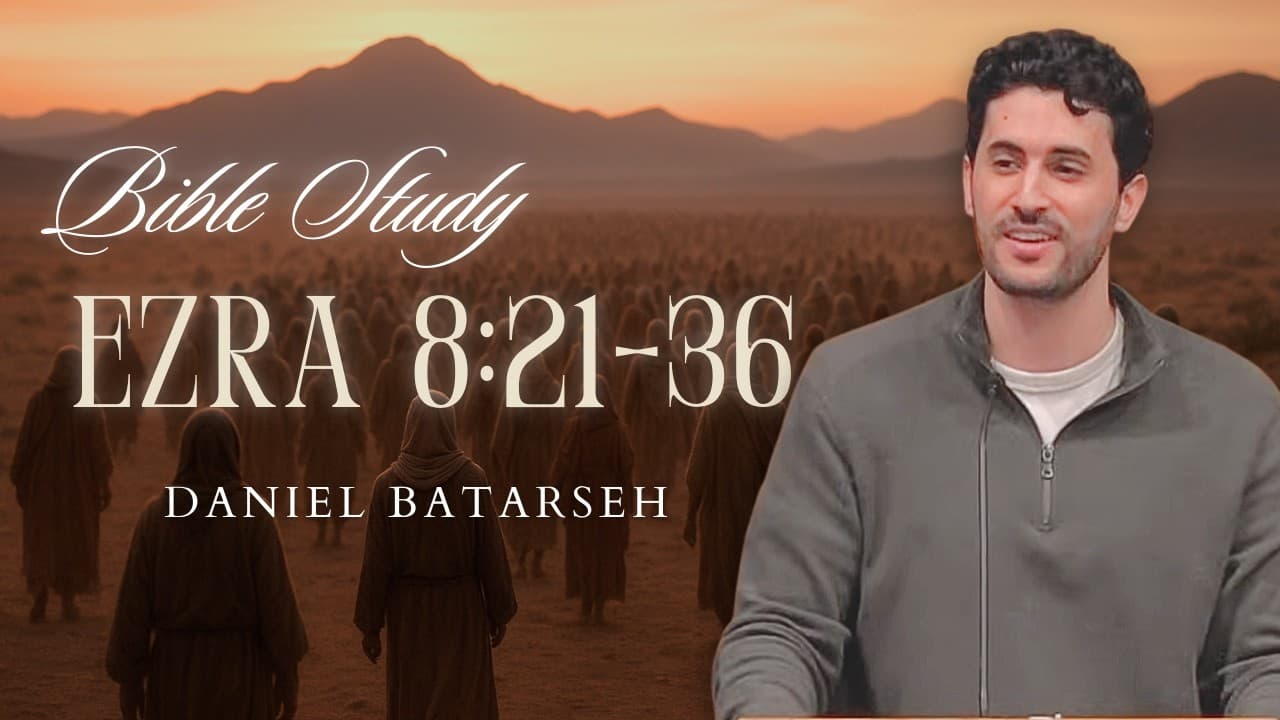
Ezra refused the king's bodyguards and staked everything on God's protection. What happened next reveals why holiness isn't optional for anyone who wants to be used by God.
You can be gifted, funded, surrounded by the right people, and still not ready to move forward. That is the uncomfortable lesson of Ezra 8:21-36. Ezra had the king's backing, the finances, the priests, the Levites, the families. Every box was checked. And yet this man — saturated in Scripture, respected by a pagan empire — refused to take a single step until he had fasted, prayed, and heard from God. Not because he lacked resources, but because he knew that resources without God's hand are just cargo waiting to be plundered.
The passage forces a question most of us avoid: Are you holy enough to carry what God wants to give you?
Ezra Had Everything — Except Permission to Move
Consider the inventory. Six hundred and fifty talents of silver. A hundred talents of gold. Twenty bowls of gold worth a thousand darics. Vessels of bronze so fine they rivaled gold itself. A single talent weighed roughly 75 to 80 pounds. Do the math on 650 of them. This was a staggering fortune being hauled across 900 miles of hostile territory — by foot — over four months. Women, children, the elderly, all in the caravan.
And Ezra had zero military protection.
Not because it wasn't offered. The king of Persia, understanding the danger, extended the help of soldiers and horsemen. Ezra turned it down flat. Why? Because he had spent years telling this king about God — that "the hand of our God is for good on all who seek him, and the power of his wrath is against all who forsake him" (watch at 22:50). To accept an armed escort now would have gutted his testimony.
This wasn't recklessness. It was integrity with consequences. Notice the word the text uses in verse 22: ashamed. Not afraid. Ashamed. Ezra felt the weight of what it would mean for his God if he hedged his bets. That kind of shame is rare. Most of us feel no discomfort when our lives quietly contradict the things we profess.
And his testimony to the king was not half a gospel. He didn't stop after "God blesses those who seek Him." He added the harder truth: the power of God's wrath falls on all who forsake Him. That is bold speech to a king. But it is also loving speech. Because love warns. When we read the king's own letter in Ezra 7:23 — "lest his wrath be against the realm of the king and his sons" — we see the seed Ezra planted had already begun to take root.
The Word Made Him Desperate, Not Just Smart
Ezra 7:10 introduced this man as one who "set his heart to study the law of the Lord, and to do it, and to teach." A scholar. A theologian. A man who could parse Hebrew in his sleep. But chapter 8 reveals the fruit of all that study — and it is not what most people expect.
It wasn't more knowledge. It was more neediness. "One of the ways you can determine if the word of God is truly at work in you is that it will cause you to be a man or a woman of prayer. Because studying the Bible is not an end in itself. It is a means to relate to God and to seek him regularly in order for him to move in and through your life" (hear this moment).
That is a searching diagnostic. You can be swollen with Scripture and still spiritually hollow — if all that knowledge never drives you to your knees. Ezra was diligent in his studies, and that diligence made him desperate. The two are supposed to travel together.
So at the river Ahava, he proclaimed a fast. Not as a spiritual wellness practice. Not as a concealed diet. Biblical fasting has teeth. It is the deliberate elimination of distraction — preparing food, consuming food, the comfort of food — so that every scrap of energy can be pressed into seeking God. "If one is fasting and they are not praying, they are missing one of the major points of fasting" (watch at 28:38).
The result? Verse 23 records it simply: "So we fasted and implored our God for this, and he listened to our entreaty." And verse 31 confirms what happened: "The hand of our God was on us, and he delivered us from the hand of the enemy and from ambushes by the way." Not from the possibility of ambush. From actual ambushes. They were targeted, and God intercepted.
Consider the parallel. When David's closest advisor Ahithophel defected to Absalom, David prayed six words: "Turn Ahithophel's counsel into foolishness" (2 Samuel 15:31). God did it — and went above and beyond what David asked. There is not one person nor any problem that God is not willing to confront when you bring it to Him sincerely. Are you worried about your finances? Your children's education? A person causing havoc in your life? Do you actually pray about it? Ezra — this man filled with the Word — teaches us that prayer works.
A note of wisdom here: Ezra's refusal of military escort does not create a doctrine against self-protection. Nehemiah, making a similar journey years later, gladly accepted royal soldiers (Nehemiah 2:9), and his faith was no less genuine. The difference was the situation, not the spirituality. Ezra had made a bold public claim about God, and now his life had to back it up. "People are much more willing to believe by what you live than by what you say. There's no way around that" (watch at 41:12).
That sentence should make every one of us uncomfortable. The watching world is not just listening to our Sunday vocabulary. They are studying our Monday behavior. They notice the Bible verse on your profile and then observe whether your posts, your reactions, your likes match what you claim to believe.
"You Are Holy" — And the Order Is Intentional
With the fast concluded, Ezra turns practical. He selects twelve priests and twelve Levites, weighs the treasure, and assigns accountability. This was not unspiritual pragmatism. Ezra knew from Numbers chapter 4 that God had assigned the Levites to disassemble, transport, and reassemble the tabernacle during Israel's original wilderness journey. There was no tabernacle now — there was a temple waiting in Jerusalem. But Ezra wanted to honor the spirit and wisdom of God's law as faithfully as he could in his own moment. That instinct — to search Scripture not for a proof-text but for a principle to apply — is the mark of someone who truly loves God's Word.
But then comes the exhortation that elevates the entire passage. Verse 28: "You are holy to the Lord, and the vessels are holy." The order is intentional. Before addressing the holiness of what they would carry, he addressed the holiness of who they were. You first. Then the work.
Isaiah 52:11 confirms the same standard: "Purify yourselves, you who bear the vessels of the Lord." And Paul, writing to the church at Corinth centuries later, picked up that very verse and applied it to New Covenant believers: "Go out from their midst, and be separate from them, says the Lord, and touch no unclean thing; then I will welcome you" (2 Corinthians 6:17). God's standard of holiness has not changed. The covenant is different. The expectation is identical.
This is not a popular message. But its unpopularity does not diminish its urgency. "If anything, holiness becomes more possible, more attractive because of the gospel. And so, yes, we do see here that there is a different covenant from the old to the new, but God's standard of purity has not changed" (watch at 58:43). Grace does not make holiness irrelevant. Grace makes holiness achievable. And ministries are being exposed and shut down precisely because leaders forgot this.
In the New Testament, we are not merely the priests who handle holy things. We are both the priesthood and the vessels. There is nothing holy about the phone in your hand or the platform you stand on. You are the holy vessel. So guard it. Guard your heart, your eyes, your ears, your mind.
The "Until" You Cannot Cancel
Ezra told the priests to "guard them and keep them until" they stood in the chambers of the house of the Lord in Jerusalem and everything was weighed and accounted for. That word carries enormous force. Because there is an "until" for your holiness and mine.
Romans 14:12 names it plainly: "So then each of us will give an account of himself to God." Not each of you — each of us. Paul included himself. This is written to Christians. Not outsiders. Believers. "There is a time coming where me and the Lord Jesus Christ are going to have a conversation about my life. Thankfully, not about my salvation — because that's determined and set by his grace. But we are gonna talk about what I did with that salvation. And so will you" (hear this moment).
How often do you think about that appointment? We manage our calendars carefully for meetings and deadlines. There is one appointment you cannot move, cannot cancel, cannot delegate. And Paul uses the judgment seat of Christ as a motivating force for how we live right now — not as a threat, but as a clarifying lens.
The illustration that sealed this truth was striking. A young pastor, early in his ministry, alone in a hotel room after a powerful conference. Couldn't sleep. A few mindless clicks on the television. Something inappropriate. Instant conviction — a cut to his heart. He put on his shoes, left the hotel, walked into a cornfield, and talked to the Lord. The impression on his heart was both tender and terrifying: "If you go down this path, I can't use you the way I want to use you." That pastor dealt with it that night. He went on to have a world-renowned ministry. Thousands attribute their salvation to his preaching.
What if he hadn't? What if he had decided he could manage the sin — nibble on it after sermons, indulge it behind closed doors? 2 Timothy 2:21 is not ambiguous: "If anyone cleanses himself from what is dishonorable, he will be a vessel for honorable use, set apart as holy, useful to the master of the house, ready for every good work." Ready. Not talented. Not funded. Not connected. Ready. And readiness is a matter of purity.
When Ezra arrived in Jerusalem and the treasure was weighed, verse 34 records the result: "The whole was counted and weighed, and the weight of everything was recorded." No discrepancy. No loss. No shame. Four months, 900 miles, actual ambushes along the way — and not a single talent unaccounted for. That is what faithful stewardship looks like. And it is the picture of how we want to stand before Christ.
The New Testament teaches that it is possible to gain salvation but suffer loss because we did not take our holiness seriously. But God is willing to empower what seems impossible and make it possible — giving you not only forgiveness but victory. Not just pardon. Power. That is the complete gospel.
What to Remember
- The Bible working in you produces prayer, not just knowledge — if your study of Scripture is not driving you to seek God on your knees, something has disconnected.
- Your life is your loudest sermon — people believe what you live far more than what you say, and every choice either confirms or contradicts your witness.
- Holiness is not an Old Testament relic softened by grace — Paul applies Isaiah 52:11 directly to New Covenant believers in 2 Corinthians 6, proving the standard has not changed.
- You are both the priest and the vessel — guard yourself, because you are the holy thing God wants to use.
- There is an "until" for your faithfulness — the judgment seat of Christ is an appointment every believer will keep, and it should shape every decision you make today.
- God answers desperate, sincere prayer over everything you commit to Him — your children, your finances, your purity, your protection are never outside His care.
Questions to Sit With
- If someone watched your private life for a week — your browsing habits, your conversations, your reactions when no one is looking — would it confirm or contradict what you profess publicly about God?
- When is the last time you fasted not to lose weight, but to strip away distractions and seek God with undivided attention? What would change if you tried it this week?
- Is there a sin you have been managing rather than killing — something you return to after worship, after conviction, after promising yourself you would stop? What would it cost you to deal with it tonight?
- How often does the reality of standing before Christ to give an account actually influence your daily decisions — or has it become an abstract theological concept filed away in your mind?
- Are you applying Scripture only where you find explicit commands, or are you — like Ezra — searching for the principles and wisdom of God's Word to inform decisions no single verse directly addresses?
Scripture Referenced
- Ezra 8:21-36 — Primary passage: fasting at Ahava, priestly delegation, safe arrival
- Hosea 14:4-8 — God as the evergreen cypress, endless source of life
- Ezra 7:10 — Ezra's heart to study, obey, and teach
- 2 Samuel 15:31 — David's prayer against Ahithophel's counsel
- Nehemiah 2:7-9 — Nehemiah accepting military escort without weaker faith
- Numbers 4 — Levitical responsibility for transporting the tabernacle
- Acts 11:28-30 — First mention of elders in Acts tied to financial stewardship
- 1 Timothy 3:3 — Pastoral qualification: not a lover of money
- Isaiah 52:11 — "Purify yourselves, you who bear the vessels of the Lord"
- 2 Corinthians 6:16-17 — Paul applying Isaiah 52:11 to new covenant believers
- Romans 14:12 — "Each of us will give an account of himself to God"
- 2 Timothy 2:21 — A cleansed vessel, ready for honorable use
This article is drawn from the sermon "Ezra 8 (Part 2) Bible Study (Fasting & Prayer/Priests to Guard Offerings) | Pastor Daniel Batarseh" by Pastor Daniel Batarseh at Maranatha Bible Church Chicago. Watch the full sermon →
Preached by
Pastor Daniel BatarsehSenior Pastor
This summary was generated by AI from the sermon transcript.
Based on the sermon