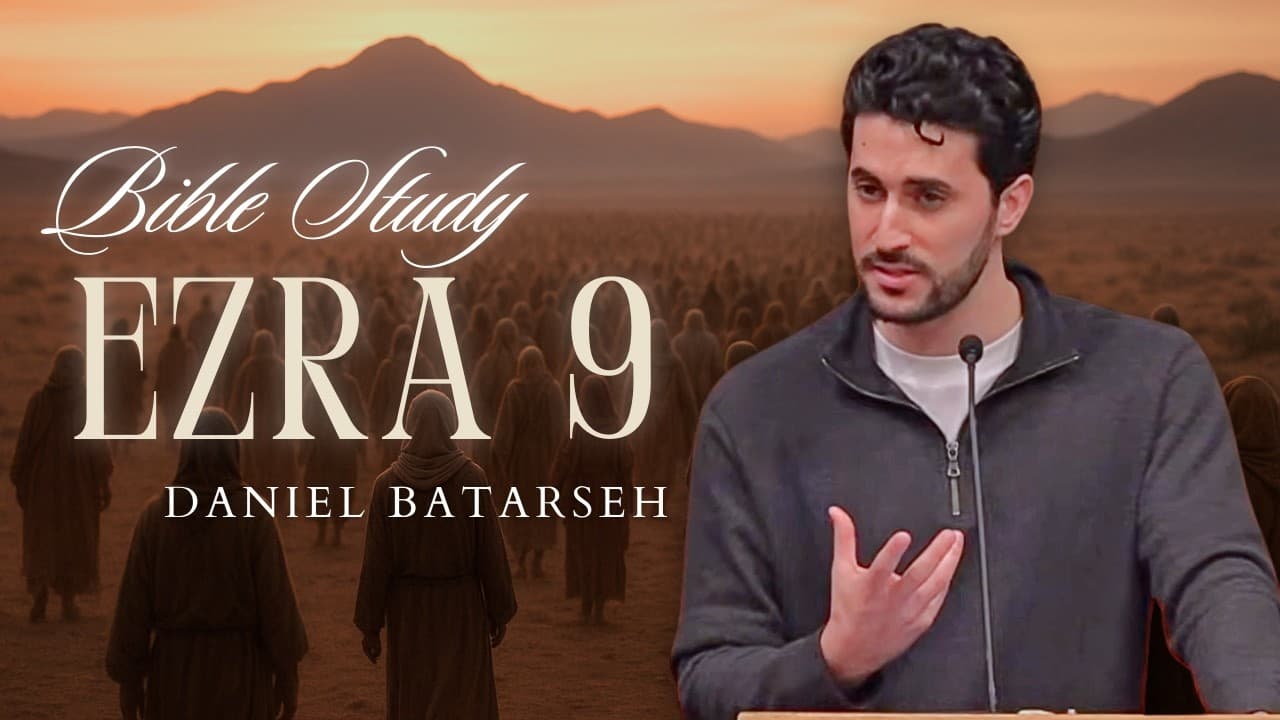
When Ezra learned of Israel's sin, he pulled his own hair. When Nehemiah faced the same sin, he pulled theirs. The difference reveals the gospel itself.
Two men faced the same sin in Israel. One pulled out his own hair. The other chased down the offenders and pulled out theirs. That contrast between Ezra 9 and Nehemiah 13 is not — as many commentators suggest — a lesson in temperament or anger management. It's a picture of the gospel. And it's the kind of insight that makes you set your coffee down and stare at the wall for a minute.
Ezra 9 records one of the most raw, unpolished prayers of confession in all of Scripture. A priest learns that the people he came to serve have been intermarrying with the surrounding pagan nations — the very sin God warned would destroy them — and his response is so visceral, so physically agonizing, that it still startles readers thousands of years later. But this chapter is far more than a dramatic reaction. Buried inside Ezra's prayer are principles of intercession that can reshape how you and I approach God when life is crushing and we don't even know what to ask for.
The Danger That Comes When Everything Is Going Well
The chapter opens with six words that deserve more attention than they usually get: "After these things had been done."
What things? The final verses of chapter 8 paint a picture of extraordinary blessing. Ezra and the exiles had arrived safely in Jerusalem after a perilous journey. The temple treasuries were preserved, accounted for, and delivered. Generous offerings were made. And the Persian king's own officials — gentile bureaucrats with no stake in Israel's worship — were actively supporting the Jewish people and the house of God (watch at 34:35).
No persecution. No political obstacles. No threats. Just calm, civility, and the tangible favor of a foreign empire.
And that's precisely when everything fell apart.
Here is a pattern that every church and every Christian needs to tattoo on their conscience: spiritual warfare includes far more than external attacks. If Satan cannot agitate you with persecution, he will quietly corrupt you from within. As Pastor Daniel Batarseh put it with striking clarity: "If you don't hear Satan roaring like a lion, he's very likely slithering like a snake in our midst, quietly sowing corruption and discord" (hear this moment).
The people of Judah didn't wake up one morning and decide to abandon their distinctiveness. It was gradual. Small compromises. Adopting customs. Accepting convictions that weren't theirs. Until eventually they were intermarrying with the very nations whose gods would consume them.
And here's what makes it sting even more. Go back to Ezra 6:19–21, decades earlier, when Zerubbabel led the first wave of exiles back to Jerusalem. There you find Jews who had stayed behind in the land — who had conformed to the surrounding culture during the exile — actually separating themselves from the uncleanness of the nations in order to join the returning exiles in worship. They were the ones who influenced others toward holiness. But by the time Ezra arrives in chapter 9, the influencers have become the influenced. The same community that once pulled others out of worldliness had been swallowed by it (watch at 46:36).
It is very rare for a professing Christian to become worldly overnight. It is always gradual. And it is most dangerous when the external circumstances of your life are peaceful.
The Sin Was Interfaith, Not Interracial
A necessary clarification: the prohibition against intermarriage in the Old Testament has nothing to do with ethnicity and everything to do with theology. This is about different religions, not different races. Deuteronomy 7:3–4 makes the reason explicit: "You shall not intermarry with them... for they would turn away your sons from following me, to serve other gods."
The danger was spiritual contamination. And it wasn't hypothetical. The holy seed — the messianic line through which Christ himself would come — was at stake. If the people of God dissolved into the surrounding religious cultures, the promise of a Savior for the entire world could be jeopardized. That's why this sin provoked such a violent response. The stakes were cosmic.
And the timeline matters. Ezra didn't learn about this problem four days after arriving. A careful reading of Ezra 10:9 alongside 7:9 reveals it was approximately four and a half months before the officials brought this report to him. Why the delay? Perhaps Ezra's teaching ministry was slowly awakening consciences. Perhaps the officials tried to handle it themselves and failed. Perhaps they were only just discovering it themselves. We aren't told explicitly. But the delay underscores something vital: the protection of the church's purity is not dependent on one man, no matter how godly that man is. Even Ezra — as spiritual as he was — was not omniscient or omnipresent. Sanctification and accountability are a collective effort.
This has a New Testament parallel. How did the Apostle Paul learn about the divisions tearing apart the Corinthian church? Through an obscure individual named Chloe — mentioned once in all of Scripture — whose people sent word to Paul that there was quarreling among the brothers (1 Corinthians 1:11). Even apostles needed the eyes and courage of ordinary believers.
So when you see a brother or sister in blatant sin, don't turn a blind eye. When you hear murmuring and division brewing, don't plug your ears. Do something. One of the central purposes Jesus assigned to his church — in one of the rare moments he even used the word church — was mutual accountability (Matthew 18). Membership in a local body means saying: I want to be held accountable, and I'm willing to hold others accountable too.
A Priest Pulls His Own Hair; A Governor Pulls Theirs
Ezra's reaction to the news is extreme even by Old Testament standards. Tearing garments — that we've seen before. But pulling hair from his own head and beard? That's rare. Men know how painful even a single hair from the beard can be. This was agony, self-inflicted, deliberate.
Only one other biblical figure does something similar: Nehemiah. But here's the difference that changes everything. When Nehemiah encounters the same intermarriage problem years later in Nehemiah 13:23–25, he doesn't pull his own hair. He chases down the offenders and pulls theirs. He confronts them, curses them, beats some of them, and forces them to take an oath.
The common interpretation is that Ezra was gentle and Nehemiah had an anger problem. That completely misses the point. The real explanation lies in their offices.
Ezra was a priest. A mediator. When he learned of the people's sin, he stood representatively in the gap — inflicting pain on himself on behalf of those who had sinned. He went to the temple and bore their grief in his own body.
Nehemiah was a governor. The closest thing to a judicial authority in post-exilic Israel. He had the right — the duty — to enforce punishment. And because Ezra's gracious, priestly approach hadn't eradicated the sin, the situation demanded more direct action.
As Pastor Daniel Batarseh observed: "Those who trample on the selflessness and the sacrifice and the gracious priestly work of Christ will face judicial punishment... Christ takes our sin upon himself, and for those who swat that away and reject that — well, you're gonna have to face Christ as judge. You don't accept his sacrifice, then you will receive his scepter" (watch at 58:49).
Jesus holds both offices. He is priest and king. He bore our sin in his body on the cross. But those who reject the priestly sacrifice will meet the royal judge. The gospel is good news and terrifying news at the same time — and it's foreshadowed in two men pulling hair in the fifth century BC.
What Loving the Word Actually Does to Your Emotions
Verse 4 gives us a telling detail about who gathered around Ezra in his grief: "all who trembled at the words of the God of Israel." They were drawn to him because they had the same word in their hearts.
Psalm 119:53 says it plainly: "Hot indignation seizes me because of the wicked who forsake your law." And the very next verse? "Your statutes have been my songs in the house of my sojourning." The same word that makes you burn with righteous grief over sin makes you sing with joy over holiness. Both responses flow from the same source.
When the Word of God truly inhabits you, it recalibrates your emotions. You begin to see as God sees. You begin to feel as God feels. Not in a self-righteous, finger-wagging way — Ezra is not proud here; he's shattered. But in the way Moses burned with anger coming down from the mountain, because he had just been in God's presence and could not tolerate what the people had done to themselves.
This is one of the most underappreciated fruits of Scripture intake: it changes what grieves you and what delights you.
Four Things That Made Ezra's Prayer So Powerful
Ezra waited to pray publicly until the evening sacrifice — not because of some mystical significance in the timing, but because he knew that's when the crowds would gather at the temple. He wanted the wider community to hear his confession and feel the weight of their rebellion. And according to Ezra 10:1, it worked: "a very great assembly of men, women, and children gathered to him... for the people wept bitterly." Prayer moved an entire community to repentance.
The prayer itself (verses 6–15) yields at least four principles for anyone who wants to see results in their own praying:
First, pray with humility. Ezra says "our iniquities" and "our guilt" — not theirs. He wasn't guilty of intermarriage. But he refused to stand above the people he was interceding for. There is a way of praying that is really just self-congratulation dressed in piety. Ezra demolished that temptation by identifying with the sinners he was weeping over.
Second, pray with an awareness of God's grace. Even in confession, Ezra pauses to recount God's mercies — the remnant preserved, the steadfast love shown in slavery, the small revivals, the protection in a hostile world. Do you ever thank God not only for what he did, but for what could have happened and didn't? As the teaching pressed: "Do you ever think about where you would have been today if you didn't get saved? What would you look like? What would you be doing on a Friday night?" (hear this moment) You want fuel for worship? Think about the disaster you could have been.
Third, pray with Scripture in your mouth. Verses 10–12 are Ezra quoting Deuteronomy and Leviticus — likely from memory. A seasoned preacher once gave this counsel about prayer: "When you feel like you don't have words to tell God, take his own words and pray them back to him." If you don't know your Bible, you won't know how to pray. It's that simple. The depth of your prayer life will never exceed the depth of your engagement with Scripture.
Fourth, pray believing God knows what to do — even when you don't. The most striking feature of Ezra's prayer is how it ends. He brings the pain before God. He names the sin. He acknowledges God's justice. But he never asks for a specific solution. He simply says: "Behold, we are before you in our guilt, for none can stand before you because of this." And Romans 8 assures us that when we don't know what to pray, the Spirit himself intercedes, translating our groans into perfect petitions before the throne. "I love to know that I don't have to come up with a game plan to bring before the Lord like it's a presentation," Pastor Daniel Batarseh reflected. "God is not asking to be persuaded. He wants you to come with childlike faith and be broken in his presence" (watch at 1:21:16).
Sometimes the most powerful prayer you can pray is two words: Help me.
What to Remember
- Spiritual danger is highest when external circumstances are calmest — if Satan can't attack from outside, he'll corrupt from within.
- The prohibition against intermarriage in the Old Testament was about protecting faith, not policing ethnicity — the issue was interfaith union, not interracial union.
- Ezra pulled his own hair as a priestly mediator; Nehemiah pulled the offenders' hair as a judicial governor — together they foreshadow Christ, who is both merciful priest and righteous judge.
- Saturating yourself in God's Word doesn't just inform your mind — it recalibrates your emotions, making you grieve over sin and sing over holiness.
- When you don't know what to pray, simply bringing the burden before God in faith is enough — the Spirit translates your groans into perfect intercession.
- Accountability in the church is not one leader's job. Every member plays a role in preserving the community's holiness.
Questions to Sit With
- What area of your life has slowly conformed to the surrounding culture — so gradually that you haven't even noticed the drift?
- If someone in your church was living in open sin, would you say something? If not, what's actually stopping you — love for them, or comfort for yourself?
- When was the last time you thanked God not for what he did, but for the disaster he prevented that you never even knew about?
- Ezra brought his grief to God without a proposed solution. Is there a burden you've been holding back from prayer because you don't know what to ask for?
- Does the Word of God actually change what makes you angry and what makes you sing — or does it remain information that hasn't reached your emotions?
Scripture Referenced
- Ezra 9:1–15 (primary passage)
- Ezra 8:36
- Ezra 7:9
- Ezra 6:19–21
- Ezra 10:1, 9
- Deuteronomy 7:3–4
- Nehemiah 13:23–25
- Psalm 19
- Psalm 119:53
- 1 Corinthians 1:11
- Romans 8
- Jonah 4:3–9
This article is drawn from the sermon "Ezra 9 Bible Study (Ezra Prays About Intermarriage) | Pastor Daniel Batarseh (3/13/26)" by Pastor Daniel Batarseh at Maranatha Bible Church Chicago. Watch the full sermon →
Preached by
Pastor Daniel BatarsehSenior Pastor
This summary was generated by AI from the sermon transcript.
Based on the sermon