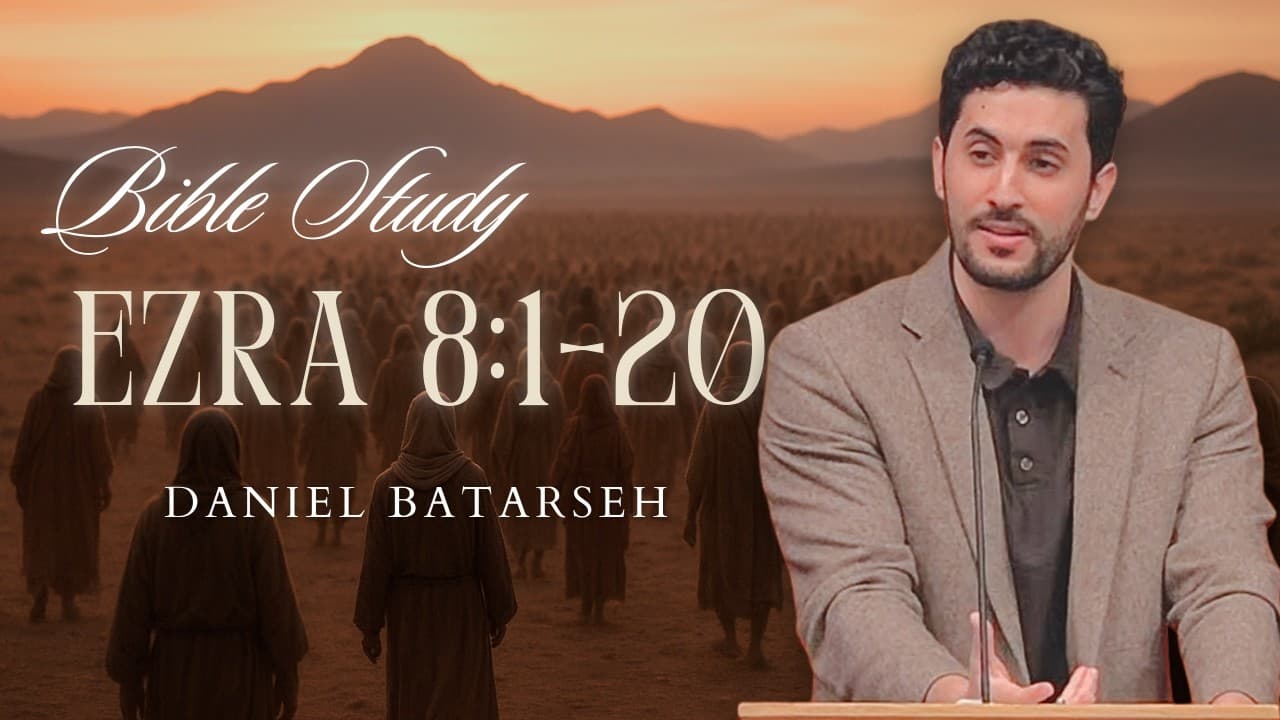
A genealogy in Ezra 8 hides a convicting truth: only some followed Ezra back to Jerusalem. What Babylon offered the Levites, comfort quietly offers us today.
Only some went back.
That single word in Ezra 7:7 should stop every reader cold. Here is Ezra -- a man whose character has been tested and validated, whose mission carries the stamp of God's own favor, whose zeal for the Word of God is so genuine that kings bend their policies to accommodate him -- and when he calls the exiles to return to Jerusalem, the response is devastating. Not most. Not a majority. Some. And by the time we reach Ezra chapter 8, the picture gets worse: among the Levites, the very tribe set apart for God's service, the number who volunteer for the second wave of return is zero.
This is not a text about ancient genealogies. This is a mirror held up to every one of us who has grown comfortable in our own Babylon.
"With Him" -- The Power of a Father Who Moves First
The genealogy of Ezra 8:1-14 is built on a repeated phrase so simple it is easy to miss: and with him. Two hundred men went with Elioenai. Three hundred went with Shecaniah. Fifty with Ebed. Over and over, the text credits a household head whose conviction was so contagious that entire families uprooted their lives to follow.
Think about what that required. Most of these families had never seen Jerusalem. They had been born in Babylon, raised in Babylon, married in Babylon. The temple was a story their grandparents told. And yet, because the men at the head of these clans carried Jerusalem in their own hearts first, their families caught the vision.
As Pastor Daniel Batarseh put it with sobering directness: "Does your heart have more ambition to see your children go to heaven with you, or to have a certain kind of job, or to play a certain kind of sport, or to make a certain amount of money?" (watch at 11:49). That question lands differently when you realize these ancient fathers chose a dangerous 900-mile journey over the security of established Babylonian lives -- because worship mattered more than comfort, more than safety, more than the familiarity of a home they had built with their own hands.
The lesson cuts both ways. If the head leads, the household follows. But the inverse is also true. When the head is passive, indifferent, or distracted, the household drifts. We can never expect those around us to move in the direction God has prepared if we are not showing them how to walk it ourselves (hear this moment).
And here is the tension we must sit in: you cannot pour your frustration into those who refuse to follow while ignoring those who are ready. "If you and I are not careful, we can spill most of our energy out of frustration toward those who aren't instead of investing in those who are" (watch at 5:30). Discipline yourself, by God's grace, to invest in the willing -- not to exhaust yourself chasing the indifferent.
A Promise Kept Across Centuries, Hidden in a Name
Buried in verse 2 is a detail that rewards the careful reader. When Ezra lists the priestly division, he does not trace the line back to Eleazar, Aaron's son. He traces it to Phinehas -- Eleazar's son, Aaron's grandson. Why?
Because Phinehas was the man who, in Numbers 25, stood up when the men of Israel were being seduced by Midianite women into idolatry and sexual sin. He took violent, decisive action. And God responded with a staggering promise: a covenant of perpetual priesthood for Phinehas and all his descendants. You can read it in Numbers 25:10-13 -- God calls Phinehas a man who was "jealous with my jealousy," and for that he receives an irrevocable covenant.
Now fast-forward centuries. The nation has been conquered. The temple has been destroyed. The people have been scattered to Babylon. Eighty years have passed since the first wave of exiles returned under Zerubbabel. And here, tucked into a genealogy that most readers skip, is the quiet proof that God kept his word. A descendant of Phinehas is alive. A descendant of Phinehas is still functioning as a priest. And in the very same verse, the royal Davidic line -- Hattush -- is confirmed as intact.
Two ancient promises, one to a priest and one to a king, both still breathing after centuries of national disaster. "Not just God is faithful -- God is precisely faithful. If he made a promise to Phinehas, he's gonna keep it. When he made it to David, he's keeping it" (watch at 19:27).
This is why genealogies matter. They are not bureaucratic filler. They are receipts -- documentary evidence that God does what he says he will do, across generations, across exile, across catastrophe. And the connection extends into the new covenant: whether the promises were made to Phinehas, to David, or to you in Christ, you can trust those promises because you can trust the Promiser. The character of God does not erode with time. Exodus 28:1 set Aaron's sons apart for the priesthood. Leviticus 10 records the sobering pruning of Nadab and Abihu. And still the line endures, right here in Ezra 8.
There is another layer here worth noticing. Phinehas acted with zeal against the corruption of interfaith compromise in Numbers 25. Ezra himself, as we will discover in the final chapters of this very book, is about to confront the same sin -- intermarriage with pagan nations that had polluted the community during eighty years of spiritual drift. Ezra is walking in the footsteps of his ancestor. The parallels are not accidental. Scripture has a memory, and it rewards those who pay attention.
Zero Levites -- The Slow Poison of Comfort
Verse 15 is the turning point of the chapter. Ezra gathers the people at the river Ahava, takes inventory, and discovers the unthinkable: not a single Levite has volunteered. In the first return under Zerubbabel eighty years earlier, recorded in Ezra 2:40, only 74 Levites joined out of roughly 50,000 people -- already a dismal number. Now? Zero.
The reason is not mysterious. Levites could not own land in Israel. That was the arrangement from the days of Moses -- they served in the temple and lived on the tithes and offerings of the people. But in Babylon, everything changed. Jeremiah had told the exiles to buy land, build houses, raise families. And the Levites, for the first time in their history, tasted what it meant to own property, run businesses, accumulate wealth. Babylon gave them what the Promised Land never could: material security.
And it held them. Eighty years of comfort eroded eighty years of calling.
The parallel to 1 Kings 11:4 is devastating: "For when Solomon was old, his wives turned away his heart after other gods, and his heart was not wholly true to the Lord his God." When did Solomon fall? Not in his reckless youth, when passions run hot and decisions feel urgent. In his old age -- settled, comfortable, no longer vigilant. Three times in one verse, the word heart appears, because that is where erosion begins. Silently. Over years. Until the man who built God's temple is bowing to foreign gods.
The Levites' decline from 74 to zero is the same kind of slow, quiet drift. Not a dramatic apostasy. Just a gradual settling in. A comfortable numbness that eventually made the call of God sound like an inconvenience rather than an invitation. "You went from 74 Levites, which is pretty sad to begin with, to zero? Eighty years go by" -- the arithmetic of spiritual erosion is that simple and that brutal.
A True Teacher Wants More Teachers, Not Fewer
Ezra's response to the missing Levites reveals his character more than any title or credential could. He does not shrug and say, "God has clearly called me -- I can handle the teaching myself." He refuses to move forward until he recruits more ministers. He sends nine men described as "men of insight" back to the settlement at Casiphia to plead with the Levites to join.
This is the mark of a true teacher: the instinct to multiply, not monopolize. "You know what you find with some teachers? They're intimidated by other teachers. Some people see ministry as a competition... If you find yourself not rejoicing and more angry and envious and jealous and comparing, you're not doing this for Christ's glory, you're doing it for your own" (watch at 31:53).
Why did Ezra need the Levites so badly? Nehemiah 8:2-7 gives us the answer. When Ezra finally opens God's Word publicly in Jerusalem, it is the Levites who stand among the people in small groups, explaining and helping them understand what is being read aloud. Ezra was planning for a movement of biblical literacy that required many teachers, not just one brilliant scholar. He saw the harvest and knew he needed laborers.
The result of his recruitment is described with a phrase that should make us pause: "By the good hand of our God upon us, they brought us a man of understanding" (Ezra 8:18). Ezra sent men, but he credited God. The laborers are God's provision. Ephesians 4 says he gave apostles, prophets, teachers. Luke 10 says to pray to the Lord of the harvest to send out laborers. Every faithful teacher, every devoted small group leader, every parent who opens the Bible with their children -- these are extensions of divine mercy. If you lack that kind of influence in your life, ask God for it. And if you have it, recognize it for what it is: grace with skin on.
38 Levites, 220 Gentiles -- And the Pattern That Points to Christ
Even after Ezra's recruitment effort, only 38 Levites responded -- 18 with Sherebiah, 20 with Hashabiah. Compare that to 220 temple servants, the Nethinim, who were almost certainly of Gentile origin, descended from the Gibeonites of Joshua 9. The people with the least claim to the temple showed the most eagerness to serve in it. Six to one.
The parallel to the New Testament is impossible to ignore. When Jesus came to call his own, "his own did not receive him" (John 1:11). But when the gospel spilled into Gentile streets, Acts 13:48 records an overwhelming response: "They began rejoicing and glorifying the word of the Lord, and as many as were appointed to eternal life believed." The pattern repeats across the book of Acts -- apostles enter synagogues, meet resistance, turn to the Gentiles, and find open hearts. That pattern was already casting its shadow here in Ezra 8.
This is a warning to anyone who has grown up around the things of God. Proximity to truth is not the same as passion for truth. The Levites had every advantage. The Nethinim had almost none. And yet 220 showed up while the tribe of Levi had to be begged.
There is also a word of grace in verse 13 for those who identify with the sons of Adonikam -- described as "those who came later." They hesitated. They delayed. We are not told why. But they came. And they were enrolled. "Should you have wasted your years, your youth, your resources? If you still have breath in your lungs, you might have come later, but God will still accept you" (hear this moment). That is not a license to procrastinate. Scripture warns against delay far more than it comforts it. But for those carrying the weight of squandered time, it is a lifeline. The thief on the cross came later. The prodigal came later. The sons of Adonikam came later. Grace received late is still grace received.
The sermon closed with the kind of direct appeal that leaves no room for comfortable neutrality: "Why do you deny Christ? How many invitations do you need? What about Christianity turns you off so much -- is it the love of God? Is it his holiness? Is it the promise of eternal life?" There is a greater Ezra calling today. The question is whether you will be among the some who answer, or among the many who stay in Babylon because it is familiar, comfortable, and demands nothing of your soul.
What to Remember
- Even the most faithful, gifted leaders cannot compel everyone to respond -- Ezra recruited "some," and that was enough for God to work with. Your inability to move everyone is not a failure of your faith.
- The repeated phrase "with him" in the genealogy proves that families move in the direction their leaders carry in their own hearts first. Spiritual influence is not delegated; it is demonstrated.
- Phinehas' descendant appearing in Ezra 8:2, alongside a son of David, is documentary proof that God keeps covenant promises across centuries and through catastrophe -- and he will keep his promises to you.
- The decline from 74 Levites to zero across eighty years warns that spiritual passion erodes not through dramatic rebellion but through decades of settling into comfort. Guard your heart.
- A true teacher is not threatened by other teachers but desperate for more of them -- if ministry feels like a competition to you, the problem is not the other minister.
- The 220 Gentile temple servants outnumbering 38 Levites foreshadows the New Testament reality: those farthest from privilege often respond most eagerly to God's invitation.
Questions to Sit With
- Am I spending more emotional energy frustrated by those who are indifferent to God than investing in those who are actually hungry for him?
- What is my Babylon -- the comfort, security, or familiarity that makes obedience to God feel like an unreasonable cost?
- When I see God raising up another believer with gifts similar to mine, is my first instinct to rejoice or to compare? What does that reveal about who I am really serving?
- Can I identify a season where my passion for God quietly shifted from pursuit to routine -- and what would it take to reverse that drift before I become another statistic like the Levites?
- Is there an invitation from God that I keep delaying my response to, and do I honestly have a good reason?
Scripture Referenced
- Ezra 8
- Ezra 7:7
- Ezra 2:40
- Exodus 28:1
- Leviticus 10
- Numbers 25:10-13
- Nehemiah 8:2-7
- 1 Kings 11:4
- Ephesians 4
- Luke 10
- Acts 13:48
- John 1:11
- Joshua 9
This article is drawn from the sermon "Ezra 8 (Part 1) Bible Study (Genealogy / Ezra Sends for Levites)" by Pastor Daniel Batarseh at Maranatha Bible Church Chicago. Watch the full sermon →
Preached by
Pastor Daniel BatarsehSenior Pastor
This summary was generated by AI from the sermon transcript.
Based on the sermon