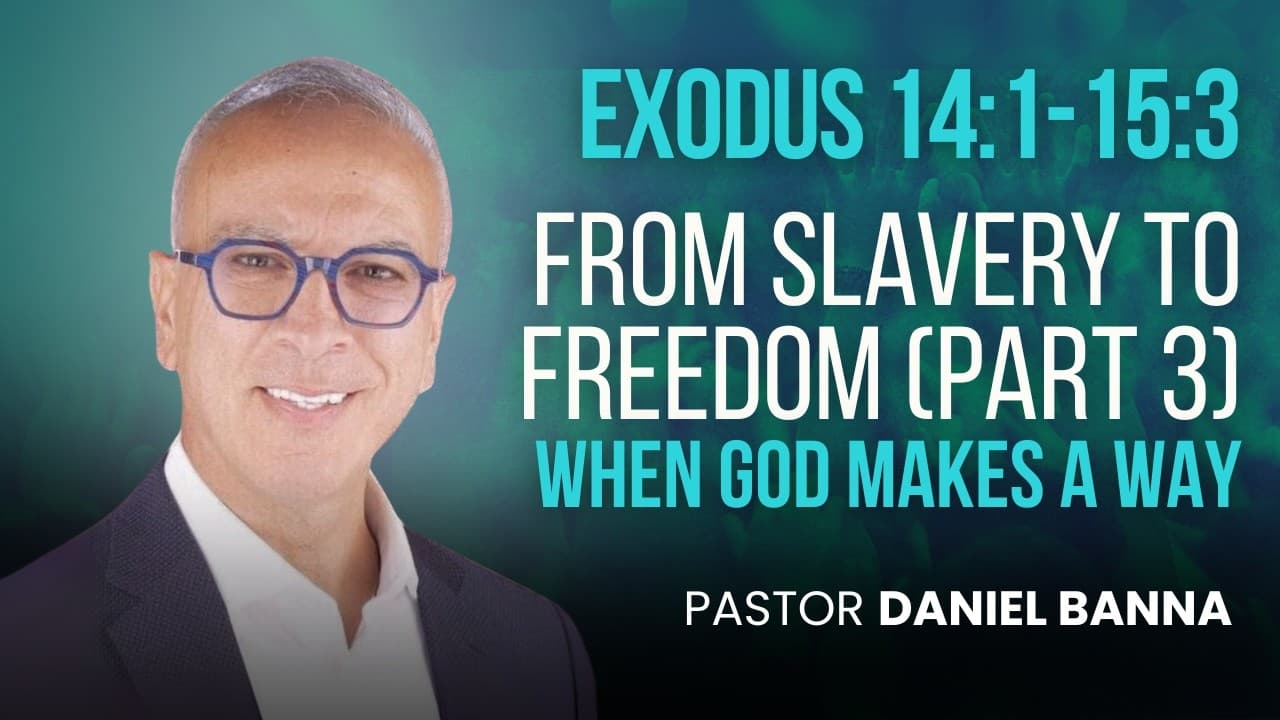
The place that looked like a death trap was literally named 'the gate of freedom.' What God did at the Red Sea Christ has done at the cross.
The place where Israel was most certain they would die was literally named "the opening of freedom."
That's the detail most people miss in Exodus 14. We read about the Red Sea parting — one of the most famous miracles in all of Scripture — and we picture the drama: walls of water, dry ground, Pharaoh's chariots swallowed by the deep. But we skip right past the name of the place where it all happened. Pi HaChirot. In Hebrew, it means "the gate of liberty." God didn't lead Israel to a random stretch of coastline. He led them to a dead end, hemmed in by mountains and sea, with the most powerful army on earth bearing down behind them — and He named that dead end freedom.
If you've ever felt trapped — every door shut, no way forward, no way back — this passage has something to say to you that you probably haven't heard before.
The Dead End God Chose on Purpose
Consider the geography. God had been leading Israel with a pillar of cloud by day and fire by night. They weren't wandering aimlessly. The Lord Himself was navigating. And where did He navigate them? Into a cul-de-sac. The sea stretched before them. Mountains boxed them in on the sides. Egypt's army was closing in from behind.
Pastor Daniel Banna put it this way: imagine you're driving to a destination, you see a "no outlet" sign, and you turn around. "This is exactly what God does with the people of Israel. They are supposed to be going to the promised land, yet where does God lead them? In front of Pi HaChirot, between Migdol and the sea. A dead end road" (watch at 7:40).
No boats. No bridge. No detour. Just water and the sound of approaching chariots. Every Israelite felt the same thing: I am trapped.
And here is where the sermon pressed into uncomfortable territory. Because this isn't just ancient history. God still leads His people to places where every door appears shut, where human reasoning screams that something has gone wrong. We stop looking at Christ and start measuring the depth of the water in front of us and counting the chariots behind us. Our peace evaporates. Our joy disappears. And like Israel, we begin to wonder whether God's promises are actually reliable.
But Pi HaChirot — the gate of liberty. The name was there the whole time. The Israelites just couldn't read the sign because they were too busy looking at the sea.
It was precisely in the most desperate condition Israel had ever faced that they experienced one of the greatest miracles ever recorded. Not despite the dead end, but because of it. God had engineered the entire situation so that when deliverance came, there would be absolutely no question about who accomplished it.
But What If You Put Yourself There?
Here the sermon made an important distinction that most teaching on this passage overlooks. There's a difference between being led to Pi HaChirot by God and ending up in a similar-looking crisis because of your own rebellion.
"You might find yourself between Egypt and the sea, but not truly at Pi HaChirot. It may have been your own will, your own stubbornness, your own rebellion that brought you there" (hear this moment). That's an honest word. Sometimes the trap we're in is one we built ourselves.
But then came the turn that kept this from becoming a guilt trip: "Even there, do not despair. Lift your eyes to Christ. Rest in his love."
The story of Jonah was brought in to illustrate this beautifully. Jonah was a prophet of God who chose his own path. He found a ship, paid the fare, sailed away from God's command. The storm, the fish, the belly of the deep — all consequences of his own disobedience. He prayed. He cried out. He made vows. He struggled and wrestled. Yet with all of that effort, he remained trapped.
But then, in Jonah 2:9, Jonah finally confessed: "Salvation belongs to the Lord." And the moment those words left his mouth, the fish vomited him onto dry land (watch at 30:55).
The pattern is unmistakable: God often waits until our self-effort comes to an end. Until we stop trying to rescue ourselves and look to Him alone. Only then do we discover that the God who allowed us to sink is also the God who reaches down to pull us out.
Stand Still, Be Silent, and Watch
Exodus 14:13-14 contains one of the most counterintuitive commands in all of Scripture. The Egyptian army is closing in. The sea is impassable. And Moses says: "Fear not. Stand firm and see the salvation of the Lord, which he will work for you today... The Lord will fight for you, and you have only to be silent."
Silent.
We hate that. We want to fight our own battles. We want to take credit for our victories. We want to do something. But what God asked of Israel at the Red Sea was the opposite of action. Stand still. Be quiet. Watch.
"In our warfare against Satan, the greatest victory often comes not through striving, but through trusting, not through frantic activity, but through quiet confidence in God. Sometimes, the most spiritual thing a believer can do is to stand firm and remain silent and watch what God will do" (watch at 36:13).
This isn't passivity dressed up as piety. The sermon was careful to note that there are times God says move, act, fight. But there are other moments — and you know them when you're in them — when faith means planting your feet and refusing to panic. When the most courageous thing you can do is nothing at all, because the battle belongs to the Lord.
And then God acted. Moses stretched out his staff. A strong east wind blew all night. The waters divided. But notice the detail the text emphasizes and that most readers gloss over: God didn't just open a path through the sea. He made the ground dry. The wind didn't merely push the water aside — it dried the seabed. Israel didn't slog through mud. They walked on firm, dry ground, with walls of water standing on their right and left.
Hebrews 11:29 picks up on this very detail: "By faith the people crossed the Red Sea as on dry land." The Holy Spirit Himself emphasizes the dryness. God's deliverance was not partial, not messy, not barely adequate. It was thorough, complete, and comfortable.
And here was a small but striking observation: "The faith of some strengthened the faith of others." It's not explicit in the text, but think about it — someone had to step onto that seabed first. Someone had to walk between those walls of water before anyone else would follow. The eyes of faith move where human reasoning hesitates. And when one person steps forward, the wavering find their courage.
Death Became a Doorway
The sea, for Israel, was a picture of death. It was the end. No hope. No escape. But God transformed the very instrument of death into a pathway of life.
This is what the cross of Christ accomplishes on an infinitely greater scale. Hebrews 2:14-15 says that through death, Christ "destroyed the one who has the power of death, that is, the devil, and delivered those who through fear of death were subject to lifelong slavery" (watch at 50:04). He entered death itself and broke its power from the inside.
Pharaoh is a picture of Satan. Egypt represents the world of bondage. The Red Sea is death. And just as Israel passed through the sea and emerged alive on the other side, so the believer passes through Christ's death and emerges into resurrection life. Death is no longer an enemy to dread — it is a conquered pathway, a doorway into the presence of Christ.
At Calvary, every power in the universe conspired against the Son of God. Political authority, religious establishment, the powers of darkness. For a moment, it appeared as though darkness had won. Christ was crucified. Laid in a tomb. But death could not hold the Prince of Life. On the third day, He rose. And because He lives, you shall also live.
Satan can never claim you again. You have been redeemed. Delivered. Set free.
Why Is Your Song Silent?
After Israel crossed the sea and stood safely on the other side, they looked back. What did they see? Dead bodies on the shore. Broken chariots. Fragments of Egypt scattered helplessly behind them. The sea itself now stood as a barrier between them and their old life. There was no turning back. Only one direction remained — forward, to the promised land.
And only then did the song come. Exodus 15:1-3 records it: "I will sing to the Lord, for he has triumphed gloriously. The horse and his rider he has thrown into the sea. The Lord is my strength and my song, and he has become my salvation."
There was no song in Egypt. Only weeping. There was no song at Pi HaChirot. Only fear and panic and cries of despair. It calls to mind Psalm 137, where the captives in Babylon were taunted: Sing us one of the songs of Zion. And they answered: "How shall we sing the Lord's song in a foreign land?"
But now — after deliverance, after witnessing God's salvation, after standing on the other side — now they could sing. And notice the subject of the song. Not one word of self-congratulation. Not one stanza about what they accomplished. The entire song is praise directed at God alone.
Then came the question that settled over the room like a weight: "How has your song been lately?" (hear this moment)
Your song reveals the condition of your soul. If the chorus has gone silent, why? Have you been lingering at Pi HaChirot for years — saved, yes, but never entering into the fullness of Christ's deliverance? Romans 7:24 is the cry of many genuine believers: "O wretched man that I am! Who will deliver me from this body of death?" But is that meant to be the permanent soundtrack of the Christian life? How could God command His people to "rejoice always" if He had given them no higher note to sing than "O wretched man that I am"?
Christ died not merely to forgive you. He died to set you free. Not only salvation from judgment, but liberty — real, present, daily freedom. The question is whether you'll cross over and live in it, or keep standing at the border, staring at the sea.
What to Remember
- God sometimes leads you to dead ends on purpose — Pi HaChirot, "the gate of freedom," looked like a death trap but became the site of the greatest deliverance Israel had ever known.
- If your crisis is the result of your own rebellion, do not despair — even Jonah, trapped by his own disobedience, was delivered the moment he confessed that salvation belongs to the Lord.
- The most spiritual thing you can sometimes do is stand still, be silent, and let God fight the battle — your track record of winning on your own strength should tell you everything you need to know.
- God didn't just open the sea; He dried the ground — His deliverance is not partial or barely adequate, but thorough and complete.
- Through death, Christ destroyed death — the Red Sea that pictured death for Israel became a pathway of life, just as the cross that appeared to be defeat became the instrument of eternal victory.
- Your song reveals the condition of your soul — if praise has gone silent, it may be because you've been camped at the border of freedom for years without crossing over.
Questions to Sit With
- Is there a "dead end" in your life right now that might actually be God's Pi HaChirot — a place He has deliberately led you so that His power can be displayed?
- Are you trapped because God led you there, or because your own choices brought you there? And does the answer change what you should do next?
- What would it look like, practically, for you to "stand still and be silent" in the situation you're currently trying to muscle your way through?
- If someone asked you to honestly describe the chorus of your spiritual life right now, would it sound more like "O wretched man that I am" or "I will sing to the Lord, for He has triumphed gloriously"? Why?
- What part of Egypt are you still longing for — and what would it take for you to finally see those desires as broken chariots on the shore?
Scripture Referenced
- Exodus 14:1-31 — The Red Sea crossing
- Exodus 15:1-3 — The song of Moses
- 1 Corinthians 5:7 — Christ our Passover lamb
- Romans 7:24 — "O wretched man that I am"
- Jonah 2:1-9 — Jonah's prayer from the belly of the fish
- Hebrews 11:29 — By faith they crossed the Red Sea on dry land
- Hebrews 2:14-15 — Through death He destroyed the power of death
- Psalm 137 — "How shall we sing the Lord's song in a foreign land?"
This summary was generated by AI from the sermon "From Slavery to Freedom (Part 3) | When God Makes A Way | Exodus 14:1-15:3 | Pastor Daniel Banna" preached by Pastor Daniel Banna at Maranatha Bible Church Chicago. Watch the full sermon →
Based on the sermon