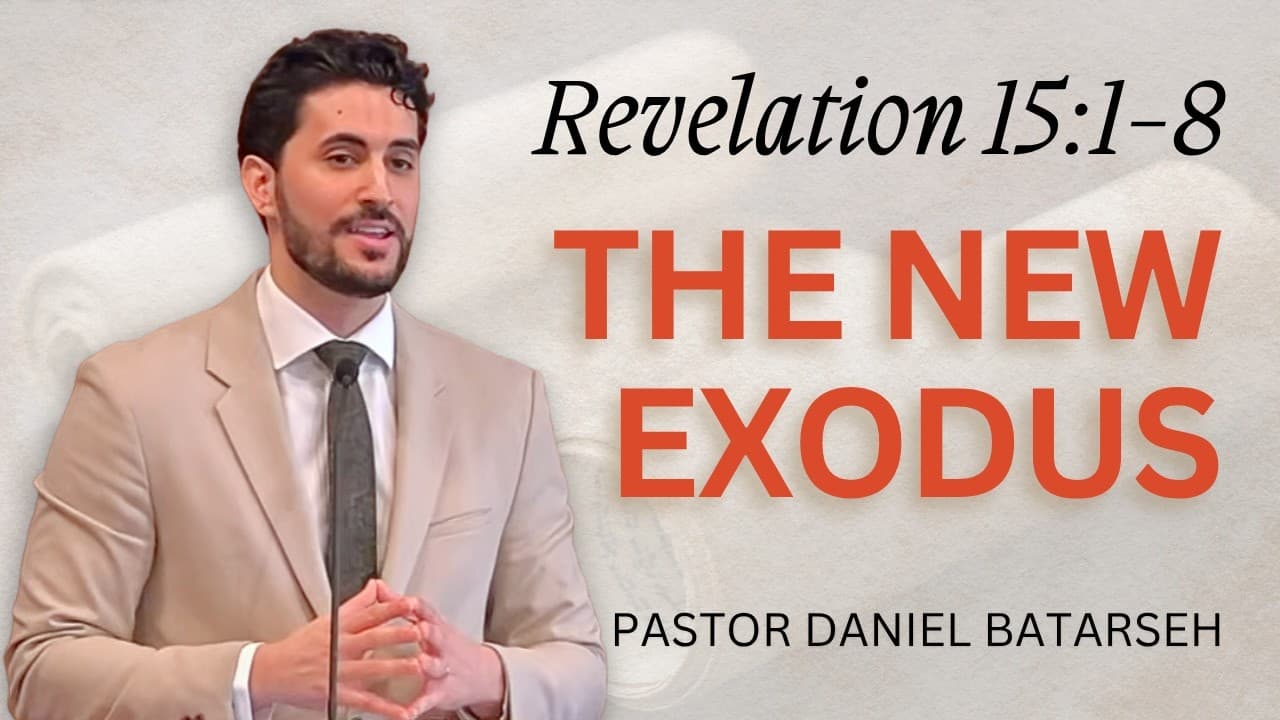
Revelation 15 reveals a coming moment when God will close heaven's tabernacle to all intercession. But today, Christ still ministers there on your behalf.
There is a moment coming when God will refuse to hear a single prayer.
Not because He's absent. Not because He's indifferent. But because He has wrapped Himself in a cloud of glory so thick, so final, that no intercession can penetrate it. Revelation 15:8 describes a scene where the heavenly sanctuary fills with smoke from God's glory and power, and no one — not an angel, not a saint, not a priest — can enter until every last drop of judgment has been poured out. That's the terrifying climax of the shortest chapter in the book of Revelation. But here's what makes this passage more than a prophecy of doom: the same heavenly tabernacle that will one day be closed for intercession is open right now. Jesus Christ is in it. And He is interceding for you this very moment.
That tension — between a door that is open today and will be shut tomorrow — is what makes Revelation 15 one of the most urgent passages in all of Scripture. And as Pastor Daniel Batarseh walked through these eight verses, what emerged was not just a preview of coming judgment, but a grand, breathtaking picture connecting Exodus, the tabernacle, the plagues, the Red Sea, and the present ministry of Christ into a single, unified vision.
The Exodus You Didn't See Coming
Revelation 15 is only eight verses long. You could read it in under a minute. But buried inside this compact vision is a mosaic of Old Testament imagery so deliberate, so layered, that missing it means missing the whole point.
The chapter mentions the song of Moses. That alone should stop you. The last time anyone sang the song of Moses, they were standing on the far shore of the Red Sea, watching Pharaoh's army drown beneath the waves. And here in Revelation 15, John sees believers standing beside — or on — a sea of glass mingled with fire, holding harps, singing that same song. There are plagues — seven of them — recalling the ten plagues God poured on Egypt. There is a tabernacle, the tent of witness, opened in heaven — the same kind of dwelling God commanded Moses to build in the wilderness after the escape from Egypt. And there is a cloud of glory filling that tabernacle, just as it filled the earthly one in Exodus 40:35 (watch at 9:11).
This is not coincidence. This is the Holy Spirit painting in broad, unmistakable strokes. What happened in Egypt was a shadow. What happens in Revelation 15 is the substance. The first Exodus liberated Israel from Pharaoh. The new Exodus liberates God's people from the beast. The first Exodus ended with plagues and a song of triumph. So does this one.
The people standing beside that glassy sea are those who conquered the Antichrist — not by military power, not by political maneuvering, but by refusing to bow the knee, even when it cost them their heads. They are martyrs. Overcomers. And their song is not about themselves.
The Worship That Strips Away Every Boast
Here is where the passage becomes deeply personal. These martyrs — believers who endured the darkest regime in human history and proved their devotion to Christ with their blood — open their mouths to sing. And every word is directed away from themselves.
Your deeds. Your ways. Your name. You alone are holy. Your righteous acts. Six times in a single stanza, God is the object of adoration. Not once do they reference their own courage, their own sacrifice, their own faithfulness.
As Pastor Daniel Batarseh observed: "These victorious, triumphant believers, when it comes to worship, give all the glory to God. You. Your. It's all about you" (watch at 2:09).
Think about that. If anyone in the history of the church had earned the right to a moment of recognition, it would be these saints. They stared down the beast and didn't flinch. They chose execution over compromise. You might call them super Christians. And yet their instinct in glory is not to rehearse their résumé but to magnify God.
This is what true worship looks like. It is the ability to acknowledge that no matter what you accomplish for Christ — no matter what you endure, no matter what you sacrifice — the source of it was never you. "Anything that happens in me, anything that happens through me, should cause me to recognize that God is the source of it. And if it wasn't for him, then I wouldn't be able to do any of this anyway" (watch at 2:20).
We live in an age that celebrates the testimony more than the God behind it. We applaud the dramatic conversion story, the radical obedience, the costly sacrifice — and rightly so. But heaven's worship corrects our aim. The harps play for God alone. The lyrics mention no human name. The spotlight never drifts.
If the greatest saints in history will worship this way, what does it say about us when our prayers are stuffed with I and me and my?
Angels Dressed Like Jesus — And Why That Should Disturb You
Out of the opened tabernacle come seven angels carrying seven plagues. These are the final judgments. The punctuation mark at the end of God's long sentence of patience. And John notices something about what they're wearing: pure, bright linen with golden sashes around their chests.
That detail is easy to skip. It isn't easy to forget once you see the connection.
The last time John saw anyone wearing a golden sash was in Revelation 1:13, where the glorified Christ Himself appeared "clothed with a long robe and with a golden sash around his chest" (watch at 5:59). These angels are not freelancing. They are not rogue agents of destruction. They are dressed like Jesus because they are representing Jesus. What they are about to do is in complete alignment with His will and desire.
This is where the passage confronts a theology that has become enormously popular — the idea that Jesus is only about love, only about mercy, only about second chances, and that judgment is somehow foreign to His character. As the sermon put it plainly: these angels "are about to do something that is in complete alignment with the will and desire of Christ himself. And that irks people because they have developed a theology about the person of Jesus Christ that completely disassociates him from any judgment against sinners" (hear this moment).
The golden sash is a rebuke to sentimental Christianity. The Jesus who washed feet is the same Jesus who dispatches plagues. The Lamb who was slain is the same Lamb whose wrath makes kings hide in caves. You cannot love the Christ of the Gospels and reject the Christ of Revelation. They are the same Person, wearing the same sash.
The Cloud That Blocks Every Prayer
Now comes the most sobering detail in the chapter. After the angels emerge, the sanctuary fills with smoke from God's glory and power. And then this devastating line: "No one could enter the sanctuary until the seven plagues of the seven angels were finished."
Why does this matter? Because of what the tabernacle has always been for. When the earthly tabernacle was built, its central function was to host God's presence so that priests could enter and intercede on behalf of the people. When the glory cloud filled Moses' tabernacle in Exodus 40:35, Moses could not enter. When it filled Solomon's temple in 1 Kings 8:10-11, the priests could not stand to minister (watch at 9:34). The pattern is unmistakable: when the cloud comes, intercession stops.
And that is exactly what happens in Revelation 15. God fills the heavenly tabernacle with His glory so that no prayer, no plea, no cry for mercy can reach Him until every bowl of judgment is emptied. The tabernacle is closed for service.
Jeremiah knew what this felt like. Writing in Lamentations 3:44, he described God's judgment against Jerusalem with haunting precision: "You have wrapped yourself with a cloud so that no prayer can pass through" (watch at 12:23). There are moments in history — and there is a final moment still to come — when God's patience reaches its limit. When the accumulated rebellion of nations exhausts every extension of mercy. When He wraps Himself in a cloud and nothing gets through.
During the bowl judgments, it won't matter how loud the nations cry. It won't matter how desperately they plead. It won't matter how long they fast. In fact, the judgments will come in such rapid succession that there will be virtually no time to pray at all. This is the end of the end.
But the Tabernacle Is Open Right Now
And here is where the passage pivots from terror to hope — not cheap hope, not sentimental hope, but the kind of hope that only means something because you've stared into the alternative.
The heavenly tabernacle is not wrapped in a cloud this afternoon. There is no smoke blocking the entrance. The door is open. And someone is inside, working on your behalf.
Hebrews 8:1-2 tells us that Christ serves as our high priest in the true tabernacle — the heavenly one that Moses' earthly tent was only a copy of. And Hebrews 7:25 tells us what He's doing there right now: "He always lives to make intercession for them."
Always. Not sometimes. Not when He feels like it. Not when you've earned it. Always.
As the sermon brought it home: "There is an open door in this heavenly tabernacle for mercy and for our needs to go in. But in Revelation 15, it will be open for judgment to come out. Don't wait" (hear this moment).
This is the contrast that should keep you awake. The same tabernacle. Two different moments. In one, mercy flows in. In the other, judgment flows out. And between those two moments stands a high priest who will never be replaced, who will never die, who doesn't borrow from the blood of earthly lambs and bulls but brings His own eternal blood every single time.
You have access to that priest today. Not because you deserve it. Not because your prayer life is impressive. But because He rose from the dead and didn't stop ministering. He stopped ministering on earth, yes. But in heaven, right now, He is willing to represent you before God the Father.
The question Revelation 15 forces on every reader is brutally simple: Will you walk through the open door while it's still open?
What to Remember
- Revelation 15 is a new Exodus: plagues, a sea, a song of deliverance, a tabernacle, and a cloud of glory — all pointing to God's final liberation of His people from the beast.
- The greatest saints in heaven direct every syllable of worship toward God alone — your deeds, your ways, you alone are holy — leaving no room for self-congratulation.
- The golden sashes on the angels match what Christ wore in Revelation 1, proving that these judgments are not separate from Jesus but issued directly by Him.
- There is a coming moment when God will fill the heavenly tabernacle with His glory so that no intercession, no prayer, and no plea for mercy can enter until judgment is complete.
- Right now, that same tabernacle is open, and Jesus Christ lives there as your high priest, making intercession for everyone who draws near to God through Him.
- The urgency of the gospel is not abstract — it is the difference between a door that is open today and will be closed forever.
Questions to Sit With
- When you worship, how much of your attention is on what God has done versus what you have done for God? Would the pronouns in your prayers look like the pronouns in the martyrs' song?
- Have you unconsciously built a version of Jesus that cannot judge — and if so, what do you do with the golden sash?
- If you knew the heavenly tabernacle would close to intercession tomorrow, what would you pray about today that you've been putting off?
- The martyrs of Revelation 15 conquered the beast by losing their lives. What would it look like for you to conquer the pressures of your own culture with that same refusal to bow?
- Do you treat prayer as a casual privilege or as access to a heavenly tabernacle that will one day be sealed shut?
Scripture Referenced
- Revelation 15:1-8 (primary passage)
- Revelation 1:13
- Exodus 40:35
- 1 Kings 8:10-11
- Lamentations 3:44
- Hebrews 8:1-2
- Hebrews 7:25
This summary was generated by AI from the sermon "The New Exodus | Revelation 15:1-8 | Pastor Daniel Batarseh (4/12/26)" preached by Pastor Daniel Batarseh at Maranatha Bible Church Chicago. Watch the full sermon →
Preached by
Pastor Daniel BatarsehSenior Pastor
This summary was generated by AI from the sermon transcript.
Based on the sermon
The New Exodus | Revelation 15:1-8 | Pastor Daniel Batarseh (4/12/26)
Watch Full SermonRelated Articles
What Revelation 21 Says About Heaven That You've Never Noticed
Pastor Daniel Batarseh · October 11, 2026
What Revelation 21 Says About Eternity (It's Not What You Picture)
Pastor Daniel Batarseh · October 11, 2026
Hebrews 9 and Why Christ's Second Coming Isn't About Sin
Pastor Daniel Batarseh · October 4, 2026