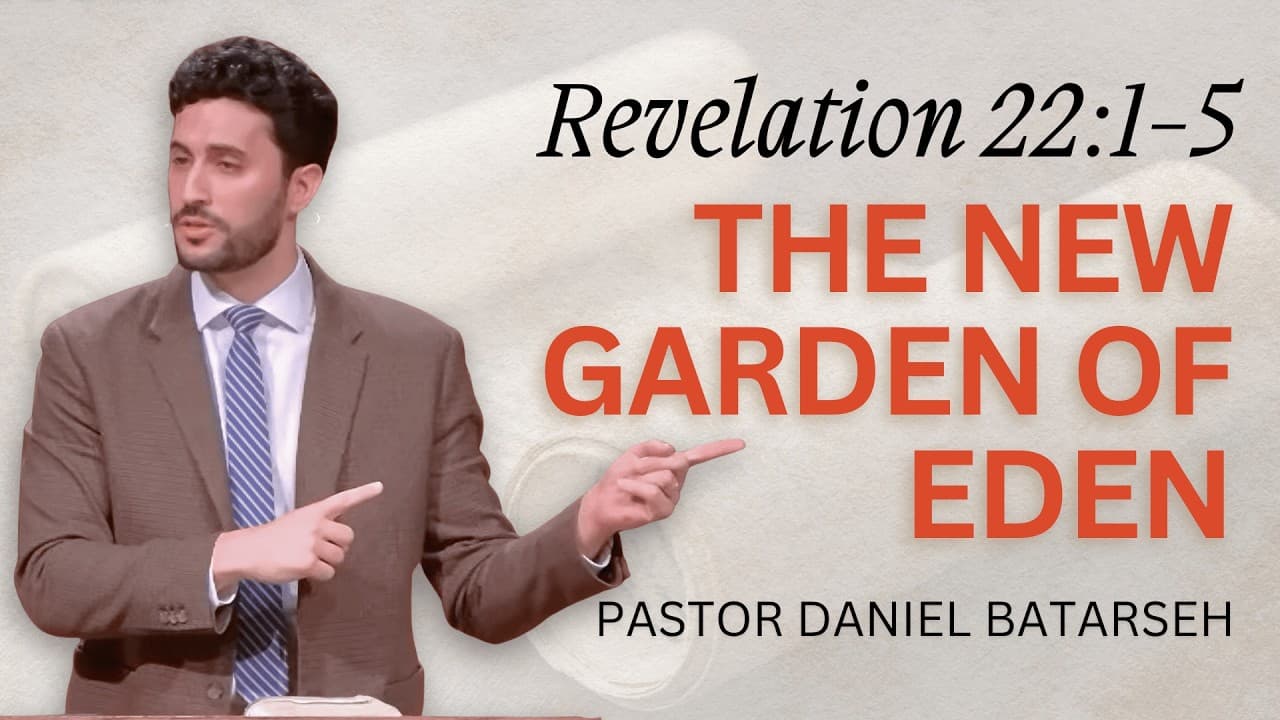
We fell at a tree. Jesus conquered on a tree. And one day we'll eat from a tree in a world where eating no longer carries the weight of a curse.
We all fell at a tree. Jesus conquered on a tree. And one day, we will eat from a tree in a world where eating no longer carries the echo of a curse — only the fullness of blessing.
That reversal sits at the heart of Revelation 22:1-5, one of the most breathtaking passages in all of Scripture. But it's also one of the most misunderstood. Is this describing the millennium? What does it mean that the tree of life produces fruit "every month" — will there be months in eternity? And what kind of "healing" do glorified, perfected people need?
Pastor Daniel Batarseh walked through these questions in a sermon that didn't just explain the text — it made the eternal age feel like something worth aching for. The answer to most of these puzzles is simpler and more staggering than we expect: the new creation isn't solving problems. It's adding to an already infinite bliss.
The Serpent's Dust Proves This Isn't the Millennium
Before you can understand what Revelation 22 is describing, you have to settle what it's not describing. And the clue comes from an unlikely source: a serpent eating dust.
In Isaiah 65:25, we get a portrait of the millennial kingdom — the wolf and the lamb grazing together, the lion eating straw like the ox. Strange. Beautiful. New. But then a familiar note intrudes: "and dust shall be the serpent's food." That's not a change. That's a continuation of the curse from Genesis 3:14, when God told the serpent, "On your belly you shall go, and the dust you shall eat all the days of your life" (watch at 0:17).
The implication is sobering: even in the millennium, there will be, as the sermon put it, "a residue of rebellion." The renewal will be extraordinary, but it will not be complete. The serpent still eats dust. The curse still lingers at the edges.
Which means that what we find in Revelation 22 — the tree of life, the throne of God, the face-to-face encounter — cannot be describing the millennium. It has to be the eternal age. The world after the world after this one. The final chapter, where every residue of rebellion has been swept away and only glory remains.
This distinction matters more than it might seem. If you confuse the millennium with the eternal state, you'll read Revelation 22 as a promise with fine print. But there is no fine print here. No asterisks. No serpent eating dust in the corner. This is the real thing.
Monthly Fruit and Therapeutic Leaves: What Eternity Actually Looks Like
Now we arrive at the questions that have puzzled readers for centuries. The tree of life produces twelve kinds of fruit, yielding its fruit each month. Its leaves are for the healing of the nations. But wait — if there's no more pain, no more tears, no more death (that was Revelation 21), then what is there to heal? And if eternity is timeless, what are "months" doing in the picture?
The mention of months doesn't necessarily mean time will tick forward in the eternal age the way it does now. Think of it the way Scripture attributes body parts to God — the arm of the Lord, the nostrils of the Lord — even though God is spirit. These are accommodations to our finite understanding, poetic handles on realities too vast for us to grip directly. The monthly fruit is a way of communicating something explosive about the life that awaits us: it will be dynamic. As Pastor Daniel Batarseh put it: "There's gonna be a diverse buffet of blessings. There is going to be not just life, incredible variety of life bursting with animation, bursting with vitality" (watch at 3:25).
Ever since childhood, if you grew up in the church, heaven probably seemed daunting — precisely because it's eternal. The unspoken fear is that it will be dull, predictable, static. A billion years of the same thing. But this single tree shatters that fear. Imagine a different fruit every month. Imagine variety built into the very architecture of the new creation. Eternity isn't a flatline. It's an ever-unfolding feast.
And the leaves? The Greek word translated "healing" is therapeia — the root of our English word "therapy." But therapy doesn't have to mean treating illness. It can mean enrichment, nourishment, the deepening of well-being that's already present. There will be no injury to treat, no disease to cure. The leaves aren't a remedy for suffering — they're an addition to joy. Everything in this new world exists not to fix what's broken but to amplify what's already glorious.
Consider how Jesus himself modeled this after his resurrection. More than once, we find the risen Christ eating. Did his glorified body need food? No. He got to eat. Why? Because there's pleasure in it. There's enjoyment in it. The resurrected life isn't stripped down to bare necessities — it's overflowing with goodness that exists purely for delight (hear this moment).
If you're someone who suspects heaven will be boring, this passage is a direct rebuke to that suspicion. And it should be a relief.
The Great Reversal: From Forbidden Fruit to the Tree of Life
Here is the insight that stopped me cold, the moment in the sermon where the whole biblical narrative clicked into a single frame.
What act of rebellion brought the entire world under the subjection of sin? Eating. Eating a fruit that was forbidden. One act of consumption at one tree in one garden, and the whole cosmos fractured.
And yet in this new world, what do we discover? Eating will no longer be associated with a curse. It will be connected to life and blessing. As the sermon declared with a force that landed on every person in the room: "We all fell at a tree. Jesus conquered on a tree and will be eating from a tree in a new world" (watch at 6:33).
That is not a coincidence. That is the architecture of redemption. God doesn't merely forgive — he reverses. He takes the very instrument of our destruction and transforms it into the vehicle of our eternal delight. The tree that killed us becomes the tree that feeds us forever. The act that cursed us becomes the act that blesses us without end.
This is what redemption actually looks like. Not a return to innocence, as if Genesis 1-2 were the ceiling. But an arrival at something greater than Eden ever was. Eden had a forbidden tree. The new creation has no such restriction. Eden had a serpent lurking. The new creation has no curse at all. Eden was a garden you could be expelled from. The new creation is a home you will never leave.
What a reversal. What a triumph.
Seeing the Face That Moses Was Denied
But the tree, the fruit, the leaves — all of it is connected to something even more staggering. Verses 3 through 5 pull us past the landscape and into the presence that fills it: "The throne of God and of the Lamb will be in it, and his servants will worship him. They will see his face."
They will see his face.
Let that land. What Moses was denied in Exodus 33 will be available to every single believer in that day. Remember the scene? Moses, the friend of God, the man who spoke with the Almighty as a man speaks to his friend, makes the most audacious request recorded in Scripture: "Please show me your glory." And God's answer, though generous, carried a devastating limitation: "You cannot see my face, for no man shall see me and live" (watch at 8:01).
But in the eternal age, we will see his face and live. In fact, seeing his face will be our source of life. No mediator. No barrier. No veil. No cloud on the mountain keeping us at a distance. God will be completely, permanently, intimately accessible. When you look someone in the face, there is an intimacy there that no other posture can replicate. That's what awaits us — not a God who is distant and transcendent only, but a God who is near enough to look in the eye.
And yet "seeing his face" means even more than visual contact. The Apostle Paul, writing to the Corinthians, said: "For now we see in a mirror dimly, but then face to face. Now I know in part, then I shall know fully, even as I have been fully known" (1 Corinthians 13:12). To see God face to face is not merely to look upon him — it is to understand. It is the opening of our comprehension into depths of knowledge and insight we have never accessed. Every theological question that kept you up at night, every mystery that felt impenetrable, every "why" that went unanswered — face to face, you will know fully, even as you have been fully known.
As Pastor Daniel Batarseh shared, reflecting on this verse: "This moved me so deeply last night. It ministered to me" (hear this moment). There was a hush in the room when he said it. Because this isn't just theology. This is the promise that the God who knows every hidden corner of your heart will one day let you know him with that same completeness. The asymmetry of the relationship — where he knows everything and we grasp at shadows — will finally be resolved. Not because we become God, but because the barrier is removed. The mirror is taken away. And we see clearly.
That is the new Garden of Eden. Not just a place with better trees and better fruit. A place where the face of God is the light, the food, the therapy, the life. A place where everything lost in the first garden is not just restored but surpassed beyond all imagination.
What to Remember
- The serpent still eating dust in Isaiah 65:25 proves the millennium is not the final perfection — Revelation 22 describes the eternal age, where every trace of rebellion is gone forever.
- "Months" and "healing" in Revelation 22 are not signs of imperfection in eternity — they are accommodations to our finite language, pointing to the dynamic variety and therapeutic richness of the life to come.
- The very act that cursed humanity — eating from a tree — is redeemed in the new creation, where eating from the tree of life brings only blessing. God doesn't just forgive; he reverses.
- Seeing God's face means more than visual contact — it means the end of partial knowledge, the opening of full understanding, knowing God as completely as he has always known you.
- Our resurrected bodies won't need food, but we will get to eat — because the new creation is designed for pleasure, not mere survival.
- Heaven will not be static, dull, or predictable. Twelve different fruits from one tree is just a hint at the relentless creativity of God in eternity.
Questions to Sit With
- If the new creation reverses the curse of Eden rather than simply erasing it, what does that tell you about how God handles the damage sin has done in your own life — does he merely remove it, or does he redeem it into something greater?
- Do you secretly believe heaven will be boring? What does that belief reveal about what you think God is actually like?
- Moses was denied the sight of God's face. You've been promised it. What would change about how you live today if you truly believed that the most intimate encounter imaginable is waiting for you?
- Paul says you will one day "know fully, even as you have been fully known." What question would you most want answered — and are you willing to trust God with the silence until then?
- If eating — the very act that brought the curse — becomes an act of pure blessing in the new creation, what broken thing in your life might God be planning to reverse rather than simply remove?
Scripture Referenced
This summary was generated by AI from the sermon "The New Garden of Eden | Revelation 22:1-5 | Pastor Daniel Batarseh (11/1/26)" preached by Pastor Daniel Batarseh at Maranatha Bible Church Chicago. Watch the full sermon →
Preached by
Pastor Daniel BatarsehSenior Pastor
This summary was generated by AI from the sermon transcript.
Based on the sermon