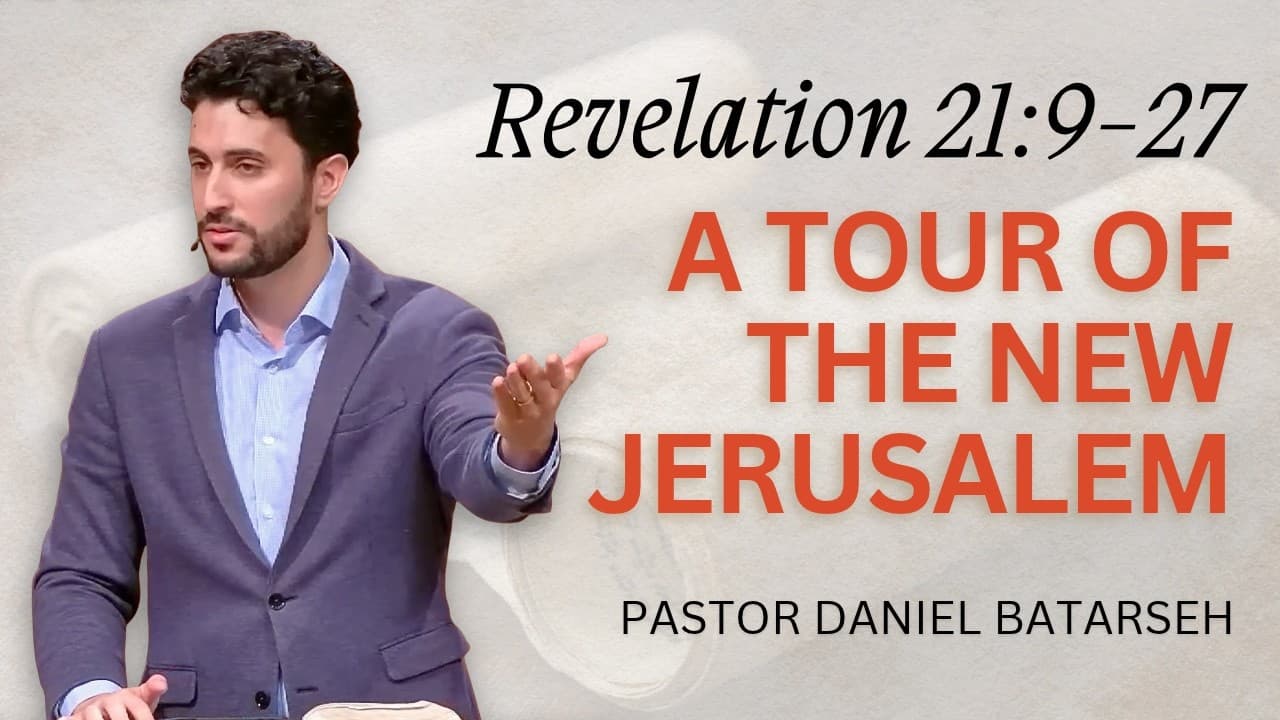
The most detailed description of eternity in all of Scripture isn't about our resurrected bodies or heavenly activities — it's a sketch of a city. And that city has something to say about what will finally satisfy you.
The most detailed description of the afterlife in all of Scripture is not about what your resurrected body will look like. It's not about the activities you'll enjoy or the conversations you'll have with Abraham and Paul. The most exhaustive portrait of eternity that the Holy Spirit ever inspired is a sketch of a city — its walls, its gates, its foundations, its streets, its dimensions, even its ecosystem. That should stop us in our tracks.
In Revelation 21:9–27, the apostle John is taken on a guided tour of the New Jerusalem, and the sheer volume of architectural detail raises a question we need to answer: Why does God devote more ink to describing a city than to describing our glorified existence within it? The answer, as Pastor Daniel Batarseh walked his congregation through in this sermon, is that the New Jerusalem is not merely a place. It is a statement — about the tangible reality of our future, about the beauty of God's glory, and about what it will finally take to satisfy the human soul.
The Lie That Your Best Life Is Now
Before John ever sets foot on the high mountain to see the city, the sermon grounded us in a passage most people wouldn't associate with a study of Revelation. In Psalm 17:14–15, David draws a line between two kinds of people — and the distinction is sharper than we might expect.
David describes the wicked as "men of the world whose portion is in this life." Pause on that phrase. Their portion — their allotment, their inheritance, the thing they believe will satisfy them — is found entirely within the boundaries of this present world. They look at the pleasures, achievements, and comforts available to them between birth and death, and they conclude: This is as good as it gets.
As Pastor Daniel Batarseh put it: "If you think the greatest ecstasies and the greatest bliss and the greatest satisfaction can only be known in this world, David says, you're carnal, you're worldly, wicked" (watch at 3:41).
That word wicked should unsettle us. David isn't describing serial killers and war criminals. He's describing a posture of the heart — the settled conviction that this life is the main event, and whatever comes after is a vague, ghostly epilogue. And here's the uncomfortable truth: many Christians functionally live this way. We say we believe in heaven, but we invest the overwhelming majority of our emotional energy into making this life comfortable. We plan for retirement with more specificity than we think about resurrection.
David then sets the contrast with himself. "As for me, I shall behold Your face in righteousness. When I awake, I shall be satisfied with Your likeness" (Psalm 17:15). The word awake is David's way of likening death to sleep — a metaphor the New Testament picks up and carries forward. And notice what David connects to satisfaction: not a place, not a reward, not a mansion. Your likeness. Beholding the face of God. That is the thing that will finally, permanently, irreversibly satisfy the human soul.
This is the lens through which we are meant to read Revelation 21. The New Jerusalem is not just a destination. It is the environment in which we will behold the glory of God without interruption, without distraction, without end.
Beauty That Creates Praise Instead of Craving
There's a moment in the sermon where the teaching shifted from theological argument to something more like worship. The subject was beauty — and specifically, the relationship between beauty and satisfaction.
We all know what it's like to encounter something beautiful. A sunset that stops you mid-sentence. A piece of music that makes the hair on your arms stand. A landscape so vast and perfect it almost hurts to look at. In those moments, something happens inside us that is difficult to articulate. Beauty creates a rush of delight. It stabilizes something restless within us. It draws out praise almost involuntarily.
But here's the thing about earthly beauty: it fades. The sunset dissolves. The song ends. You drive away from the overlook. And what you're left with is not satisfaction but longing — a hunger for more of what you just tasted. Every beautiful thing in this world is a signpost pointing somewhere else.
The sermon pressed this point with a simple but devastating question: "If a sunset has a way of keeping us on our feet and staring at the sky uninterruptedly, to talk about it, to take pictures of it so that we can show others — what about the Creator Himself?" (hear this moment).
That question reframes everything. If derivative beauty — beauty that is merely a reflection of the Artist — can arrest us, humble us, make us forget ourselves for a moment, then what will the unmediated glory of God do to us? This is why John, standing on that high mountain and looking at the New Jerusalem descending from heaven, reaches for the only language available to him. He doesn't describe it in precise architectural terms. He says, It's like. Over and over. It's like a most rare jewel. It's like jasper, clear as crystal.
John isn't being imprecise because he's a poor writer. He's being imprecise because human language was never designed to contain what he's seeing. The glory of God radiating through a physical city exceeds the capacity of words. And the promise embedded in that struggle for language is this: what awaits you is better than anything you can currently imagine.
"After a thousand years go by, ten thousand years after that, and a million years, you will never know a moment where your soul feels empty" (watch at 7:26). That single sentence is worth sitting with for a long time. A million years in, and your soul will still be full. Not bored. Not restless. Not scrolling for the next thing. Full.
Walls, Gates, and Foundations: Why the Details Matter
Now John zooms in. The angel takes him closer, and the camera tightens on specific features of the city: walls, gates, and foundations. Revelation 21:12–14 tells us the city has a great high wall with twelve gates, each gate bearing the name of one of the twelve tribes of Israel, and twelve foundations, each inscribed with the name of one of the twelve apostles of the Lamb.
Walls, gates, and foundations were standard features of ancient cities. Nothing unusual there. But the inscriptions are everything. The twelve tribes of Israel on the gates. The twelve apostles on the foundations. Old Testament and New Testament. Promise and fulfillment. The entire story of redemption, from Abraham to the apostolic church, permanently etched into the architecture of the eternal city.
This is not decorative. It's theological. The New Jerusalem is a physical monument to the unified plan of God across all of history. Every person who enters through those gates walks past the names of the patriarchs — a reminder that God's covenant faithfulness stretches back millennia. And every stone beneath their feet bears the name of an apostle — a reminder that the church was built on the foundation of apostolic testimony about the Lamb.
And notice the phrase that closes verse 14: "the twelve apostles of the Lamb." Not the twelve apostles of Jesus. Not the twelve apostles of the Christ. Of the Lamb. The sacrificial title. The identity of Jesus that is most connected to the cross. Even in the architecture of the eternal city, the slaughtered Lamb is the organizing principle of everything. You cannot walk through the New Jerusalem without being reminded that you are there because of blood.
Your Future Is Physical — And That Changes Everything
One of the most important correctives in this passage is one that many Christians desperately need to hear. The popular imagination of the afterlife — floating on clouds, strumming harps, existing as disembodied spirits in some immaterial dimension — is not what the Bible teaches. Not even close.
As the sermon put it plainly: "Many people, including Christians, have this idea that the story with the redeemed ends with us becoming disembodied spirits, removed from this planet that will be pummeled by God's judgment as we now abide in some immaterial dimension forever and ever. That is not how the Bible describes your future and mine" (watch at 11:16).
The New Jerusalem has dimensions. It has walls you can measure. Streets you can walk on. Gates you can pass through. It descends from heaven to the new earth — a renewed, physical creation. God is not abandoning the material world. He is redeeming it. He is not rescuing us from physicality but through it and into a perfected version of it.
This matters more than we realize. If your view of eternity is essentially ghostly — a wispy, spiritual existence disconnected from anything tangible — then you will inevitably conclude that this present material life is the only "real" one. And that conclusion will shape everything: how you spend your money, what you chase, what you grieve over, what you refuse to let go of. You'll cling to this world because you secretly believe it's the only solid thing you'll ever touch.
But if your future includes a resurrected body in a renewed creation, walking on real streets in a real city that radiates with the unfiltered glory of God — then this present world, as beautiful and good as it is, becomes what it was always meant to be: a prologue. A shadow. A taste of something incomprehensibly better.
The level of detail in Revelation 21 is the Holy Spirit's way of saying: This is real. More real than what you're standing on right now. Plan accordingly.
The Ecosystem of the Eternal City
One detail that often gets overlooked is the mention of the city's ecosystem. John doesn't just describe architecture — he describes a living environment. The New Jerusalem is not a sterile monument. It is a habitation. A place designed for dwelling, for life, for the kind of flourishing that sin has made impossible in this age.
And at the center of it all is not a temple, not a cathedral, not a holy of holies separated by a veil. At the center is God Himself, dwelling with His people. The entire city is, in a sense, the Holy of Holies expanded to cosmic proportions. There is no need for a temple because the Lord God Almighty and the Lamb are its temple. There is no need for sun or moon because the glory of God is its light.
Every detail in this passage points in one direction: unhindered access to God. No barriers. No mediators. No distance. The satisfaction that David longed for in Psalm 17 — beholding God's face, being satisfied with His likeness — will be the permanent, uninterrupted experience of every redeemed person in the New Jerusalem.
And that is why the most detailed description of eternity in all of Scripture is a description of a city. Because a city is where people live. And God is telling you, in painstaking detail, that He intends to live with you. Not above you. Not apart from you. With you. In a place so real you can touch the walls, so beautiful it will make every sunset you've ever seen look like a pencil sketch, and so saturated with His presence that your soul will never — not once, not ever — feel empty again.
What to Remember
- If your deepest satisfaction is anchored entirely in this life — your career, your family, your comfort — David calls that the posture of the wicked, not because those things are evil, but because they were never meant to be your portion.
- The New Jerusalem is not a metaphor. It has measurements, materials, and an ecosystem. God gave us architectural detail to remind us that our future is physical, tangible, and real.
- Every beautiful thing you've ever encountered — every sunset, every symphony, every face you love — is a faint echo of the Creator whose glory will illuminate the eternal city without need for sun or moon.
- The names of the twelve tribes and twelve apostles inscribed on the city's gates and foundations are a permanent reminder that God's redemptive plan spans all of history and centers on the Lamb who was slain.
- A million years into eternity, your soul will not be bored, restless, or empty. The glory of God does not diminish with exposure — it deepens.
Questions to Sit With
- If someone examined how you spend your time, money, and emotional energy, would they conclude that your "portion" is in this life or the next?
- When was the last time something beautiful stopped you in your tracks — and did you let it point you toward the Creator, or did you just take a photo and move on?
- How does your mental picture of the afterlife shape the way you handle loss, disappointment, and aging right now? If your picture is vague and ghostly, is it any wonder you cling so tightly to what you can see?
- The Lamb — the sacrificial title of Jesus — is inscribed into the very foundations of the eternal city. What would it look like for the cross to be that central in your daily thinking?
- If you knew with absolute certainty that the New Jerusalem was as real as the room you're sitting in, what would you stop being afraid of?
Scripture Referenced
- Revelation 21:9-27 (primary passage)
- Revelation 21:12-14
- Psalm 17:14-15
This summary was generated by AI from the sermon "A Tour of The New Jerusalem | Revelation 21:9-27 | Pastor Daniel Batarseh (10/18/26)" preached by Pastor Daniel Batarseh at Maranatha Bible Church Chicago. Watch the full sermon →
Preached by
Pastor Daniel BatarsehSenior Pastor
This summary was generated by AI from the sermon transcript.
Based on the sermon
A Tour of The New Jerusalem | Revelation 21:9-27 | Pastor Daniel Batarseh (10/18/26)
Watch Full SermonRelated Articles
What the New Jerusalem Reveals About Eternity (Rev 21:9-27)
Pastor Daniel Batarseh · October 18, 2026
What Revelation 21 Says About Heaven That You've Never Noticed
Pastor Daniel Batarseh · October 11, 2026
What Revelation 21 Says About Eternity (It's Not What You Picture)
Pastor Daniel Batarseh · October 11, 2026