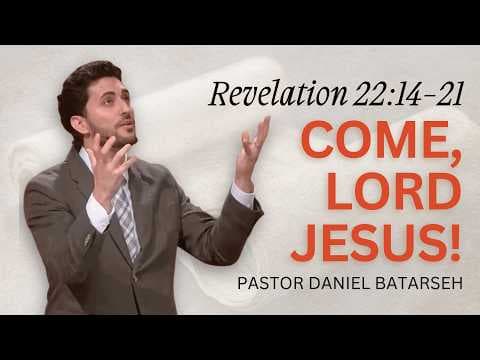
The Bible's last words aren't wrath — they're grace. Revelation 22:14-21 reveals the final invitation to sinners and a warning that should make every false teacher tremble.
The last word of the Old Testament is "curse." The last word of the New Testament is "grace." That single contrast tells you everything about what God accomplished between Malachi and Revelation. And it tells you something about the heart of God that should stop you cold — because Revelation 22:14-21 doesn't end the Bible with fire. It doesn't end with a gavel. It ends with an open door and an outstretched hand.
But make no mistake: the invitation comes paired with one of the most severe warnings in all of Scripture. And sandwiched between them is a cry from the Holy Spirit that, once you understand it, will change the way you pray.
There's a Dress Code for Eternity — And You Can't Meet It
Verse 14 drops a phrase that some translations render differently. If you're reading the King James, you'll see "Blessed are those who do His commandments." The ESV and NASB read "Blessed are those who wash their robes." The difference comes down to underlying Greek manuscripts — earlier manuscripts favor the washing imagery, which is consistent with language already established in Revelation. In Revelation 7:14, the great multitude before the throne are described as those who "have washed their robes and made them white in the blood of the Lamb." Same imagery. Same book. No contradiction.
But here's what matters: throughout Scripture, clothing functions as a picture of spiritual condition. Soiled garments mean sinfulness. Clean garments mean righteousness. Jesus Himself criticized members of the church in Sardis for having "soiled their garments" (Revelation 3:4) — not their physical clothes, but their spiritual state (watch at 7:07).
So when the Holy Spirit closes this book with the image of washed robes, He's making something unmistakable: there is a dress code for the New Jerusalem, and no human being can produce the required attire. You cannot scrub your own garments clean. You cannot spend a lifetime generating enough moral consistency to earn a pass. As Titus 3:5 puts it, "He saved us, not according to our works in righteousness, but according to the washing and regeneration of the Holy Spirit."
The connection to the tree of life makes this even more devastating. Think about it — the last time clothing and a tree appeared together in Scripture was in Eden. Adam and Eve sinned, realized their nakedness, and sewed fig leaves to cover themselves. Those fig leaves did nothing. God replaced them with animal skins — a foreshadowing of sacrifice — but even that couldn't reverse the curse. Now, at the end of the story, clothing appears again. But these robes are different. Washed in another's blood. Made white by another's work. Given as a gift.
As Pastor Daniel Batarseh put it: "You have to be willing to take off your fig leaves. You have to be able to even look at all the goats and bulls that have been slain in the Old Testament and say none of that will work. I need my robes washed in Christ's blood" (watch at 10:59). That is the only garment God will accept at the gate.
"Loves and Practices" — The Two Words That Reveal Your Destiny
But the grace of washed robes does not mean universal salvation. Verse 15 dismantles that idea with blunt force: "Outside are the dogs and sorcerers and the sexually immoral and murderers and idolaters and everyone who loves and practices falsehood."
The word "dogs" isn't about household pets. In the ancient world, dogs were scavengers — unclean animals roaming in packs, feeding on refuse and decay. The term became a metaphor for the spiritually impure. Paul uses it the same way in Philippians 3:2: "Beware of the dogs."
But rather than dissecting every sin on the list, look at the phrase that captures them all: "everyone who loves and practices falsehood." Two words carry the weight — loves and practices. One is about affection. The other is about pattern. Together, they reveal a heart condition and, ultimately, a destiny.
This is where comfortable Christianity gets uncomfortable. The question isn't whether a Christian will ever sin again — of course we will. The question is whether your affection for sin and your attitude toward it have fundamentally changed. "If I love sin, if I walk in it habitually, without conviction, without remorse, without repentance, and without godly sorrow, according to this verse, I'm an outsider" (watch at 14:43).
This is what the gospel actually does to a person. It doesn't just forgive — it transforms. It changes what you love. It alters how you live. 1 John 3 says you "cannot make a practice of sinning" if you've been born again. Not because you've achieved perfection, but because the Holy Spirit has taken up residence in your heart, and He will not let you sit comfortably in what God calls evil.
So here's the honest question: Is the way you process sin any different from someone who doesn't know Christ? Can you celebrate what God condemns? Can you scroll past what should grieve you? Can you indulge without a twinge of conviction? If so, verse 15 isn't a warning for someone else. It might be a mirror.
Why the Holy Spirit Cries "Come, Lord Jesus"
Verse 17 is one of the most remarkable verses in the entire Bible, and most people read it too quickly. "The Spirit and the bride say, 'Come.' And let the one who hears say, 'Come.' And let the one who is thirsty come. Let the one who desires take the water of life without price."
There are actually two invitations compressed into a single verse. The first "come" is directed at Christ — a cry for His return. The second shifts mid-sentence and turns toward the unbeliever: come, drink, be satisfied. Jesus isn't thirsty. He doesn't need the water of life. He is the water of life. So when the verse says "let the one who is thirsty come," the audience has changed.
The bride saying "come" to Christ makes intuitive sense. His return means our resurrection, our glorification, face-to-face communion with Him forever. But why does the Holy Spirit say "come"? He's already in perfect union with the Son and the Father. What does the third person of the Godhead gain from Christ's return?
The answer lies in John 16:14, where Jesus says of the Spirit: "He will glorify me, for he will take what is mine and declare it to you." The Holy Spirit's mission — His deepest longing — is the full, visible, undeniable exaltation of Jesus Christ. And that exaltation will only be complete when Christ returns in glory. Every blasphemer silenced. Every rebel conquered. Every knee forced to bow. The Spirit wants the world to see it.
"One of the reasons why we are so desperate for Christ to return — yes, it means our rescue — but it also means Christ will be vindicated. It means every knee has no choice but to bow, and every tongue has to confess that Jesus Christ is Lord. We should all long to see it" (watch at 25:54).
This reframes everything about how we pray "Come, Lord Jesus." It's not just about escaping suffering. It's not just about getting our glorified bodies. It's about Christ receiving what is His due. Every false religion that distorts His nature. Every person who drags His name through the dirt. Every casual blasphemy tossed around like it means nothing. The Spirit says come because He burns for Christ to be seen as He truly is.
And here's the practical force of this: verse 16 leads to verse 17. When Jesus reveals Himself — "I am the root and the descendant of David, the bright morning star" — the response is twofold. A yearning to know Him more, and a compelling conviction to tell others about Him. Greater glimpses of Christ produce both deeper worship and bolder witness. You don't need a program for evangelism. You need a bigger view of Jesus.
The Bible's Most Severe Warning Is in Its Final Pages
Verses 18-19 contain the most exhaustive warning of its kind in all of Scripture. Similar cautions appear in Deuteronomy, but none carry this level of detail or severity. And the placement is no accident — these words sit at the end of Revelation, which sits at the end of the entire canon. This isn't just a warning about tampering with one book. It encapsulates all of divine revelation.
The warning isn't aimed at sincere believers who struggle to interpret every vision perfectly. It targets those with a "far more sinister and arrogant attitude" — false teachers who would distort, censor, or supplement God's Word with their own subjective experiences. Adding to it brings the plagues of this book upon you. Taking away strips you of the tree of life. Both consequences are devastating, and both underscore something crucial: the plagues in Revelation are real, not merely symbolic. If they were symbolic, the threat of having them added to you would be meaningless (hear this moment).
People are playing a dangerous game when they approach this book with arrogance — dismissing it, gutting it, reshaping it to fit cultural preferences. This isn't about honest scholarly evaluation. It's about those who know they're handling divine revelation and choose to mangle it anyway.
The Last Word: Not Wrath, But Grace
After the warning, after the invitation, after John's aching cry of "Amen, come Lord Jesus" — the final sentence of the Bible is a benediction: "The grace of the Lord Jesus be with all. Amen."
Grace. In a book of plagues and beasts and bowls of wrath. Grace. And the book doesn't just end with grace — it opens with it. Revelation 1:4-5 begins, "Grace to you and peace from Him who is and who was and who is to come." Grace bookends the entire apocalypse.
Why? Because every fearful thing in this book — every seal, every trumpet, every judgment — can be escaped. And there is only one way: the grace of Jesus Christ. As Pastor Daniel Batarseh declared in the closing moments of his final sermon on Revelation: "We're the safest people on earth" (watch at 42:11). Not because of our strength. Not because of our righteousness. Because of grace.
And notice how John's final reaction to everything he witnessed — every terrifying vision, every cataclysmic judgment — isn't fear. It isn't anxiety. It isn't anger at the world. It's a personal plea: Come, Lord Jesus. That's what the book of Revelation is designed to produce. Not prophecy charts. Not end-times speculation. Worship. Longing. Love for the person to whom all of it points.
If you've studied this book and your primary takeaway is a timeline rather than a Savior, you've missed it.
What to Remember
- The only "dress code" for eternity is a righteousness you cannot produce yourself — robes washed in Christ's blood, received by faith, not earned by effort.
- Your affection for sin and your pattern of life reveal your spiritual condition more than any profession of faith ever could.
- Greater glimpses of who Jesus is will always produce two things simultaneously: deeper desire for Him and bolder urgency to tell others about Him.
- The Holy Spirit's deepest longing is the full, public, undeniable exaltation of Jesus Christ — and He invites you to share that longing.
- The Bible's final word is not curse but grace — and that grace is available to you right now, today, without price.
- If the book of Revelation produces fear in you rather than worship, you haven't yet grasped the grace that bookends every page of it.
Questions to Sit With
- If someone examined the pattern of your life — not your worst moments, but your loves — would they see someone whose affections have been fundamentally changed by the gospel?
- When was the last time a fresh glimpse of who Jesus is moved you to tell someone else about Him — not out of obligation, but because you couldn't help it?
- Do you pray "Come, Lord Jesus" primarily because you want to escape this world, or because you want Christ to receive the glory He is owed? What's the difference, and does it matter?
- Have you actually handed over your "fig leaves" — your self-made attempts at righteousness — or are you still trying to sew them together and present yourself as acceptable to God?
- If the Bible's last word is grace, why do so many Christians live as though the last word is fear?
Scripture Referenced
- Revelation 22:14-21 — primary passage
- Revelation 7:14
- Revelation 3:4
- Revelation 1:1, 4-5
- Revelation 22:6-7, 9-10
- Titus 3:5
- Philippians 3:2
- 1 John 3
- John 16:14
- Malachi 4:6
- Deuteronomy
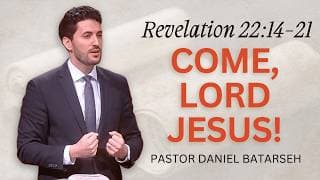
This summary was generated by AI from the sermon "Come, Lord Jesus! | Revelation 22:14-21 | Pastor Daniel Batarseh (11/22/26)" preached by Pastor Daniel Batarseh at Maranatha Bible Church Chicago. Watch the full sermon →
Preached by
Pastor Daniel BatarsehSenior Pastor
This summary was generated by AI from the sermon transcript.
Based on the sermon