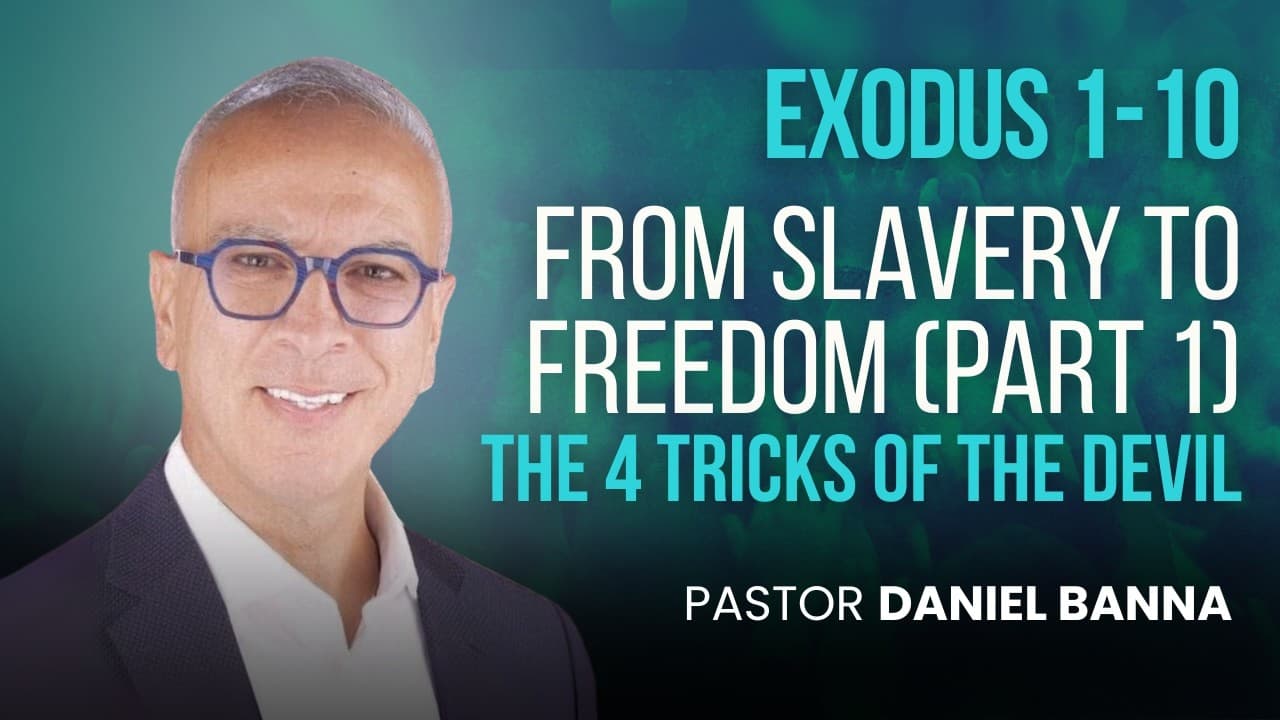
Pharaoh didn't just refuse to let Israel go — he made four cunning counteroffers. Each one mirrors a trick Satan still uses to keep people from full freedom in Christ.
Satan doesn't always roar. Sometimes he negotiates.
That's the surprise buried in Exodus chapters 5 through 10. Most people remember the ten plagues — water turning to blood, frogs, darkness, death. But wedged between those spectacular displays of God's power are four quiet conversations between Pharaoh and Moses that reveal something far more dangerous than brute opposition. Pharaoh makes four counteroffers, each one a carefully calibrated compromise designed to keep Israel under his control while appearing to give them what they want. And as Pastor Daniel Banna showed in this gripping sermon, these four tricks are the exact same strategies Satan deploys against every soul God is drawing out of darkness.
If you've ever shared the gospel with someone and watched them get worse instead of better — or if you've ever felt the strange pull to follow Jesus without actually leaving your old life behind — this passage explains why.
Before Freedom Comes, Things Get Worse
The story begins in a place most of us would rather skip: the moment when obedience makes everything harder.
Moses walks into Pharaoh's court with a simple, non-negotiable message from God: Let my people go. Pharaoh's response? Defiance. "Who is the Lord that I should obey his voice?" (watch at 18:11). And then, instead of easing the burden, Pharaoh doubles it. No more straw for bricks. Same quota. More suffering.
This is the part of the Exodus story that rattles people. God shows up — and things get worse. The Israelites themselves turned on Moses: "You've made us stink in the sight of Pharaoh!" And here is where so many people lose heart, both in their own spiritual lives and in their prayers for others.
You've been praying for a friend, a spouse, a child. You've shared the gospel faithfully. And instead of softening, their resistance hardens. They were indifferent before; now they're hostile. They were quietly worldly; now they're aggressively anti-Christian. As the sermon put it plainly: "Satan knows very well how to tighten his grip when the light of the gospel begins to shine on someone. And often before we see any softening of heart, you see increased resistance" (watch at 20:33).
Don't be surprised by this. Don't be discouraged. This is the pattern. The enemy never releases captives without a fight. But here's what Pharaoh didn't count on: increased resistance is not the same as increased power. God was not intimidated by Pharaoh's stubbornness. The plagues came anyway.
And that's when Pharaoh changed tactics.
Trick #1: "Worship God, But Stay in Egypt"
After four devastating plagues, Pharaoh finally cracks — or appears to. In Exodus 8:25, he calls Moses and Aaron and says, "Go, sacrifice to your God within the land."
It sounds reasonable. Generous, even. You want to worship? Fine. Worship. Just do it here.
But that word — within the land — is the whole deception. Egypt was the house of bondage. Egypt represented the dominion of Pharaoh, the old life, the old master. To worship God inside Egypt was to serve God on Satan's terms, within Satan's territory, under Satan's watchful eye.
This is the trick that has swallowed whole churches. It's the version of Christianity that says: follow Christ, but don't surrender everything. Go to church on Sunday, but keep your old company close. Read the Bible, but bend it to fit your culture. Confess Christ with your mouth, but remain under Egypt's influence in your heart.
As Pastor Daniel Banna said with a weight that silenced the room: "Satan is content with a Christianity that bears Christ's name while remaining under Egypt's influence" (watch at 26:26).
Moses refused. His answer was clear: "We must go three days' journey into the wilderness and sacrifice to the Lord our God as he tells us" (Exodus 8:27). Not as Pharaoh permits. As God commands. True worship requires separation — a complete departure from the old life. And that three days' journey? It wasn't arbitrary. Throughout scripture, the third day is the day of deliverance. Abraham received Isaac back on the third day. Jonah was released from the belly of the fish on the third day. And fifteen hundred years after the Exodus, Jesus Christ — the ultimate Deliverer — rose from the grave on the third day.
The three days' journey points to the cross and the empty tomb. It means passing from one realm to another entirely: from slavery to freedom, from death to life, from the kingdom of darkness into the kingdom of God's beloved Son.
You cannot straddle both kingdoms. You must leave Egypt.
Trick #2: "Go, But Don't Go Far"
Pharaoh's first trick failed. So he pivoted. In Exodus 8:28, he says: "I will let you go to offer sacrifices to the Lord your God in the wilderness, but you must not go far."
Stay within reach. Stay at the border. Keep one foot in the wilderness and one foot in Egypt, so that when the worship service ends and the emotion fades, I can pull you back.
This is borderline Christianity — the faith that goes just far enough to ease the conscience but never far enough to be truly free. It's the believer who attends church but never submits to Christ's lordship over their finances, their relationships, their ambitions. It's the person who prays but never repents. Who reads the Bible but never obeys it.
The sermon drew a devastating comparison here between two men in Genesis: Abraham and his nephew Lot. Lot pitched his tent toward Sodom. He lived at the border. He had enough religion to be "vexed" by the wickedness around him (2 Peter 2:7–8), but not enough conviction to leave. His testimony was so compromised that when judgment came and he warned his sons-in-law, they laughed at him. His own children had married into Sodom. He was a borderline believer — technically saved, but with nothing to show for it.
Abraham, by contrast, left his country entirely. He lived as a pilgrim, looking for a city whose architect and builder is God. He was called the friend of God. The difference between Abraham and Lot is the difference between a Christian who has truly departed Egypt and one who lingers at the border hoping for the best of both worlds.
There is no best of both worlds. The border is enemy territory dressed up as neutral ground.
Trick #3: "Go, But Leave the Children Behind"
By Exodus 10:10, Pharaoh has endured plague after plague. He's desperate enough to make a bigger concession — but not without one final condition. "Go, the men among you, and serve the Lord," he says. But the children? They stay.
Pharaoh knew exactly what he was doing. If the children remain in Egypt, the parents will come back for them. And if Egypt keeps the children long enough, Egypt will shape their hearts. This is not ancient history. This is the battle being fought in every Christian home right now.
Satan is patient. He is content to lose one generation if he can capture the next. He doesn't need your children to reject God outright — he just needs them to absorb the world's values so thoroughly that the faith of their parents becomes an irrelevant relic. He'll use screens, peers, cultural pressure, and the relentless drumbeat of a society that calls evil good and good evil.
The sermon's plea to parents was urgent and specific — not a vague "raise your kids right," but concrete: bring them with you to church among God's people. Take time to pray with them and for them. Read the Bible to them. Teach them God's word. Show them by example that Christ is worthy of their whole lives. "Never leave a single little one in Egypt," the sermon warned, "because if the world captures their heart, it may one day draw you also yourself back to it" (watch at 34:35).
And then, turning directly to the young people in the room, the message was equally direct: the world is not your friend. It is at enmity with God, with your faith, with Christ, and with you. It will use every means possible to capture your heart and destroy your soul. Do not believe its lies.
Moses refused this trick too. All must leave. No exceptions.
Trick #4: "Go, But Leave Your Flocks Behind"
The final trick is the subtlest. Exodus 10:24 — Pharaoh says: "Go, serve the Lord. Your little ones also may go with you. Only let your flocks and your herds remain behind."
It sounds almost generous. The three days' journey — granted. The children — granted. What's a few animals? Why fight over livestock?
Because the livestock was the sacrifice. The flocks and herds were the very offerings Israel would present to God in the wilderness. Without them, they could leave Egypt but have nothing to give the Lord when they arrived. It would be worship without substance. Obedience without cost. Freedom without devotion.
Moses' answer is one of the great lines in all of scripture: "Not a hoof shall be left behind" (Exodus 10:26). Not one. Because God alone determines what he requires of his people, and Moses had no authority to bargain away any part of God's command.
This is the trick that catches mature believers — the ones who have genuinely left Egypt, who have brought their families, who have gone the full three days' journey, but who hold back some portion of their lives from God's altar. A career. A relationship. A habit. A grudge. A sum of money. A private sin. They've given God almost everything. Almost.
But Christ does not call us to partial obedience. Romans 12:1 says: present your bodies as a living sacrifice, holy and acceptable to God. Your whole body. Your whole life. Not the parts you've selected, not the portions that feel comfortable, but everything — laid on the altar, held back by nothing.
As Pastor Daniel Banna pressed the question to every person in the room: "Can you say this today — I have left Egypt, and not a single hoof is left there?" (watch at 39:00).
Why God Saved Israel in the First Place
One of the most striking moments in this sermon came early, before the four tricks were even introduced. It was a question most people never think to ask: Why did God deliver Israel? Was it because they were suffering? Was it because they deserved rescue?
Neither. The prophet Ezekiel tells us in chapter 20 that while Israel was still in Egypt, they had become idolaters. They refused to forsake the idols of Egypt. They stood under God's judgment as surely as the Egyptians did. Free or slave, oppressor or oppressed — all stood guilty before God.
So why did God save them? Two reasons. First, he remembered his covenant with Abraham, Isaac, and Jacob (Exodus 2:24). Second — and this is the one that should stop you cold — God says through Ezekiel: "I acted for the sake of my name" (Ezekiel 20:9). God's deliverance was rooted not in Israel's worthiness but in his own glory.
This is the foundation of the entire Exodus, and it is the foundation of your salvation. God did not save you because you were impressive. He saved you because he is glorious. And no king, no nation, and no power on earth can overturn that plan.
The God who said "I have come down to deliver" in Exodus 3:7–8 is the same God who came down fifteen hundred years later in the person of Jesus Christ. As 1 Timothy 1:15 declares: Christ Jesus came into the world to save sinners. He went to the cross to deliver us from the hand of Satan, to set the captives free. And if the Son sets you free, you will be free indeed (John 8:36).
You cannot improve a dead man. You cannot reform a corpse. What a dead soul needs is the Spirit of God to bring it back to life. That is what Christ alone can do.
What to Remember
- Satan's most dangerous strategy is not outright opposition — it's compromise. He'll happily let you worship God as long as you stay under his influence.
- Increased resistance after the gospel is shared is not a sign of failure. It's often a sign that God is moving and the enemy is scrambling.
- Borderline Christianity is not Christianity at all. Staying within Pharaoh's reach means you never truly left Egypt.
- The battle for the next generation is the battle Satan is most patient about winning. Christian parents must never leave their children's hearts to the world's formation.
- "Not a hoof shall be left behind" means every area of your life belongs on God's altar — your career, your relationships, your money, your secret sins. All of it.
- God's deliverance is rooted not in your worthiness but in his own glory and his covenant faithfulness. That's why it cannot fail.
Questions to Sit With
- Which of Pharaoh's four tricks most closely describes your current spiritual condition — worshiping within Egypt, lingering at the border, leaving your children exposed to the world, or holding back part of your life from God's altar?
- Is there someone you've been praying for whose resistance to the gospel has increased? Does the pattern in Exodus give you reason to keep praying rather than give up?
- What are the "leeks, onions, and garlic" of Egypt that still look appealing to you — the comforts of the old life that make you forget the milk and honey God provides?
- If Moses had no authority to bargain with God's command, what makes us think we have the authority to negotiate which parts of Scripture we'll obey?
- Can you honestly say today: "Not a single hoof is left in Egypt"? If not, what remains?
Scripture Referenced
- Exodus 1:7-14
- Exodus 2:24
- Exodus 3:7-8
- Exodus 5:1-9
- Exodus 7:13, 22; 8:15, 19, 25-28
- Exodus 10:10, 24-26
- Ezekiel 20:8-10
- Numbers 11:5
- Isaiah 55:1-2
- Romans 12:1
- 1 Timothy 1:15
- John 10:10
- John 8:36
- Revelation 3:1
- Revelation 11:8
- 2 Corinthians 4:4
- Colossians 1:13
This summary was generated by AI from the sermon "From Slavery to Freedom: The 4 Tricks of the Devil | Exodus 1 & 5-10 | Pastor Daniel Banna (7/5/26)" preached by Pastor Daniel Banna at Maranatha Bible Church Chicago. Watch the full sermon →
Based on the sermon