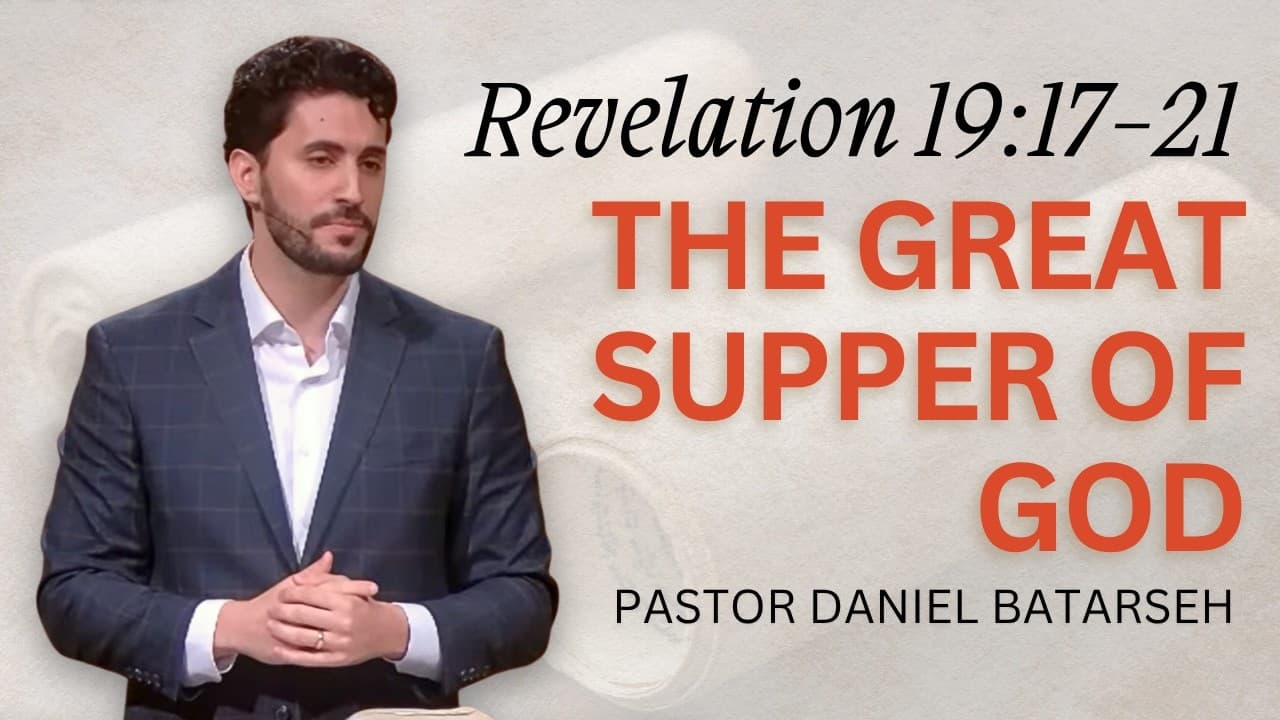
Revelation 19 presents two feasts — the marriage supper of the Lamb and the great supper of God. One is an invitation. The other is a verdict.
The United Nations headquarters has a famous inscription on its grounds. It reads: "They shall beat their swords into plowshares, and their spears into pruning hooks." It sounds noble. Aspirational. The kind of sentiment diplomats toast champagne to. But there's a problem — they only quoted half the verse.
The first part of Isaiah 2:4 says this: "He shall judge between the nations and shall decide disputes for many peoples." They took the promise of peace and cut out the Person who brings it. And that omission tells you everything you need to know about why the world craves peace but can never manufacture it — and why Revelation 19:17–21 is not merely a terrifying vision of the end, but the most necessary event in human history.
The World Wants Peace Without the Prince of Peace
This is the tension that runs beneath the surface of Revelation 19 like a fault line. Two suppers are set before humanity. One is the marriage supper of the Lamb — the joyous, eternal feast where Christ receives His bride, the church, in glory (Revelation 19:7). The other is what Scripture calls "the great supper of God" — a meal where the guests aren't seated at the table. They are the table.
The contrast is staggering. And it's intentional.
Pastor Daniel Batarseh drove this home with the Isaiah 2:4 illustration in a way that made the whole room sit up. He pointed out that the UN plaque quotes the second half of the verse — the part about nations not learning war anymore — but deliberately omits the first half, the part about Christ judging and deciding disputes. As he put it: "They cut out the part that matters the most. You're not gonna have nations not learn war anymore unless you have the king who occupies the right throne from Jerusalem" (watch at 8:27).
Then came the line that landed like a thunderclap: "People want peace. They don't want the Prince of Peace. Go on dreaming. Have as many meetings as you want at the UN. You need Christ if you want this prophecy fulfilled" (hear this moment).
This isn't cynicism. It's biblical realism. Every peace treaty, every summit, every resolution — however well-meaning — is a bandage on a wound that requires surgery. The surgery is the return of Christ. And Revelation 19 describes what happens when the Surgeon finally arrives and finds the patient fighting Him.
The Most Shameful Thing That Can Happen to a Body
To modern Western ears, the imagery of Revelation 19:17–21 sounds like the stuff of horror films. An angel standing in the sun, summoning the birds of the air to feast on the flesh of kings, captains, mighty men — every rank and station of humanity that set itself against Christ. But the original audience would have heard something even more devastating than violence. They would have heard dishonor.
In the ancient world — and throughout the entire Old Testament — the denial of burial was the ultimate humiliation. It wasn't just gruesome. It was a theological statement. To leave a body unburied, exposed to scavengers, was to declare that person's life an utter waste, their cause a total failure, their legacy erased from the earth.
This pattern runs deep through Scripture. In Psalm 79:1–2, the psalmist laments the destruction of Jerusalem with raw grief: "They have given the bodies of your servants to the birds of the heavens for food, the flesh of your faithful to the beasts of the earth" (watch at 4:27). This wasn't a footnote in his lament. It was the first thing he cried about. The bodies of God's people — sacred, made in the image of God — left to be torn apart by animals. That's what made the destruction of Jerusalem so unbearable.
And here's what should stop you cold: God Himself issued this very threat against His own covenant people when they persisted in rebellion. Deuteronomy 28:26 records the warning plainly: "Your dead body shall be food for all the birds of the air and for the beasts of the earth, and there shall be no one to frighten them away" (hear this moment).
Did you catch that last phrase? "No one to frighten them away." In normal circumstances, someone who loved the deceased would stand guard, would chase off the vultures, would ensure the body was treated with dignity. But in the judgment of God, there would be no one left who cared. No one left who could. The desolation would be total.
So when Revelation 19 describes the birds gathering for the great supper of God, it isn't gratuitous violence. It is the final, definitive declaration that every kingdom, every army, every ideology that raised its fist against the Lamb has been weighed, measured, and found wanting. Their cause is over. Their bodies will not be honored. They will, as the sermon put it, "be so devoured by the beasts of the earth and the birds of the air until you essentially disappear, physically speaking" (watch at 5:40).
This is not cruelty. This is the consequence of a war that humanity started and refused to end.
Two Suppers, One Choice
Revelation 19 is structured around a contrast so sharp it should cut you. Before the great supper of God in verses 17–21, there is the marriage supper of the Lamb in verse 7. One is a wedding feast. The other is a battlefield. One is an invitation extended in love. The other is a verdict rendered in justice.
And every human being is headed to one or the other.
This is where the sermon moved from exposition to exhortation — and it was impossible to sit comfortably. The prayer that opened and closed the teaching carried a weight that transcended the usual pastoral benediction. There was a plea for the wayward children, for the struggling marriages, for the people so consumed by personal suffering that eschatology feels like a luxury they can't afford. "The people who are in a test, in a trial, who don't even have room in their thinking for the end times — they feel like they're living in the end times with their personal struggles and challenges" (watch at 0:23).
That line hit differently than most end-times teaching. Because it acknowledged something most prophecy sermons don't: some people in the room aren't thinking about the Second Coming because they're barely surviving Tuesday. And yet — and this is the genius of the pastoral heart behind this sermon — the return of Christ is precisely the hope those people need most. The marriage supper of the Lamb isn't just a future event to study. It's the promise that every trial has an expiration date. Every tear has a final moment. Every struggle is temporary because the King is coming, and when He comes, He makes all things right.
The question this passage forces on every listener is brutally simple: Which supper are you attending?
A Bride Who Has Lost Sight of That Day
Perhaps the most convicting moment of the entire sermon wasn't about the enemies of God. It was about the people of God. There was a confession woven into the prayer that should haunt every church in the Western world: "Forgive us, Lord, for being a bride that has lost sight of that day" (hear this moment).
When was the last time you heard a congregation pray that? When was the last time you prayed it?
We have become a church that is more comfortable planning for retirement than preparing for the return of Christ. We sing about heaven in vague, sentimental terms but rarely with the ache of a bride counting the days until the wedding. The early church ended their gatherings with "Maranatha" — "Come, Lord Jesus." It wasn't a slogan. It was a cry. A longing. The kind of thing you say when you mean it with every fiber of your being.
The call here was not for more prophecy conferences or end-times charts on the wall. It was for something far more radical: that the truth of Christ's return would recapture the pulpit, the fellowship, the singing. That it would stop being a doctrine we affirm and start being a reality we live by. That the bride would look up from her distractions and remember that the Bridegroom is coming.
And He's not coming to negotiate.
He's coming to reign. Whether the UN quotes His verse or not. Whether the nations acknowledge Him or not. Whether the church is watching or not. As Pastor Daniel Batarseh declared with the kind of holy confidence that only comes from standing on Scripture: "Whether the UN wants him or not, he's coming. And he's gonna fulfill this" (watch at 8:57).
And we can applaud that.
No — we must applaud that. Because the return of Christ is not a threat to those who love Him. It is the answer to every prayer we've ever prayed. It is the end of cancer, divorce, addiction, war, injustice, and death itself. It is the moment when the King sits on the right throne in Jerusalem and the nations finally — finally — learn war no more.
Not because the UN resolved it. Because He arrived.
What to Remember
- Revelation 19 presents two suppers — the marriage supper of the Lamb and the great supper of God — and every person is headed to one or the other.
- Denial of burial in the ancient world was the ultimate declaration of defeat and dishonor; when Revelation describes birds feasting on the slain, it is declaring the total and permanent failure of every rebellion against Christ.
- God Himself warned His own covenant people in Deuteronomy 28:26 that persistent rebellion would lead to this same shameful end — the pattern of judgment in Revelation 19 is not new; it is the culmination of warnings that span the entire Bible.
- The world wants the results of Christ's reign — peace, justice, no more war — without submitting to Christ Himself. Isaiah 2:4 makes clear you cannot have one without the other.
- The church's greatest failure regarding the Second Coming is not theological error but emotional apathy — we have become a bride who has stopped looking for the Bridegroom.
- Your personal suffering does not disqualify you from the hope of Christ's return; it is the very reason that hope exists.
Questions to Sit With
- If someone asked you today, "Are you genuinely eager for Christ to return?" — would your honest answer reveal more about your comfort in this world than your longing for the next?
- The UN quoted half of Isaiah 2:4. What parts of Scripture have you quietly edited out of your own theology because they feel too severe, too exclusive, or too uncomfortable?
- Which supper in Revelation 19 are the people you love most headed toward — and what are you doing about it?
- When was the last time you prayed "Come, Lord Jesus" and actually meant it — not as a closing line, but as the deepest desire of your heart?
- If Christ's return would end every trial you're currently enduring, why does eschatology feel like a distraction rather than a lifeline?
Scripture Referenced
This summary was generated by AI from the sermon "The Great Supper of God | Revelation 19:17-21 | Pastor Daniel Batarseh (8/16/26)" preached by Pastor Daniel Batarseh at Maranatha Bible Church Chicago. Watch the full sermon →
Preached by
Pastor Daniel BatarsehSenior Pastor
This summary was generated by AI from the sermon transcript.

Based on the sermon
The Great Supper of God | Revelation 19:17-21 | Pastor Daniel Batarseh (8/16/26)
Watch Full SermonRelated Articles
What Revelation 21 Says About Heaven That You've Never Noticed
Pastor Daniel Batarseh · October 11, 2026
What Revelation 21 Says About Eternity (It's Not What You Picture)
Pastor Daniel Batarseh · October 11, 2026
Hebrews 9 and Why Christ's Second Coming Isn't About Sin
Pastor Daniel Batarseh · October 4, 2026