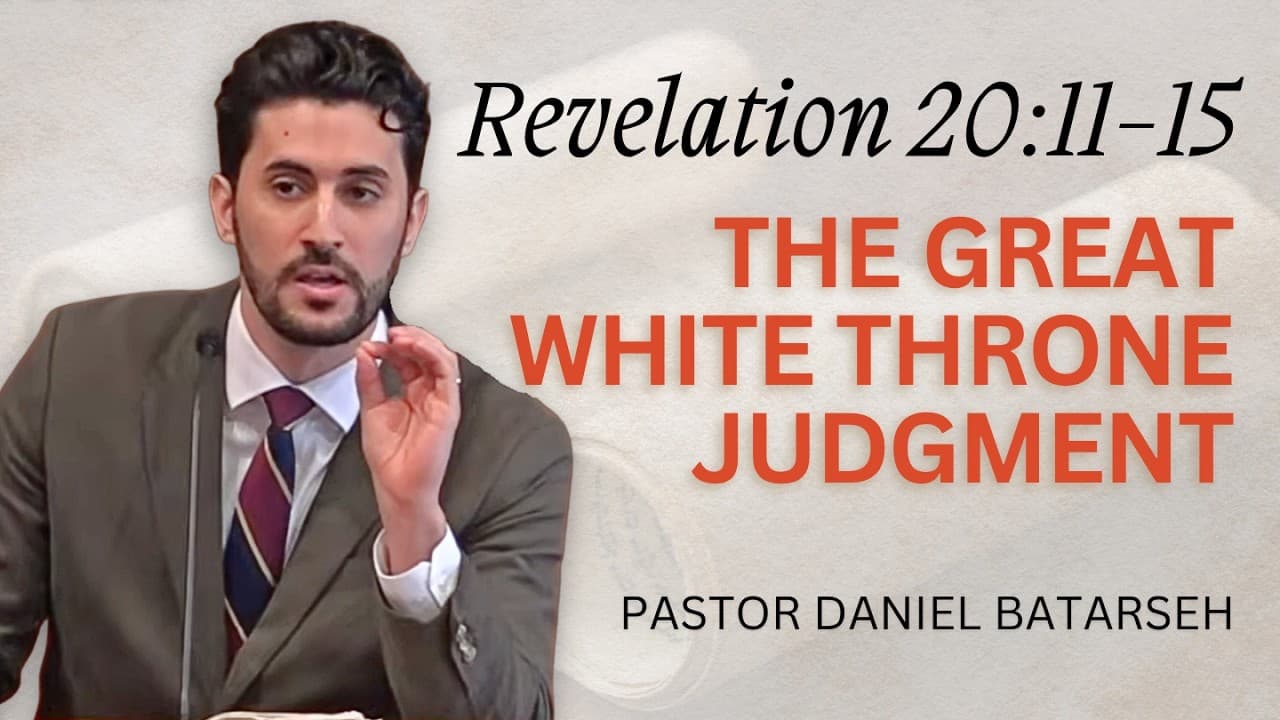
Revelation 20:11-15 describes the final courtroom in the universe — where heaven and earth flee, the dead stand before God, and only one thing determines your fate.
There is a courtroom coming from which nothing in the created order can hide. Not the earth. Not the sky. Not the dead. Revelation 20:11–15 describes the last judgment in human history — the Great White Throne — and its verdict is absolute. No appeals. No mitigating circumstances. No second hearing. The books are opened, and every person who has ever lived outside the covering of Christ stands exposed before the God whose face makes heaven and earth flee.
This is not metaphor. This is not poetry reaching for dramatic effect. This is the culmination of everything Scripture has been building toward — the moment when God's patience, which Peter says some mistake for slowness, reaches its appointed end.
Heaven and Earth Have Nowhere to Run
John writes it plainly: "Then I saw a great white throne and him who was seated on it. From his presence earth and sky fled away, and no place was found for them" (Revelation 20:11). Stop and feel the weight of that sentence. The earth — the planet you're sitting on right now, the ground beneath every empire, every cathedral, every grave — runs from the presence of the One on the throne. And it finds no place to hide.
Pastor Daniel Batarseh drew attention to this staggering detail during his teaching through this passage: "The sky itself will disappear" (watch at 0:00). He let that statement sit. No rushing past it. The physical universe — everything we consider permanent, solid, reliable — dissolves before the holiness of the Judge. If creation itself cannot endure his gaze, what makes us think we can stroll into that courtroom on our own merits?
The throne is white because the Judge is pure. Every ruling is righteous. There is no corruption in this court, no technicalities to exploit, no clever lawyer who can find a loophole in the law of God. White speaks of holiness so total that it exposes everything it touches. And it is great — not merely large, but supreme, final, and utterly without rival.
This is the throne that every other throne in history has been a shadow of. Every human judge who ever banged a gavel was borrowing authority from this seat. And now the original takes its place.
The Dead Stand — Every Single One
"And I saw the dead, great and small, standing before the throne, and books were opened" (Revelation 20:12).
Great and small. Emperors and peasants. The famous and the forgotten. The powerful and the powerless. Death, which so many treat as the final escape — the ultimate way to avoid accountability — turns out to be nothing of the sort. The sea gives up its dead. Death and Hades give up their dead. Every human being who died without Christ is summoned to stand.
Notice they are standing. Not sitting. Not reclining. Standing — the posture of a defendant before a judge. And the books are opened.
What books? The record of every deed. Every thought. Every word spoken in secret. Every motive buried so deep you forgot it yourself. Jesus warned in Matthew 12:36 that people will give account for every careless word they speak. Not just the cruel words. Not just the blasphemous words. The careless ones. The ones you didn't think mattered. They were being recorded.
This is the moment that should make every honest person tremble. Because if you are judged by your works — by the exhaustive, unedited record of your life — you will not survive the verdict. No one will. Romans 3:23 is not a suggestion. It is a diagnosis. All have sinned. All fall short. The books confirm what God already knows and what we spend our lives trying to deny: we are guilty.
The Other Book — The One That Changes Everything
But John mentions another book. Not the books of deeds — the Book of Life.
"And another book was opened, which is the book of life. And the dead were judged by what was written in the books, according to what they had done" (Revelation 20:12).
Here is the hinge of eternity. There are two sets of records in that courtroom. The books of works condemn everyone. But the Book of Life — the Lamb's Book of Life, as Revelation 13:8 calls it — contains the names of those who belong to Jesus Christ. If your name is written there, the verdict of the books of works does not determine your destiny. Christ's work does.
This is the gospel in its most terrifying and most beautiful light. Terrifying because it means there are people whose names are not in that book. Beautiful because it means there is a book at all — that God, in his mercy, made a way for guilty people to be declared righteous. Not by their performance. Not by their sincerity. Not by their religious effort. By the blood of the Lamb who was slain before the foundation of the world.
The Great White Throne is not where believers go to find out if they made the cut. Romans 8:1 has already settled that: "There is therefore now no condemnation for those who are in Christ Jesus." The Great White Throne is the final demonstration that apart from Christ, no human being can stand before God and survive. It is the courtroom that proves the cross was not optional. It was the only way.
The Lake of Fire Is Not a Metaphor for Disappointment
"Then Death and Hades were thrown into the lake of fire. This is the second death, the lake of fire. And if anyone's name was not found written in the book of life, he was thrown into the lake of fire" (Revelation 20:14–15).
We live in a culture that has made peace with almost every doctrine in Christianity except this one. We will accept a God of love. A God of justice, even — as long as justice means rehabilitation, not punishment. But a lake of fire? Eternal, conscious separation from God? The modern mind recoils.
But the text does not flinch. And neither should we — not because we delight in judgment, but because we take God at his word. The second death is not annihilation. It is not a temporary correction. It is final, irreversible, and devastating beyond anything human language can capture. The fact that Death itself — the last enemy, as 1 Corinthians 15:26 calls it — gets thrown into the lake of fire tells you something about the totality of God's victory. Even death dies. But those whose names are absent from the Book of Life share death's destination.
This is why the gospel is urgent. Not interesting. Not helpful. Urgent. Every funeral you attend, every news headline about tragedy, every quiet moment when you sense the fragility of your own life — these are all signposts pointing to a throne that is coming. And the question is not whether you will stand before God. The question is whether your name is in the book.
A Baby, a Name, and the God Who Is With Us
What struck me during this service was the juxtaposition that Pastor Daniel Batarseh allowed to unfold without forcing it. Before teaching on the most sobering passage in all of Scripture — the final judgment of the dead — he held a baby.
The child's name was Emmanuel. God with us.
As he held that infant before the congregation, he prayed that this boy would "live up to that name and that wherever he goes, people would sense God" (watch at 1:07). He asked the parents whether they would commit to showing Emmanuel "what it means to follow Jesus Christ" through their own lives and through intentional teaching of the Scriptures (hear this moment).
Think about that. A baby named "God with us" — dedicated to the Lord in a room that was about to hear about the judgment of those who lived as though God were not with them. The tenderness of that moment and the terror of the passage that followed were not contradictions. They were the same truth seen from two angles. God is with us in mercy now so that we do not face him in judgment later. The dedication of a child and the Great White Throne are both about the same thing: the inescapable reality of God.
Every parent who teaches their child the Scriptures is doing something with eternal consequences. Every prayer over a newborn is an act of war against the second death. The stakes are not abstract. They are as concrete as a baby's name.
The Friday Connection: Nehemiah and the Weight of God's Word
Pastor Daniel Batarseh also pointed the congregation toward the church's ongoing Friday study through Nehemiah, noting that the Old Testament is not a relic to be intimidated by but a living word that speaks to "our own walk with Christ" (watch at 0:00). This matters more than it might seem. Nehemiah is a book about rebuilding — about a people who returned from exile and had to reconstruct not just walls but their identity before God. The connection to Revelation 20 is this: Nehemiah's generation had to reckon with whether they would live as God's covenant people or drift back into the patterns that sent them into exile in the first place.
The Great White Throne is the ultimate end of all drifting. It is where every exile becomes permanent. And the Scriptures — Old and New — are the voice of God calling people back before it is too late.
What to Remember
- The Great White Throne Judgment in Revelation 20:11-15 is the final, irreversible verdict on every person who died outside of Christ — no appeals, no second chances, no exceptions.
- Creation itself flees from the presence of the Judge — if the earth and sky cannot endure his holiness, no human being can survive that courtroom on their own merit.
- Two sets of books are opened: the books of deeds, which condemn everyone, and the Book of Life, which contains the names of those covered by the blood of Christ. Your destiny depends on which book defines you.
- The lake of fire is not metaphor, not rehabilitation, and not temporary — it is the second death, and even Death itself is thrown into it.
- Every act of teaching a child the Scriptures, every prayer over a newborn, every moment of pointing someone to Christ is an act of eternal significance — because the throne is coming and the books will be opened.
- The gospel is not merely comforting — it is urgent. The Great White Throne proves the cross was not optional; it was the only escape from a verdict no one can overturn.
Questions to Sit With
- If you stood before the Great White Throne tonight and the books of your deeds were opened — every thought, every motive, every word — would you want to be judged by that record? If not, have you truly trusted the One whose Book of Life is your only hope?
- Do you live with the urgency that this passage demands — or have you made peace with the idea that the people you love who don't know Christ will somehow be fine?
- What would change about the way you raise your children, speak to your neighbors, or spend your weekends if you genuinely believed that a final, irreversible judgment is coming?
- Is there a part of you that wants to soften this passage — to make the lake of fire metaphorical, to assume God will make exceptions? What does that impulse reveal about your view of God's holiness?
- Emmanuel means "God with us." Is God with you as Savior now — or will you meet him only as Judge later?
Scripture Referenced
This summary was generated by AI from the sermon "The Great White Throne Judgment | Revelation 20:11-15 | Pastor Daniel Batarseh (9/27/26)" preached by Pastor Daniel Batarseh at Maranatha Bible Church Chicago. Watch the full sermon →
Preached by
Pastor Daniel BatarsehSenior Pastor
This summary was generated by AI from the sermon transcript.
Based on the sermon
The Great White Throne Judgment | Revelation 20:11-15 | Pastor Daniel Batarseh (9/27/26)
Watch Full SermonRelated Articles
What Revelation 21 Says About Heaven That You've Never Noticed
Pastor Daniel Batarseh · October 11, 2026
What Revelation 21 Says About Eternity (It's Not What You Picture)
Pastor Daniel Batarseh · October 11, 2026
Hebrews 9 and Why Christ's Second Coming Isn't About Sin
Pastor Daniel Batarseh · October 4, 2026