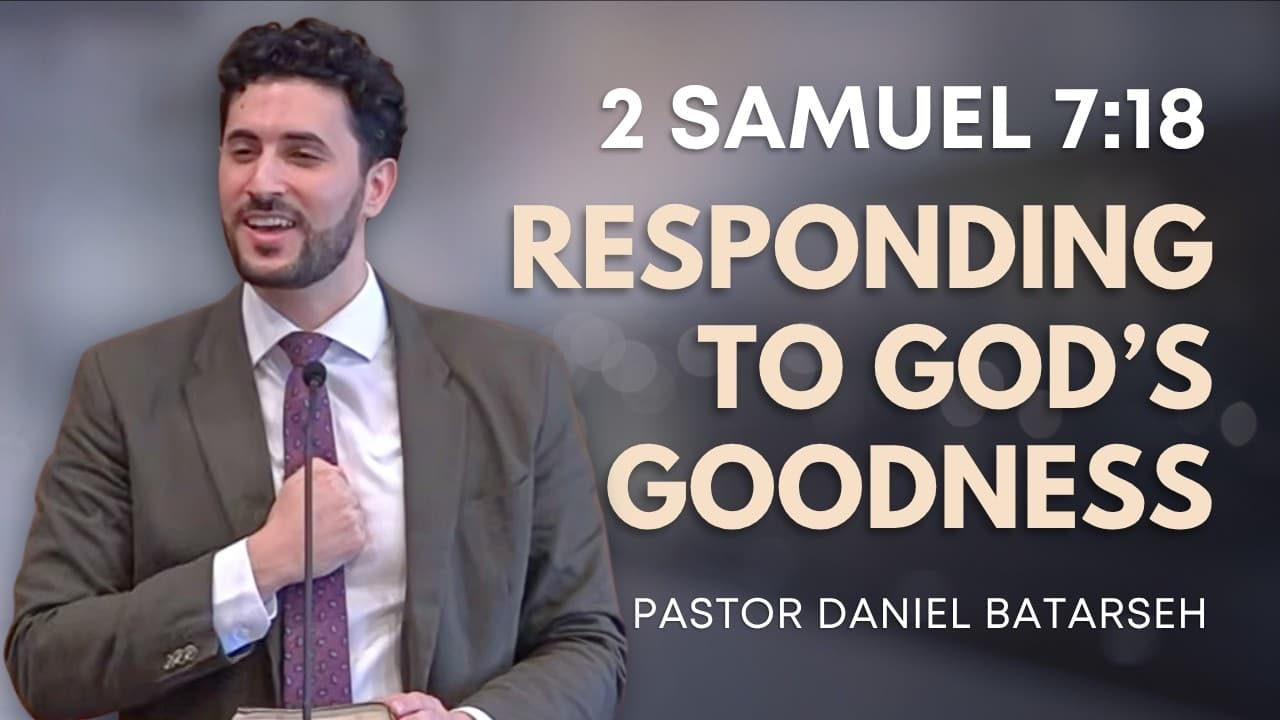
David's prayer in 2 Samuel 7:18 isn't just ancient poetry — it's a mirror that exposes how poorly most of us respond when God actually blesses us.
Success has a reputation for expelling our thoughts of God — not exalting them.
That single observation, dropped midway through Pastor Daniel Batarseh's final sermon at Maranatha Bible Church's longtime meeting place, landed like a stone in still water. It names a truth most of us feel but rarely confess: the very blessings we beg God for are often the things that pull us away from Him once they arrive. 2 Samuel 7:18 captures a man who broke that pattern. King David, at the absolute peak of his career — enemies defeated, nation united, palace built — did the one thing almost nobody does at the summit. He sat down, stayed put, and worshiped.
This wasn't a quick thank-you prayer before moving on to the next agenda item. It was a sustained, deliberate act of lingering in God's presence, and it reveals three things that blessing should always produce in us.
The Posture Nobody Expects from a King at His Peak
The setup matters. 2 Samuel 7 opens with David enjoying rest from every enemy. He's loved by his people. He's feared by his adversaries. He's living in a cedar palace. And what occupies his mind in that moment isn't expansion plans or legacy projects — it's the fact that God's ark is sitting in a tent while he sleeps under a magnificent roof.
That detail alone is a rebuke. David's first instinct at the height of prosperity was concern for God's glory, not his own comfort. He wanted to build God a house. He lost sleep over it — Psalm 132 tells us he couldn't rest until he found a dwelling place for the Lord. This wasn't a passing thought. It had been marinating in his heart for a long time.
But God said no. Through the prophet Nathan, the Lord flipped the script entirely: David wouldn't build God a house. God would build David a house — a dynasty, a covenant, an eternal kingdom that would culminate in the Messiah Himself.
And here's where most of us would stumble. David had poured his heart into a plan for God's glory, and God rejected it. The prayer in verse 18 could have opened with protest. It could have carried a whiff of disappointment, a negotiation, a subtle "but Lord, I had something better in mind." Instead, David went in, sat before the Lord, and stayed (watch this moment).
Sitting and praying is not a common posture in Scripture. Standing, kneeling, prostrating — those are everywhere. But sitting communicates something specific: I intend to stay. When a guest in your home stands up, even while still talking, they're signaling departure. David did the opposite. He settled in. He lingered. He treated God's unexpected blessing not as a transaction to acknowledge and move past, but as an invitation into deeper fellowship with the One who gave it.
This is the first thing blessing should do: bring you to the Blesser Himself. Every gift from God is an invitation to draw closer to the Giver. David understood that instinctively. The question is whether we do.
We all know that affliction has a way of sobering us. Pain sharpens our prayers. Suffering clarifies what matters. But David shows us that blessing can do the same thing — if we let it. The problem is that we rarely let it. We take the gift and run. We thank God quickly and get back to the logistics, the planning, the next thing. David refused to do that, and so should we.
"Who Am I?" — The Question That Keeps You Low
The second movement of David's prayer cuts even deeper. Look at his opening words: "Who am I, O Lord God, and what is my house, that you have brought me thus far?"
This is not false humility. This is a king — the narrator calls him "King David" in the same verse — who refuses to flex his title in the presence of God. Notice the contrast: the narrator says "King David," but David calls himself simply "David." And then, ten times in this single prayer, he refers to himself as God's servant. Not king. Servant. (watch at 1:00:10)
As Pastor Daniel Batarseh put it: "Was David a king? Sure. But he understood that there was a king above him, and he dared not flex his title in the presence of God. Others can call him king, and he was a king, but in this moment, he understood — I'm just David. I'm no one special" (hear this moment).
There's a striking connection here that most readers miss. In Psalm 86:16, David prays, "Give your strength to your servant, and save the son of your maidservant." That word — maidservant — is the only thing Scripture tells us about David's mother. She was a servant of the Lord. We don't know her name. We don't know her story. She likely served God faithfully in obscurity, raising children in a small town. And David, the famous king, the renowned psalmist, the feared warrior, essentially says: I am no better than my lowly mother. No matter my gifts, no matter who praises me, I share equal status before God with the most obscure, faithful servant in my family.
That's what real humility looks like when blessing arrives. It doesn't say, "I earned this." It doesn't even say, "I'm grateful for this." It says, "Who am I that You would do this?"
The warning from Deuteronomy 8:17-18 makes this concrete and uncomfortable: "Beware lest you say in your heart, 'My power and the might of my hand have gotten me this wealth.'" Notice — God doesn't say beware what you say with your mouth. He says beware what you say in your heart. The pride that destroys doesn't start with a public boast. It starts with a private whisper: I had something to do with this. My talent. My effort. My strategy. And God says, sound the alarm while it's still hidden, before it reaches your lips, before it becomes what Nebuchadnezzar said standing on his palace roof — "Is not this great Babylon, which I have built?" — and God humbled him in terrifying fashion (watch at 1:04:06).
The antidote is David's question: Who am I? And if you really want to answer that honestly, compare yourself to God — not to the person next to you. Live in the light of His presence, and the math becomes very clear very fast. Without Christ, we are wicked, vile, incapable of standing before a holy God if He were to count our iniquities. And yet He doesn't just allow us to stand — He hands us a covenant, a blessing, a kingdom.
Paul understood this. Standing before King Agrippa, falsely accused, facing execution, he said something easy to miss: "To this day I have had the help that comes from God" (Acts 26:22). Unashamed. Unambiguous. Every breath, every open door, every preserved life — from God's hand, not his own.
When God's Blessing Doesn't Match Your Blueprint
Here's where the sermon pressed hardest into real life. David wanted to build God a temple. God said no. Then God gave David something far greater — an eternal dynasty. And David's response contained not a single syllable of complaint.
Think about how unnatural that is. David had a God-honoring desire. He wasn't asking for wealth or fame — he wanted to build something magnificent for the Lord's glory. And God still said no. The prayer in verses 18-29 could have opened with, "Lord, I appreciate the covenant, but can we trade? I really had my heart set on the temple." Instead, David responded with gratitude, not grumbling. There isn't a shred of irritation. There isn't any hint of discontentment.
As Batarseh said plainly: "The willingness to genuinely worship the Lord's sovereignty in the face of His denials is one of the truest marks of a man or woman of God" (hear this moment).
Why could David do this? Two reasons emerge from the text.
First, he knew his place. Verse 27-28 makes the contrast explicit: "Your servant... you are God." That's it. That's the entire theology of contentment in six words. I'm the servant. You're God. Whatever You providentially make clear for me, I will gladly accept. The reason we get upset with how God chooses to bless us, if we're honest, is because somewhere deep down we think He's our servant — that He should give the way we think He should give, on our timeline, matching our specifications. David never made that mistake.
Second, David trusted that God knew him better than he knew himself. Verse 20: "For you know your servant, O Lord God." The implication is breathtaking: God gives the perfect gift — not too heavy that it would crush you, not too light that you wouldn't sense His thoughtfulness. He knows exactly what you need, exactly what you can handle, exactly what will bless you and be used to bless others.
David didn't have all the answers at this point. He didn't yet know why God refused his temple-building plan. That explanation came later — his hands were stained with blood, and God wanted a man of peace to build His house. But with what he knew in the moment, David still worshiped. He still thanked. He still honored.
That's the hardest kind of faith: trusting God's no before you understand His reasons.
The Saul Contrast That Changes Everything
One of the most illuminating threads running through this teaching was the comparison between David and his predecessor. Saul was consumed with protecting his dynasty, securing his throne, seizing power — at the expense of obeying God. He made his throne an idol. And the result? He lost his kingdom.
David, at the height of success, was consumed with God's honor and reputation. And what did God give him? A kingdom that would last forever.
The pattern is devastating in its clarity. Grip your blessings with clenched fists and they'll be pried from your hands. Hold them loosely, eyes fixed on the Giver, and He entrusts you with more than you ever asked for. Saul chased a temporary throne and lost everything. David chased God's glory and received an eternal covenant.
The same dynamic plays out in Luke 17, when Jesus healed ten lepers and only one returned to give thanks. "Were not ten cleansed? Where are the nine?" Jesus asked. The Lord is mindful of who He blesses — and He is equally mindful of how they respond. Nine men received the gift and kept walking. One came back to the Giver. David was that one.
The question for every one of us is simple: When God blesses you — with a job, a spouse, a child, a ministry, a provision you didn't expect — are you the one who returns, or are you among the nine?
What to Remember
- Every blessing from God is an invitation into deeper fellowship with Him — take the gift, but sit at the Giver's feet before you move on.
- The pride that destroys you doesn't start with a public boast; it starts with a private whisper in your heart that says, "My effort produced this."
- When God says no to your God-honoring plan and gives you something different, trust that He knows you better than you know yourself.
- David called himself God's servant ten times in one prayer — your title means nothing in the presence of the One who gave it to you.
- The person who grips their blessings with clenched fists loses them; the person who holds them loosely with eyes on the Giver receives an eternal inheritance.
- Faithfulness in the test is your only responsibility; God already has all the answers (John 6:6).
Questions to Sit With
- When was the last time a blessing from God actually drew you closer to Him — rather than distracting you from Him?
- If you searched your heart honestly, is there any area of your life where you privately believe your success is because of your own effort rather than God's power?
- Is there a "no" from God that you're still quietly resenting — a prayer He answered differently than you wanted? What would it look like to respond like David instead?
- David lost sleep over God's glory. What keeps you up at night — and what does that reveal about what truly occupies your soul?
- If God knows you better than you know yourself, what blessing might He be withholding right now precisely because He loves you?
Scripture Referenced
- 2 Samuel 7:1-29 (primary text)
- Isaiah 11:1-16
- Isaiah 12:1-6
- John 6:5-6
- Luke 17:17-18
- Psalm 86:16
- Deuteronomy 8:17-18
- Acts 26:22
This summary was generated by AI from the sermon "Responding to God's Goodness | 2 Samuel 7:18 | Pastor Daniel Batarseh (5/24/26)" preached by Pastor Daniel Batarseh at Maranatha Bible Church Chicago. Watch the full sermon →
Preached by
Pastor Daniel BatarsehSenior Pastor
This summary was generated by AI from the sermon transcript.
Based on the sermon