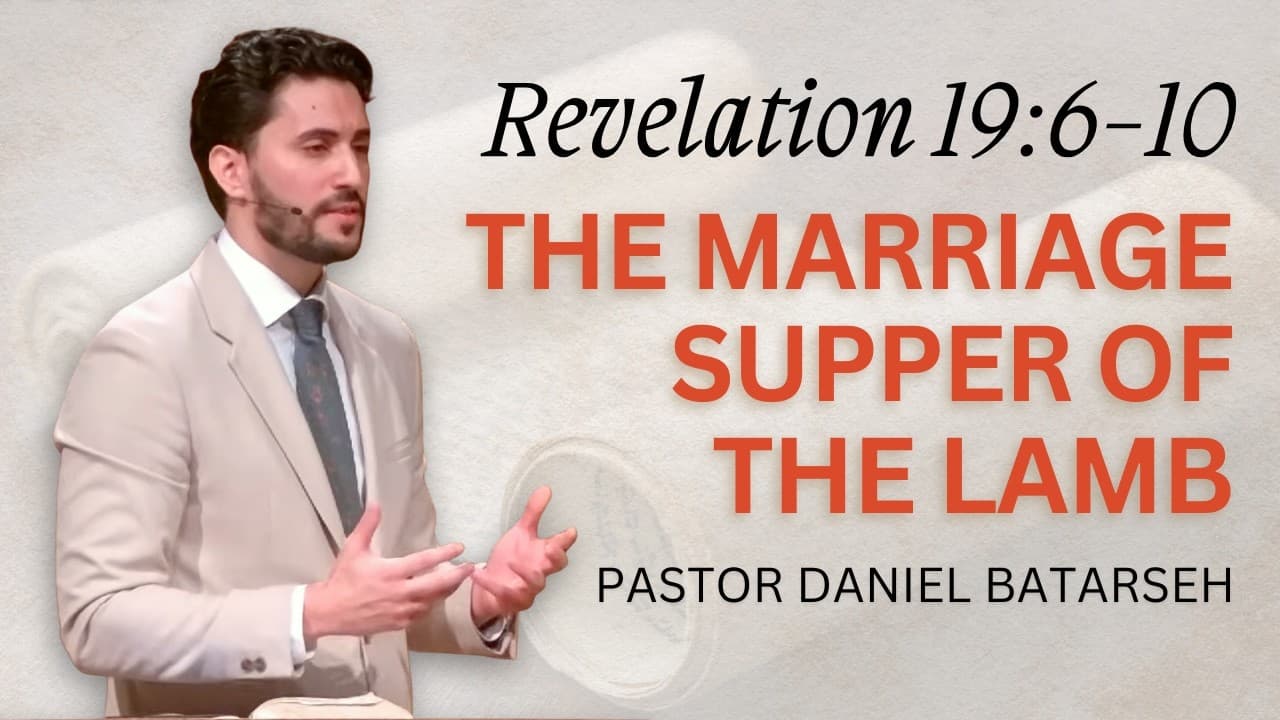
The loudest hallelujah in Revelation is reserved for one event — and most Christians can't explain what it actually is. Revelation 19:6-10 reveals a wedding that changes everything.
Most Christians have heard of the Marriage Supper of the Lamb. Ask them what it is, and you'll get something like: "It has to do with Jesus coming back, and there's a dinner." Maybe a lighthearted debate about the menu. But the conversation rarely goes deeper than that — which is a tragedy, because Revelation 19:6-10 reveals that this event is so staggering that it draws the loudest, most emphatic hallelujah in all of Scripture. Not the judgment of Babylon. Not the vindication of the martyrs. The thing that makes heaven roar like thunder is a wedding.
And the question that should keep every one of us awake is not "What will be served at the feast?" but "Am I getting ready for it?"
The Loudest Hallelujah Is Reserved for This
Four times in Revelation 19, the word "hallelujah" appears — its only occurrences in the entire New Testament. Each one celebrates a different facet of God's triumph. But the fourth hallelujah is different. It's climactic. John describes it this way: "Then I heard what seemed to be the voice of a great multitude, like the roar of many waters and like the sound of mighty peals of thunder, crying out, 'Hallelujah! For the Lord our God the Almighty reigns'" (watch at 37:13).
The earlier hallelujahs had a great multitude. This one adds the roar of many waters and mighty peals of thunder. The volume is increasing. The intensity is building. Everything has been leading to this moment — and what triggers it is not a battle won or an enemy destroyed. It's a marriage.
"Let us rejoice and exult and give him the glory, for the marriage of the Lamb has come, and his Bride has made herself ready" (Revelation 19:7).
Why does this truth get the strongest praise in heaven? Because throughout all of Scripture — from Genesis to Revelation — the imagery of marriage is used to describe the deepest thing God offers: covenant relationship. Not distant sovereignty. Not abstract theology. Personal, intimate, permanent union. As Pastor Daniel Batarseh put it: "We are united with God and it is marked by experiential love, protection, provision, and commitment. And this reality that we get to taste on a daily basis will be even more fully known when we meet Christ face to face. That is what this loudest, strongest, most emphatic hallelujah is reserved for" (hear this moment).
And here's something worth noticing: the very last reference to the church in the entire Bible is not as a body, not as a temple, not as a flock. It's as a bride. Revelation 22:17 reads: "The Spirit and the Bride say, 'Come.'" As history closes, as every promise finds its fulfillment, the one identity that remains is relational. The bride calling for her bridegroom. That's the final word.
The Shulamite Woman and the Question You Have to Answer
One of the most striking moments in this sermon was an unexpected detour into Song of Solomon — a book most churches skip past with mild embarrassment. But the connection was electric.
The woman in that love poem is a working-class laborer. Her skin is darkened by the sun. She tends vineyards. She and King Solomon are on opposite ends of the social spectrum. And yet the king pursues her with everything he has. She responds — not with excitement about the wealth she'll inherit, the fame she'll receive, or the palace she'll live in. She never once gushes about what marriage to a king will get her.
All she talks about is him. His beauty. His presence. His character. "I am my beloved's, and my beloved is mine." For this woman, the benefit of being married to the king is being with the king. Nothing more. Nothing less.
That illustration landed like a weight in the room, because it forced an honest question: What is the most meaningful thing to you about being a follower of Jesus Christ? Not what should be — what is? If someone asked you what you're looking forward to most about heaven, could you honestly say, "Unbroken fellowship with my King forever"? Or would the honest answer be something else — relief from suffering, reunion with loved ones, the absence of pain?
Those things are real and good. But they aren't the main thing. The main thing is Him. And the marriage of the Lamb tells us that this is what all of history is driving toward — not just rescue from something, but union with Someone.
You're Engaged, Not Married — And Paul Wants You to Know the Difference
Here's a truth that surprises many believers: you are not yet married to Christ. You are betrothed.
The apostle Paul makes this explicit in 2 Corinthians 11:1-2: "I betrothed you to one husband, to present you as a pure virgin to Christ" (watch at 57:14). The language is deliberate. When Paul preached the gospel to the Corinthians and they believed, they didn't enter into the fullness of marriage with Christ — they entered into engagement. Official, covenantal, real — but not yet consummated. There is still a wedding to come.
This distinction matters enormously. It means the relationship you have with Christ right now is genuine but incomplete. You know Him, but you see through a mirror dimly. You love Him, but you haven't yet seen Him face to face. The fullness is coming. And in the meantime, Paul sees himself as a spiritual guardian with one overriding responsibility: to protect the moral purity and doctrinal faithfulness of God's people until they are presented blameless before their bridegroom.
Every true pastor, every true elder carries this weight. Not just helping people navigate Monday through Saturday — but preparing them for eternity. "How can I preach, how can I exemplify, how can I correct, how can I encourage and get the people of God more ready to meet Christ?" (hear this moment). That's the heartbeat of faithful ministry.
And the implication for every engaged believer is sobering: don't cheat on Jesus. Not with false teaching. Not with a counterfeit gospel. Not with a comfortable version of Christ that makes no demands on your life. You have a ring on your finger. Act like it.
The Ceremony and the Reception — When Does This Actually Happen?
The timing of the marriage of the Lamb is hotly debated among faithful Christians, and the sermon handled this with refreshing honesty rather than dogmatic certainty. The two major views are straightforward: either the marriage takes place at the second coming of Christ, or it takes place before it — which requires a belief in the rapture as a distinct event preceding Christ's bodily return to earth.
The textual argument presented was compelling. In Revelation 19:8, the bride is clothed in "fine linen, bright and pure." Then in verses 11-14, when Christ descends from heaven on a white horse, the armies following Him are described in the same language: "arrayed in fine linen, white and pure." If these are the same group — and the matching description strongly suggests they are — then the bride is already with Christ in heaven before He returns to earth. She's descending with Him in her wedding garments. How did she get there if she wasn't caught up to Him beforehand?
But this was presented as a serious case to consider, not an ultimatum. Others argue the armies are angels, or that believers are caught up to Christ in the air at the very moment of His return — the rapture and second coming as a single event. The honest admission was welcome: "When Paul speaks about seeing through a mirror dimly, to me that truth becomes more real when you have this kind of conversation."
What nearly everyone agrees on, however, is this: the celebration of the marriage continues on earth when Christ establishes His kingdom. And Isaiah 25:6-8 paints the picture: "On this mountain the Lord of hosts will make for all peoples a feast of rich food, a feast of well-aged wine... He will swallow up death forever, and the Lord God will wipe away tears from all faces" (watch at 68:34).
How do we know Isaiah is describing the same event? Because Paul quotes this exact passage in 1 Corinthians 15:54 and tells us it will be fulfilled when we are resurrected. "Death is swallowed up in victory" — that's Isaiah 25, and Paul says it happens when the perishable puts on the imperishable.
So here's the framework: the marriage of the Lamb — the ceremony — is the initial union with Christ, whether in heaven or in the air. The marriage supper of the Lamb — the reception — is the ongoing feast on earth when Christ reigns forever. It's been a long engagement. The reception will match.
The Bride Who Didn't Bother Getting Ready
The most convicting moment of this sermon wasn't theological — it was practical. Revelation 19:7 says the bride "made herself ready." Verse 8 explains that her fine linen represents "the righteous deeds of the saints." And yet verse 8 also says this readiness "was granted her" — it's sourced in grace, not earned by effort.
This is the beautiful tension of the Christian life. The bride's beauty is a gift from God. Heaven gives Him the glory for her readiness. And yet she responds to that grace with action. She prepares. She anticipates. She gets ready.
The illustration that drove this home was devastatingly simple: imagine a young woman who is engaged to be married, and she has done absolutely nothing to prepare for the wedding. No thought about the dress. No planning. No anticipation. What would you conclude? Either she doesn't believe she's actually getting married, or her love for her fiancé is suspect.
As Pastor Daniel Batarseh pressed the point: "How much do you think about that union with Christ? When's the last time you thought, 'There is a day coming where I will come face to face with the Lord Jesus Christ'? Come on. We're Christians here. This is a core tenet of our faith" (watch at 1:21:46).
1 John 3:3 says that whoever has this hope in Christ "purifies himself as he is pure." And John himself warns that it is entirely possible for a genuine Christian to be ashamed at the appearing of Jesus Christ — in the same way a bride would be mortified showing up to her wedding completely unprepared.
The encouragement, though, is just as real: "The Spirit and the Bride say, 'Come.'" If you can't manufacture excitement about the return of Christ, the Holy Spirit will help you. That's His job. That's what He does. But you have to want it. You have to ask.
Even John Almost Missed the Point
The passage ends with a startling failure. John — the beloved disciple, the aged apostle, the man who leaned on Jesus' chest — falls down to worship the angel who delivered this vision. A man in his nineties, still battling idolatry. Still tempted to give his devotion to something lesser than God.
The angel's rebuke is swift: "You must not do that. I am a fellow servant with you... Worship God."
And then this piercing statement: "For the testimony of Jesus is the spirit of prophecy" (Revelation 19:10). Every Old Testament prophecy, every New Testament teaching — it's all about Jesus. If you study Revelation for hours and it doesn't lead you to worship Christ more deeply, you've missed the entire point. Charts are fine. Timelines have their place. But if they don't produce adoration, what are you doing?
This is the warning for every serious Bible student: you can make an idol of good things. Of knowledge. Of a teacher. Of the study itself. The angel — a glorious heavenly being — said to John, "I'm a servant just like you." How much more should we be careful about elevating flesh and blood?
What to Remember
- The loudest hallelujah in heaven is not for judgment executed but for a wedding — the permanent, perfect union of Christ and His people.
- You are currently betrothed to Christ, not yet married. The engagement is real, but the consummation is coming — and faithfulness during the engagement matters.
- The marriage is called "of the Lamb" deliberately — the sacrifice of Jesus is what makes this relationship possible. He pursued you to the point of death to have you.
- Grace and readiness are not in tension: God grants the bride her beauty, and she responds by preparing herself with righteous living. Both are true simultaneously.
- If studying Bible prophecy doesn't lead to greater worship of Jesus Christ, you've missed the testimony of Jesus that is the spirit of all prophecy.
- A Christian who never thinks about meeting Christ face to face either doesn't believe it's real or has a love problem that only the Holy Spirit can fix.
Questions to Sit With
- If someone asked you today, "What are you most looking forward to about heaven?" — would your honest answer be Christ Himself, or something He provides? What does the difference reveal?
- What does it look like, practically, for an engaged bride to "make herself ready"? What are you doing this week that reflects anticipation of meeting Jesus face to face?
- Paul told the Corinthians not to cheat on Jesus with false teaching or a counterfeit Christ. Is there any teaching, habit, or affection in your life right now that functions like infidelity toward your bridegroom?
- John — a ninety-year-old apostle who had walked with Jesus — still fell into idolatry in a moment of spiritual ecstasy. What does that tell you about your own vulnerability, especially in seasons of spiritual growth?
- The Spirit and the Bride say, "Come." Is that cry present in your heart right now? If not, have you asked the Spirit to awaken it?
Scripture Referenced
- Revelation 19:6-10 (primary passage)
- Revelation 19:11-14
- Revelation 22:17
- Revelation 7:14
- 2 Corinthians 11:1-2
- Isaiah 25:6-8
- 1 Corinthians 15:51-57
- 1 Corinthians 14:6
- 1 Peter 2:1-12
- 1 John 3:3
- John 14:1-3
- Song of Solomon
This summary was generated by AI from the sermon "The Marriage Supper of the Lamb | Revelation 19:6-10 | Pastor Daniel Batarseh (7/26/26)" preached by Pastor Daniel Batarseh at Maranatha Bible Church Chicago. Watch the full sermon →
Preached by
Pastor Daniel BatarsehSenior Pastor
This summary was generated by AI from the sermon transcript.
Based on the sermon
The Marriage Supper of the Lamb | Revelation 19:6-10 | Pastor Daniel Batarseh (7/26/26)
Watch Full SermonRelated Articles
What Revelation 21 Says About Heaven That You've Never Noticed
Pastor Daniel Batarseh · October 11, 2026
What Revelation 21 Says About Eternity (It's Not What You Picture)
Pastor Daniel Batarseh · October 11, 2026
Hebrews 9 and Why Christ's Second Coming Isn't About Sin
Pastor Daniel Batarseh · October 4, 2026