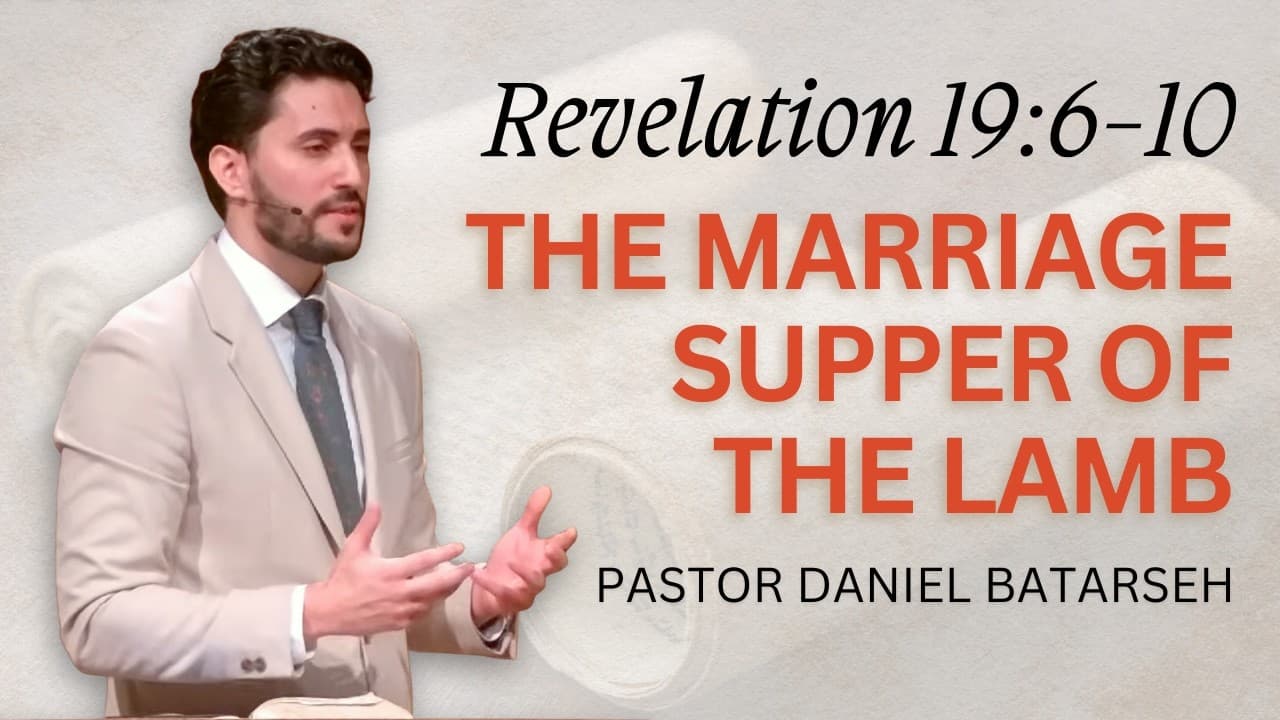
The strongest hallelujah in all of Revelation is reserved for one event: the marriage of the Lamb. Most Christians know there's a wedding and a dinner — but miss the truth that should shake us awake.
The loudest worship in the entire book of Revelation — the most thunderous, most emphatic hallelujah recorded in all of Scripture — is not reserved for the fall of Babylon. Not for the final judgment on evil. Not even for the vindication of the martyrs. It is reserved for a wedding.
The marriage supper of the Lamb is one of those doctrines most Christians can name but few can explain. Ask the average believer what it is, and you'll get something like: It has to do with Jesus coming back, and there's a big dinner. Maybe a lighthearted comment about what's on the menu. But the conversation rarely goes deeper than that — and that's a tragedy, because Revelation 19:6-10 is the most detailed passage in the Bible about this future event, and what it reveals should change the way you live this Monday morning.
Here is the core of it: the marriage of the Lamb is the moment when Christ and His people will be united in perfect, permanent, unbroken fellowship — face to face, with nothing between. And the fact that heaven's loudest praise is aimed at this truth tells us something about what the Holy Spirit wants us to be most excited about.
The Loudest Hallelujah Is Not About Judgment — It's About Intimacy
Four hallelujahs appear in Revelation 19. Each one responds to a different aspect of Christ's return. But when you read them side by side, you notice that the final hallelujah is different. It's not just louder — it's layered. John describes it as "the voice of a great multitude, like the roar of many waters and like the sound of mighty peals of thunder" (watch at 37:13). The earlier hallelujahs had the great multitude, but this one piles image on image — ocean roar, thunder crash — as if language itself is straining under the weight of what heaven is celebrating.
And what is heaven celebrating? Not the destruction of enemies. Not the display of raw power. The text tells us plainly: "For the marriage of the Lamb has come, and his bride has made herself ready."
This is intentional. It's as though all the worship in heaven has been building toward this single crescendo, and the crescendo is relational. The pinnacle of heavenly praise is aimed at the truth that God's people will finally be with God — not at arm's length, not through a mirror dimly, but in the fullness of covenant love.
Think about the different ways the church is described throughout the Bible: the temple of the Holy Spirit, the body of Christ, a pillar and buttress of the truth, the flock of God. But consider the last reference to the church in the entire Bible. In Revelation 22:17, as the canon of Scripture draws to its final breath, the church is called the bride: "The Spirit and the bride say, 'Come.'" As Pastor Daniel Batarseh put it: "As history draws to a close, the work is complete, all the promises are fulfilled, judgment is done — the one thing that remains is relational intimacy and fellowship with God. That is what all of this is leading to" (hear this moment).
That is the heartbeat of the entire Bible. Not information. Not obligation. Union.
The Shulamite Woman and the Question You Have to Answer
One of the most striking moments in the sermon came from an unlikely source: the Song of Solomon. That strange little book of love poetry that most of us skip or blush through. But there's a detail in it that cuts right to the heart of what the marriage of the Lamb demands of us.
The woman in the Song of Solomon — the Shulamite — is everything Solomon is not, socially speaking. He was born into royalty, raised in a palace. She describes herself as a working-class woman, skin darkened by the sun because she labors outdoors in the vineyards day after day. They're on opposite ends of the social spectrum. And yet Solomon pursues her with everything he has.
Here's what's remarkable: this woman, who stands to inherit unimaginable wealth and status by marrying the king, never once talks about what she'll receive. Not the palace. Not the crown. Not the fame. The sole object of her delight is the king himself. She can't stop talking about his beauty. She aches for his presence. She says, "I am my beloved's, and my beloved is mine." For this woman, the benefit of marrying the king is being with the king. Nothing more. Nothing less.
Now the question lands: What is the most meaningful thing to you about being a follower of Jesus Christ? And if you can't honestly say, "It's Christ Himself" — something is wrong. If someone asked you what you're most looking forward to about heaven, and your first thought isn't the unbroken presence of your King, something is deeply off.
As the sermon pressed: "I don't wanna just believe it. I wanna be excited for it. And here's the encouraging part... If you can't get yourself to be excited about the return of Christ, the Spirit will help you" (watch at 1:23:05). The Spirit and the bride say, "Come." If your heart is cold toward that future, the Spirit of God is willing to warm it. But you have to ask.
You Are Engaged to Christ — Not Yet Married
Here is something that may surprise you: according to the apostle Paul, the church is not yet married to Christ. We are betrothed — engaged. In 2 Corinthians 11:1-2, Paul writes to the Corinthian church with the tenderness of a father guarding his daughter before her wedding: "I betrothed you to one husband, to present you as a pure virgin to Christ." The language is unmistakable. The relationship is real, official, covenantal — but the fullness of it is still future. There is still a wedding to come. The ceremony hasn't happened yet.
This distinction matters enormously. Because if the marriage is future, then the engagement period is now. And engagement carries expectations. Paul understood his role as a spiritual leader through this lens: his job was to protect the church's moral purity and doctrinal faithfulness until the bride could be presented blameless before her bridegroom. Every sermon, every correction, every encouragement was aimed at one ultimate goal — getting God's people ready for eternity. Not just helping them navigate this life, but preparing them for the face-to-face encounter with Christ.
And notice what the text says about the bride in Revelation 19:7-8: "His bride has made herself ready. It was granted her to clothe herself with fine linen, bright and pure — for the fine linen is the righteous deeds of the saints." There's a beautiful tension here that we dare not flatten. The bride's readiness is granted — it's a gift, sourced in grace, and heaven gives God the glory for it. But the bride also responds. She makes herself ready. Her righteous deeds are the garments she wears.
This is not grace plus works. This is grace producing works. What Christ has done on our behalf is the animating power for our faithfulness. The equation runs throughout the entire Bible.
But here's the uncomfortable application: imagine a woman who is engaged and has done absolutely nothing to prepare for her wedding. No thought about the ceremony. No consideration of the dress. No anticipation whatsoever. What would you conclude? Either she doesn't believe the wedding is actually going to happen, or her love for her fiancé is questionable.
As the sermon put it bluntly: "When's the last time you thought, 'There is a day coming where I will come face to face with the Lord Jesus Christ'? Come on. We're Christians here. This is a core tenet of our faith" (watch at 1:21:46). 1 John 3:3 tells us that whoever has this hope in Christ purifies himself as He is pure. The anticipation of the wedding changes how you live during the engagement.
The Ceremony and the Reception: Why Both Matter
One of the most clarifying observations in this study is the distinction between the marriage of the Lamb and the marriage supper of the Lamb. These are not the same event — and the text itself hints at this.
In Revelation 19:7, we read about the marriage of the Lamb. Then in verse 9, the angel speaks of the marriage supper of the Lamb. Think of it in terms we all understand: there is the ceremony, and then there is the reception. The initial union — the moment when Christ and His church come face to face — is the ceremony. The feast that follows, when Christ returns to establish His earthly and eternal kingdom, is the reception.
And Isaiah saw it coming. In Isaiah 25:6-8, the prophet writes: "On this mountain the Lord of hosts will make for all peoples a feast of rich food, a feast of well-aged wine, of rich food full of marrow, of aged wine well refined." This is a messianic banquet — a feast on earth when the Messiah reigns. And then Isaiah adds: "He will swallow up death forever. And the Lord God will wipe away tears from all faces."
Does that sound familiar? It should. Because the apostle Paul quotes this very passage in 1 Corinthians 15:51-57 when he teaches about the resurrection of our bodies. "When the perishable puts on the imperishable and the mortal puts on immortality, then shall come to pass the saying that is written: 'Death is swallowed up in victory.'" That's Isaiah 25 (watch this connection at 1:11:10). Paul links the fulfillment of Isaiah's feast prophecy to the moment believers are resurrected and gathered to Christ. The threads run from the Old Testament prophets through the apostolic letters and into the final book of the Bible. This is one story.
And the reception? It's going to be a long feast. But then again, it's been a long engagement.
There's also a sobering detail tucked into these verses that's easy to miss. In Revelation 19:11-14, when Christ returns in glory, the armies of heaven following Him are described as "arrayed in fine linen, white and pure" — the same language used to describe the bride's garments just a few verses earlier. If the armies of heaven are the bride, then the bride is descending from heaven with Christ already dressed for the wedding. Which raises the question: how is she already there unless she was with Him beforehand? This is one of the textual reasons some hold that the marriage takes place in heaven before Christ's visible return to earth — though faithful Christians disagree on the precise timing.
The Danger of Bowing Before the Wrong Thing
The passage ends with one of the strangest moments in Revelation. John — the aged apostle, the beloved disciple, a man likely in his nineties — is so overwhelmed by what he's just witnessed that he falls down and begins to worship the angel who delivered the message.
An apostle. Worshiping a creature. After receiving the most glorious revelation of his Savior's future.
The angel's rebuke is immediate: "You must not do that. I am a fellow servant with you and your brothers who hold to the testimony of Jesus. Worship God."
This is a warning for every one of us. Even after hearing the most magnificent truths about Christ, you and I can walk out the door and bow our hearts before something lesser. We can make idols of good things — even of the messengers who bring us God's word. As the sermon warned: "If this angel can say to John, 'I'm a servant just like you,' how much more flesh and blood? Get up. You must worship God" (hear this moment).
And then the angel gives the reason: "For the testimony of Jesus is the spirit of prophecy." Every Old Testament prophecy, every New Testament teaching — the core theme of all of it is Jesus Christ. If you study Revelation and it doesn't lead you to greater worship of Jesus, you've missed the entire point. Charts and timelines have their place. But if they don't produce worship, what are you doing?
It Doesn't End with Suffering — It Ends with a Wedding
The closing promise of this passage — and of the sermon — comes from John 14:1-3: "Let not your hearts be troubled. Believe in God; believe also in me. In my Father's house are many rooms... I will come again and will take you to myself, that where I am you may be also."
Your story doesn't end with your suffering. It doesn't end with disease or loss or grief. It ends with a feast. With Christ. Forever.
But the invitation must be accepted. The robes of the redeemed are white because they've been washed in the blood of the Lamb (Revelation 7:14). The question isn't whether the wedding will happen — the date is already set. The question is whether you've answered the Bridegroom's proposal.
What to Remember
- The loudest hallelujah in Revelation is reserved not for God's judgment on evil, but for the intimate, permanent union between Christ and His people — that is what all of history is building toward.
- The church is currently betrothed to Christ, not yet married. The engagement period is now, and how you live during the engagement reveals whether you believe the wedding is real.
- The marriage of the Lamb is the ceremony; the marriage supper of the Lamb is the reception — a feast on earth when Christ establishes His kingdom, prophesied in Isaiah 25 and confirmed by Paul in 1 Corinthians 15.
- The bride's readiness is grounded in grace — "it was granted her" — but grace produces a response. A bride who never thinks about her wedding either doesn't believe it's happening or doesn't love the groom.
- Even after receiving the most glorious revelation, we are capable of worshiping created things instead of the Creator. The testimony of Jesus is the spirit of all prophecy — if your Bible study doesn't lead to worship, you've missed the point.
Questions to Sit With
- If someone asked you today, "What are you most looking forward to about heaven?" — would your honest answer be Christ Himself, or something He gives you?
- What would change about your daily life if you genuinely believed you were engaged to the King of the universe and the wedding was approaching?
- Is there anything — a person, a comfort, a theological system, even a ministry — that you've been bowing before instead of God?
- When was the last time you felt genuine excitement about meeting Christ face to face? If it's been a while, are you willing to ask the Spirit to rekindle that desire?
- The angel told John, "These are the true words of God." What promise of God feels too good to be true to you right now — and what would it mean to believe it anyway?
Scripture Referenced
- Revelation 19:6-10 (primary passage)
- Revelation 19:11-14
- Revelation 22:17
- Revelation 7:14
- 2 Corinthians 11:1-2
- Isaiah 25:6-8
- 1 Corinthians 15:51-57
- 1 Corinthians 14:6
- 1 Peter 2:1-12
- 1 John 3:3
- John 14:1-3
This summary was generated by AI from the sermon "The Marriage Supper of the Lamb | Revelation 19:6-10 | Pastor Daniel Batarseh (7/26/26)" preached by Pastor Daniel Batarseh at Maranatha Bible Church Chicago. Watch the full sermon →
Preached by
Pastor Daniel BatarsehSenior Pastor
This summary was generated by AI from the sermon transcript.
Based on the sermon
The Marriage Supper of the Lamb | Revelation 19:6-10 | Pastor Daniel Batarseh (7/26/26)
Watch Full SermonRelated Articles
What Revelation 21 Says About Heaven That You've Never Noticed
Pastor Daniel Batarseh · October 11, 2026
What Revelation 21 Says About Eternity (It's Not What You Picture)
Pastor Daniel Batarseh · October 11, 2026
Hebrews 9 and Why Christ's Second Coming Isn't About Sin
Pastor Daniel Batarseh · October 4, 2026