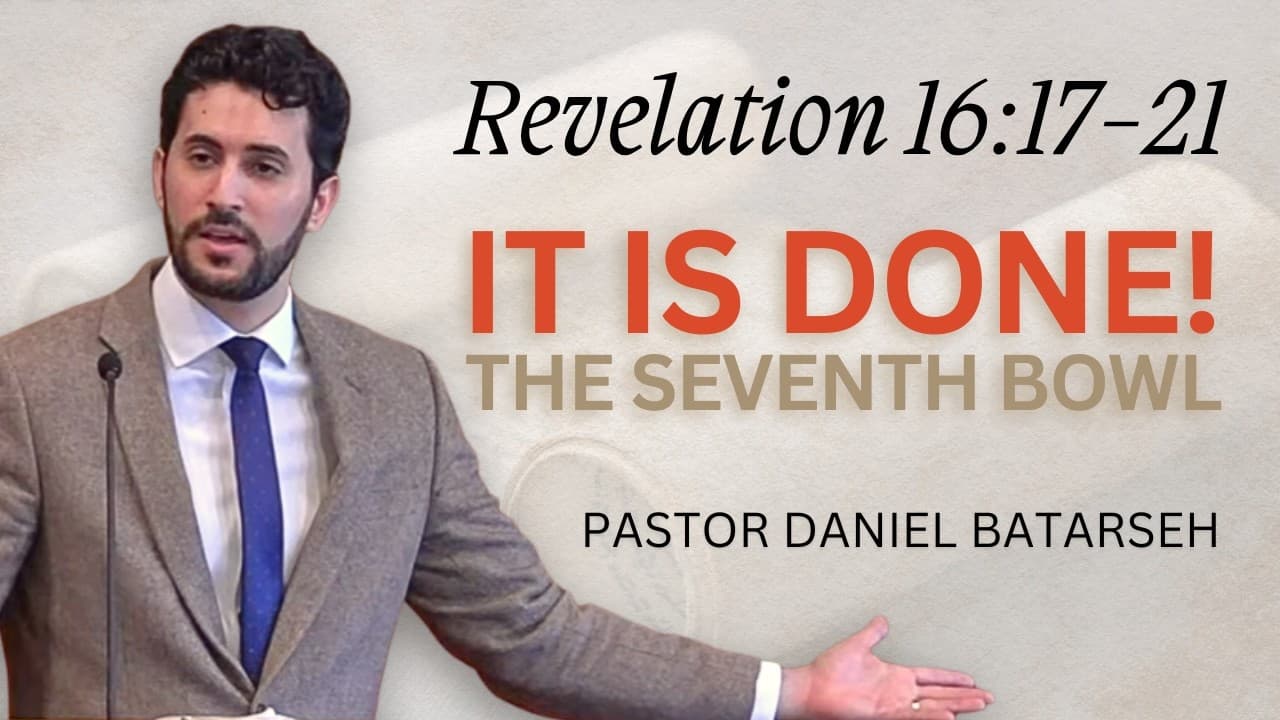
Jesus said "it is finished" at Calvary. But in Revelation 16, God declares "it is done" — and it means something entirely different. One saves. The other shakes the earth.
"It is finished." Those three words from the cross have echoed through two thousand years of Christian worship. But most believers don't realize that a strikingly similar declaration appears near the end of the Bible — and it has nothing to do with salvation. In Revelation 16:17-21, a voice thunders from the heavenly throne: "It is done." Not finished — done. And what follows is not redemption. It is the final, catastrophic outpouring of God's wrath upon a world that has exhausted every last drop of divine patience. If "it is finished" is the most comforting sentence in Scripture, "it is done" may be the most terrifying.
This distinction — between the cross and the final bowl of wrath — anchored a recent sermon by Pastor Daniel Batarseh through Revelation 16:17-21. What emerged was not just a lesson in eschatology but a deeply personal call: the declaration that saved you and the declaration that will end the age are spoken by the same God. Which one you stand under depends entirely on what you've done with the first.
Seven Times "Mega" — And That's Not an Accident
The passage is only five verses long, but the Greek text is loaded with a single word that John refuses to stop using: megas. In most English translations, the word "great" appears five times. But in the original language, megas shows up seven times — a number that should stop any student of Revelation in their tracks.
The word hides in places your English Bible won't show you. The "loud" voice from the throne in verse 17? That's megas. The plague described as "severe" in verse 21? Megas again. John is stacking the word like bricks in a wall, building toward an unmistakable conclusion: everything about this final judgment is massive. The earthquake is mega. The city that falls is mega. The hailstones are mega. The plague is mega. God is not winding down history with a whimper. He is closing it with force that dwarfs anything human civilization has ever recorded.
This isn't rhetorical flourish. It's theological architecture. Seven is the number of completion throughout Revelation, and John deploys megas exactly seven times to signal that this is the complete unleashing of divine power. Nothing is held back. Nothing is restrained. The seventh bowl is poured into the air — the last domain left — and the declaration from the throne confirms it: It is done. (watch at 1:24)
The Earthquake That Rewrites Geography
Verse 18 describes an earthquake "such as there had never been since man was on the earth." That phrase alone should settle a debate that rages in many corners of the church. If this earthquake is unprecedented in all of human history, it hasn't happened yet. It cannot be allegorized into some past event. And John doesn't leave it vague — he gives us physical, geographical consequences. Cities crumble. Islands vanish. Mountains are flattened. Jerusalem itself splits into three parts.
But here's where the cross-referencing becomes electric. Turn to Zechariah 14:3-5, and you find the same earthquake described from a different angle — centuries earlier. Zechariah tells us that when the Lord returns to fight against the nations, "his feet shall stand on the Mount of Olives," and the mountain will split in two from east to west, creating a massive valley. The Jewish people will flee through that valley to escape their enemies. (watch at 9:03)
And then the parallel hits you: When God delivered Israel from Egypt, He brought them through a valley between towering walls of water. In this final deliverance, He will bring them through a valley between mountains. Same God. Same pattern. Same faithfulness — bookending the entire story of Israel's rescue.
But Zechariah doesn't stop at the earthquake. Verses 8-11 describe living waters flowing from Jerusalem, the entire landscape being transformed into a plain, and the Lord reigning as king over all the earth. These are not metaphors floating in mystical space. They are coordinates. Gate names. Directional markers. North, south, east, west. As Pastor Daniel Batarseh put it: "At the very least, can you and I admit and acknowledge the remarkable detail of what will actually take place, the topography that will ensue at the return of Christ?" (watch at 11:39)
The land of Israel is not incidental to Christian theology. It is central to how the Bible describes the return of Jesus and His millennial kingdom. Dismissing these passages as allegory requires you to ignore the very specificity that makes prophecy prophecy.
When a Prophet Can't Help But Worship
There was a moment in this sermon that cut through all the eschatological data and landed somewhere far more personal. It came from Zechariah — not from his prophecy, but from his posture.
Right in the middle of describing the cataclysmic return of the Messiah, Zechariah breaks form. He shifts from third person to first. He stops narrating and starts confessing: "Then the Lord my God will come, and all the holy ones with him" (Zechariah 14:5).
Do you see it? He can't help himself. The weight of what he's seeing through prophetic vision overwhelms his role as reporter, and he becomes a worshiper. He's not just describing a future king. He's claiming Him. My God.
As Pastor Batarseh observed with evident conviction: "You know why some people study prophecy? So they can get more ammunition for debate about who has the more accurate eschatology and framework of understanding the last days. Okay. You guys argue all you want and there is time to debate, but I wanna be like this prophet who in seeing and understanding what the Lord will do causes him to say, 'Oh, he's my God.'" (watch at 14:30)
That rebuke was gentle, but it landed hard. Prophecy is not a puzzle to solve for intellectual satisfaction. It is a revelation of a Person. And if studying the end times doesn't make you fall on your face and say He is mine and I am His, you've missed the point entirely.
Connect the dots further: Jesus ascended from the Mount of Olives in Acts chapter 1. Angels promised He would return the same way He left. Zechariah says His feet will land on that very mountain. The playbook is not hidden. It's written in plain sight for anyone willing to read it — and worship the One it reveals.
God Remembered Babylon — And He Remembers What Was Done to You
Verse 19 introduces a phrase that sounds almost casual: "God remembered Babylon the Great." But that language carries a weight that most readers blow past.
God doesn't forget things. He doesn't misplace information. When Scripture says God "remembered," it means He is now acting on what He has always known. Babylon — that future global system of economic, political, and spiritual corruption described in detail across Revelation 18 — will be annihilated. Chapters 17 and 18 are entirely dedicated to her destruction. That's how important this is to God. Two full chapters. (watch at 17:17)
But the application that followed was not about Babylon. It was about you.
As Pastor Batarseh said plainly: "There is not a single injustice that's been committed against you that will be forgotten by God. Not one." (hear this moment) And then he pressed into the tension that every wounded believer knows: the temptation to avenge yourself. To replay the fantasy of getting even. To rehearse what you'd say, what you'd do, how you'd make them feel what they made you feel.
Romans 12:19 says, "Never avenge yourselves, but leave it to the wrath of God." The original language carries the sense of making room — stepping aside so that God's justice can occupy the space your revenge wants to fill. And here's the problem with doing it yourself: "When we seek to repay evil with evil, we often do it with interest. We tend to go overboard. We tend to go beyond and we make a bigger mess for ourselves and for others." (watch at 21:04)
Every word of gossip. Every slander. Every betrayal by someone who sat next to you in a pew and then stabbed you behind closed doors. God remembers. If they are His children, He will discipline them. If they are His enemies, He will deal with them. Your job is not to execute justice. Your job is to get out of the way.
God's Hailstones Are Not Random — They're His Weapons of War
The final image in this passage is staggering: hundred-pound hailstones falling from the sky. Not metaphorical. Not symbolic weather. Literal ice the weight of a grown man, hurled from heaven onto the heads of those who have cursed God through every previous judgment and still refuse to repent.
Why hailstones? Because throughout Scripture, hail is God's weapon of choice when He defends His people. In Joshua 10, God flung great hailstones at the kings who opposed Israel during the conquest — the same chapter where the sun stood still. In the Exodus, hail was the seventh plague against Egypt. And in Job 38:22-23, God Himself told Job that He has "storehouses of the hail, which I have reserved for the time of trouble, for the day of battle and war." (watch at 25:03)
Reserved. Stored up. Waiting. God has an armory, and hail sits in it alongside His patience — both held back until the appointed hour.
And notice where this seventh bowl is poured: into the air. Not the earth, not the sea, not the rivers, not the sun — all of those have already received their judgment. The air is the last domain. And Ephesians 2:2 tells us who currently holds power there: Satan, the prince of the power of the air. This final bowl seems to purge the very atmosphere of demonic authority, clearing the way for Revelation 19:11 — heaven opening, a white horse appearing, and the One called Faithful and True descending to make war. The hailstones are His advance guard. The earthquake is His footstep. The falling mountains are the earth bowing before its King.
The Two Declarations That Define Your Eternity
Here is where the sermon landed, and where it must land for every person reading this. Two declarations. Same God. Entirely different purposes.
It is finished — spoken from a cross, with cracked lips and torn flesh, securing your salvation.
It is done — spoken from a throne, with thunder and hailstones, completing His wrath.
If you have placed your life into the truth of the first, you have no reason to fear the second. None. You are clean. You are saved. You are safe forever. But if you have not — if you have kept the gospel at arm's length, treating it as interesting theology rather than the only thing standing between you and the wrath described in these verses — then every page of Revelation should make you tremble.
The same hand that was nailed to wood will split the Mount of Olives. The same voice that whispered forgiveness to a thief will thunder judgment on the nations. He is the Lamb and the Lion, and both are coming.
What to Remember
- The Greek word megas appears seven times in Revelation 16:17-21 — a deliberate signal that this final judgment is the complete and total unleashing of God's power with nothing held back.
- The earthquake described in this passage is confirmed and expanded by Zechariah 14, which provides specific geographical details — gate names, directional markers, topographical changes — that resist allegorical interpretation.
- God "remembering" Babylon does not mean He forgot. It means He is now acting on what He has always known. The same is true for every injustice committed against you.
- Hailstones are not random acts of nature in Scripture — they are God's stored weapons of war, reserved for the defense of His people and the defeat of His enemies.
- The seventh bowl is poured into the air — Satan's domain — suggesting a purging of demonic authority to clear the path for Christ's physical return.
- "It is finished" and "it is done" are two sides of the same divine character: the God who saves completely and the God who judges completely. Which declaration defines your future depends on what you've done with the cross.
Questions to Sit With
- When you study biblical prophecy, does it produce worship in you — like Zechariah crying out "my God" — or does it primarily fuel arguments about timelines and frameworks?
- Is there someone who wronged you whose punishment you are still trying to manage yourself? What would it look like to literally make room for God's justice instead?
- If the geographical details of Zechariah 14 are literal — gate names, directional splits, water flowing east and west — what does that mean for how you read other Old Testament prophecies you've been told are "just symbolic"?
- The people in Revelation 16:21 experience hundred-pound hailstones and respond by cursing God. What does that reveal about the human heart's capacity for defiance — and about the insufficiency of evidence alone to produce repentance?
- Do you live with the daily confidence that "it is finished" actually settled your standing before God — or do you functionally act as though you still need to earn what was freely given?
Scripture Referenced
- Revelation 16:17-21 — Primary passage: the seventh bowl of God's wrath
- Zechariah 14:3-5 — The Lord's return to the Mount of Olives and the great earthquake
- Zechariah 14:8-11 — Geographical transformation at Christ's return
- Revelation 18:9-10 — The kings of the earth mourning Babylon's destruction
- Revelation 18:20 — God's judgment of Babylon on behalf of His people
- Romans 12:19 — "Never avenge yourselves, but leave it to the wrath of God"
- Revelation 11:8 — Jerusalem identified as "the great city"
- Job 38:22-23 — God's storehouses of hail reserved for battle
- Revelation 19:11 — Heaven opens and Christ returns on a white horse
- Ephesians 2:2 — Satan as the prince of the power of the air
This summary was generated by AI from the sermon "It is Done! | Revelation 16:17-21 | Pastor Daniel Batarseh (5/3/26)" preached by Pastor Daniel Batarseh at Maranatha Bible Church Chicago. Watch the full sermon →
Preached by
Pastor Daniel BatarsehSenior Pastor
This summary was generated by AI from the sermon transcript.
Based on the sermon