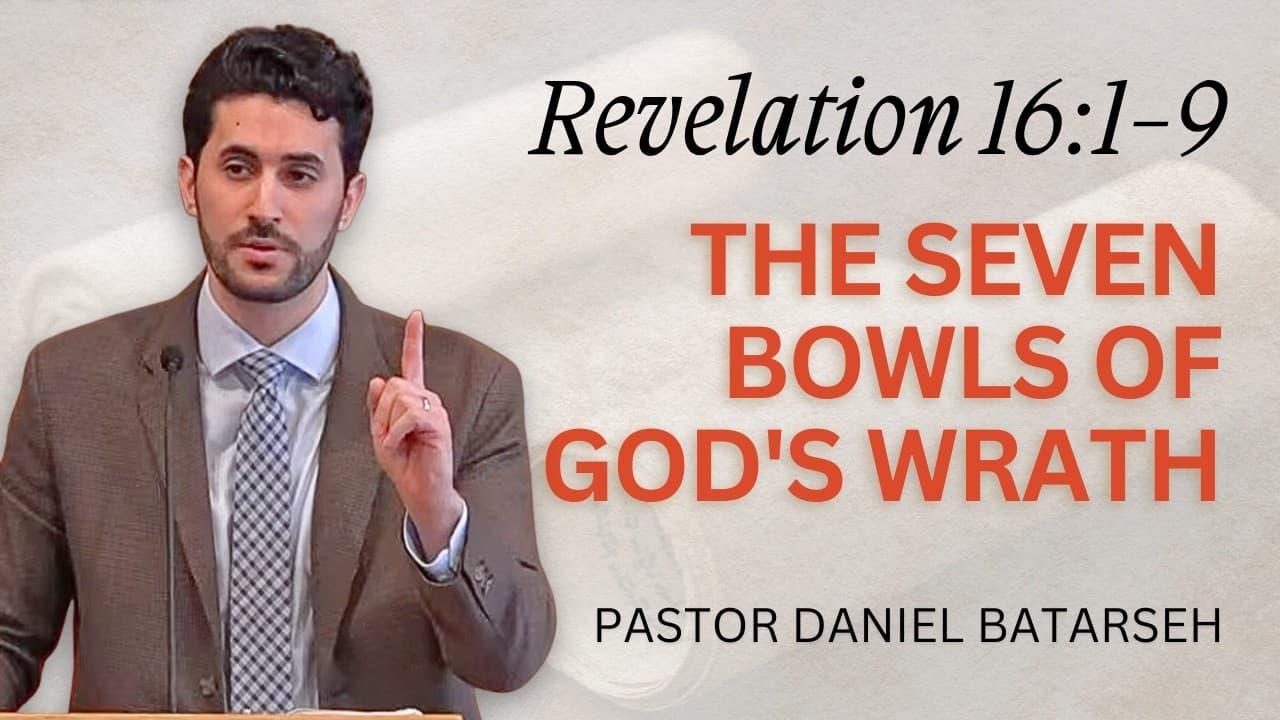
The first four bowls of God's wrath in Revelation 16 aren't random destruction — they expose what happens when humanity worships anything other than the living God.
There are two kinds of worship. One leads to fullness of joy that never runs dry. The other guarantees the multiplication of sorrow. And the only difference between them is the object of your devotion. That is the piercing truth at the center of Revelation 16:1–9, where the first four of the seven final bowls of God's wrath are poured out on a world that has pledged its allegiance to a man instead of its Maker. These aren't random acts of cosmic cruelty. They are the calculated, precisely targeted consequences of false worship — and they carry a warning that reaches far beyond the tribulation period into your living room this afternoon.
Most people read the bowl judgments as apocalyptic spectacle — plagues, blood, scorching heat — and miss the logic threaded through every verse. God is not having a mood swing. He is not being sadistic. He is being just. And the text goes out of its way to tell you so, even pausing the sequence of destruction to let an angel explain why these judgments are righteous. Understanding that logic changes how you read the passage, how you think about God's character, and how you evaluate the quiet idolatries in your own life.
The Mark That Couldn't Protect Them
The first bowl lands on the earth, and its effect is visceral: harmful, painful sores break out on every person who bears the mark of the beast and worships its image (Revelation 16:2). Most likely cancerous tumors, severe skin afflictions — something agonizing and, as the context reveals, lasting. By the time the fifth bowl is poured out in verse 10, people are still gnawing their tongues in anguish over these sores. This isn't a twenty-four-hour bug. It's a condition that accumulates alongside every subsequent judgment.
Notice who gets hit. Not everyone on earth indiscriminately — those who bore the mark. These are the people who branded themselves with the Antichrist's insignia to survive economically, to escape the death penalty, to secure provision in a world spiraling into chaos. They made what seemed like the pragmatic choice. And the irony is devastating: the very man whose mark was supposed to guarantee their survival cannot shield them from God's first blow. As Pastor Daniel Batarseh put it, "Whatever provision or promise the Antichrist makes for these people who think that this is the best choice... ultimately, he will fail to protect them and provide for them in the greatest time of need when God's wrath shows up" (watch at 47:21).
This is not just a future problem. It is a present one. Most people — right now, today — make decisions without factoring in a final day of accountability. They plan, purchase, pursue, and invest as though this life is all there is. Proverbs 11:4 says it plainly: "Riches do not profit in the day of wrath, but righteousness delivers from death." Riches can do a lot for you between now and the grave. They can do absolutely nothing for your soul.
And here's the deeper layer the text exposes: the sores that afflict the marked aren't just punishment. They're the painful outcome of false worship made visible on the body. These people used their hands and foreheads to declare allegiance to a counterfeit god, and God afflicted their flesh. There is a grim poetry to it. You gave your body to a lie, and now your body tells the truth.
Psalm 16's Forgotten Verse
This is where the sermon drew a connection most people miss. Nearly every Christian knows Psalm 16:11 — "In your presence there is fullness of joy; at your right hand are pleasures forevermore." It's on coffee mugs and Instagram posts. But almost nobody quotes verse 4 of that same psalm: "The sorrows of those who run after another god shall multiply."
Same psalm. Same David. Two realities sitting side by side. Worship God, and you inherit joy that compounds forever. Chase anything else — a career, a relationship, a substance, a political savior, your own autonomy — and sorrow doesn't just arrive. It multiplies. It breeds. It layers.
This is not a threat from an insecure deity. It is the architecture of reality. You and I were designed to find our ultimate satisfaction in God. When we redirect that worship toward something that was never built to bear the weight of our devotion, the structure collapses. Every time. The tribulation saints who rejected the mark and suffered for it may have looked like losers in the moment. But they escaped something the "winners" could not outrun — the compounding sorrow that always follows misdirected worship.
So before you read Revelation 16 as a chapter about other people in a distant future, ask yourself: what am I worshiping that is quietly multiplying sorrow in my life right now?
Blood to Drink: Why God's Justice Isn't Random
The second bowl poisons every living thing in the sea. The third turns rivers and springs to blood. And it's at this third bowl that the text does something remarkable — it stops the action to make an argument.
An angel speaks: "Just are you, O Holy One, who is and who was, for you brought these judgments. For they have shed the blood of saints and prophets, and you have given them blood to drink. It is what they deserve" (Revelation 16:5–6). The altar itself responds: "Yes, Lord God the Almighty, true and just are your judgments."
The Holy Spirit knows what you're thinking. He knows you're reading about the entire world's water supply turning to blood and you're trying to reconcile this with a God of love. So he inserts a defense attorney — an angel — to lay out the case. And the case is simple: these people murdered Christians on a scale the church has never seen. They hunted families. They slaughtered the innocent. And God's response is poetic justice: you poured out blood, so here's blood to pour down your throat.
But here's where the sermon drew a connection that lit up the room. This isn't just a Revelation pattern. It's an Exodus pattern. In Exodus 7:20, the Nile turns to blood — the very first plague on Egypt. Why the Nile? Because Pharaoh had decreed that every Hebrew baby boy be thrown into it. You shed blood in those waters? Now those waters become blood. Same God. Same justice. The bookends of the Bible mirror each other with terrifying precision (hear this moment).
And the parallel goes deeper than the plagues themselves. It extends to the stubbornness. After the Nile turned to blood, what did the Egyptians do? Exodus 7:24 says they dug along the banks looking for alternative water. They didn't repent. They didn't look up. They looked down and started digging holes, trying to find their own supply. The sane response would have been surrender. Instead, they pivoted — resilient, yes, but in the most terrifying way. Resilient against God.
As the sermon pressed this point home: "It could be even today that as we come to a close in this message that you find yourself enduring things and instead of going to the fountain of life, you are digging holes trying to find your own water. It will not satisfy" (watch at 1:19:39).
That image should haunt you. How many of us, when God sends disruption meant to get our attention, respond not by surrendering but by scrambling for alternative sources of comfort? The Nile is poisoned, and we're on our knees with a shovel, digging along the banks.
Meanwhile, the same God who offers blood as judgment offers blood as salvation. Matthew 26:27–28 records Christ at the table, handing the cup to the very men who would abandon him: "Drink it, all of you, for this is my blood of the covenant, which is poured out for the forgiveness of many." Two cups. One of wrath, one of grace. The generation in Revelation 16 rejected the blood of the covenant offered by the saints and prophets preaching during the tribulation. They chose the other cup.
The Sun Needs Permission
The fourth bowl is poured on the sun, and it scorches people with fire. The atmosphere becomes an oven. But buried in verse 8 is a phrase that deserves more attention than it usually gets: "it was allowed."
Two words that reframe everything. The sun doesn't act independently. It was allowed to scorch. Which means that right now, today, the sun is allowed to warm your skin and grow your food and light your morning — because God permits it. "The sun needs permission from God to shine. The sun needs permission from God to radiate a certain level of heat and to remain a certain size" (watch at 1:07:04).
In Genesis, God spoke everything into existence with a word. In Revelation, he can end it all with a word. And in between — right now, in this ordinary Tuesday or Sunday or whenever you're reading this — he upholds every system with that same word. Your heartbeat is borrowed. Your next breath is on loan. The politicians who think they determine the course of nations are operating at the mercy of a God who can render all their plans to nothing.
This is where the escalation pattern matters. During the trumpet judgments, God affected a third of the sea, a third of the creatures, a third of the ships (Revelation 8:8–9). A third. He left room. He was extending mercy, giving space for repentance. But they kept rejecting it. And now, in the bowl judgments, the restraint is gone. Every living thing in the sea dies. Every river turns to blood. The sun's heat becomes unbearable. God's patience has virtually run out.
And the response? Verse 9: "They cursed the name of God who had power over these plagues. They did not repent and give him glory." They acknowledged God was behind it. They recognized the supernatural origin. And they blasphemed him anyway. Not a single plea for mercy. Not one cry for relief. Just cursing.
Pastor Daniel Batarseh shared a memory that crystallized this: shortly after his conversion, eager and hungry, he was reading online discussions between atheists and Christians. One comment stopped him cold. Someone had written: "I would rather go to hell than be in heaven with your God." And then came the sobering assessment: "There are more people who believe that and want that than you think" (hear this moment).
Our sanitized church experience can insulate us from this reality. But Revelation rips the veil off. There are people — masses of them — who are so enthralled by darkness that they would choose a brutal, torturous death over submitting to a holy God. And apart from grace, you and I would be no different.
What to Remember
- The object of your worship determines whether you inherit lasting joy or lasting sorrow — Psalm 16 puts both outcomes in the same breath, and the bowl judgments prove the principle on a global scale.
- God's wrath in Revelation 16 is not arbitrary or uncontrolled — it is calculated, orderly, targeted at specific guilt, and defended by angels as righteous.
- Every system sustaining your life right now — the sun, the water, the air — operates only because God permits it. The same word that created it all can end it all.
- The blood of Christ offered at the Lord's table and the blood of wrath poured out in Revelation are the two cups set before every generation — you will drink from one of them.
- Delayed answered prayer is not denied prayer — the martyrs of Revelation 6 cried out for justice, and in Revelation 16, it arrives. God never forgets your cry.
- Stubbornness in the face of God's discipline looks the same in every era: the Egyptians dug along the Nile for alternative water rather than repent, and the tribulation generation curses God rather than surrender. The question is whether you're doing the same thing with a better vocabulary.
Questions to Sit With
- What are you currently worshiping — giving your deepest attention, energy, and hope to — that is quietly multiplying sorrow in your life?
- Is there an area where God has disrupted your comfort and instead of surrendering, you've been "digging along the banks" for alternative sources of satisfaction?
- If you truly believed that every breath and heartbeat is borrowed from God, how would that change the way you walked out your front door tomorrow morning?
- The tribulation generation acknowledged God's power but refused to repent. Is there something you know to be true about God that you're acknowledging intellectually but refusing to act on?
- When you see God bless someone else in ways He hasn't blessed you, does your heart rejoice — or does it quietly accuse Him of being unfair?
Scripture Referenced
- Revelation 16:1-9 (primary text)
- Revelation 16:10
- Revelation 8:8-9
- Matthew 24:21-22
- Matthew 26:27-28
- Matthew 20:12-15
- Philippians 2:1-11
- Proverbs 11:4
- Psalm 16:4, 11
- Psalm 33:8-12
- Isaiah 24:6
- Exodus 7:20-24
This summary was generated by AI from the sermon "The Seven Bowls of God's Wrath (Part 1) | Revelation 16:1-9 | Pastor Daniel Batarseh (4/19/26)" preached by Pastor Daniel Batarseh at Maranatha Bible Church Chicago. Watch the full sermon →
Preached by
Pastor Daniel BatarsehSenior Pastor
This summary was generated by AI from the sermon transcript.
Based on the sermon
The Seven Bowls of God's Wrath (Part 1) | Revelation 16:1-9 | Pastor Daniel Batarseh (4/19/26)
Watch Full SermonRelated Articles
What Revelation 21 Says About Heaven That You've Never Noticed
Pastor Daniel Batarseh · October 11, 2026
What Revelation 21 Says About Eternity (It's Not What You Picture)
Pastor Daniel Batarseh · October 11, 2026
Hebrews 9 and Why Christ's Second Coming Isn't About Sin
Pastor Daniel Batarseh · October 4, 2026