John uses the word 'son' for believers only once in all his writings — and the placement in Revelation 21 reveals something stunning about who you'll become in eternity.
In every book he wrote — his Gospel, his three epistles — the apostle John was meticulous about one linguistic distinction. When he spoke about believers, he called us children of God. When he spoke about Jesus, he reserved the word son exclusively for Christ. He never broke this pattern. Until Revelation 21:7, where he records God's own voice declaring over every conquering believer: "I will be his God and he will be my son."
That single word — son, not children — tucked into the final pages of the Bible, is a seismic shift. And it points to something most people miss when they read about the new heaven and the new earth: this isn't just a change of scenery. It's a change of you.
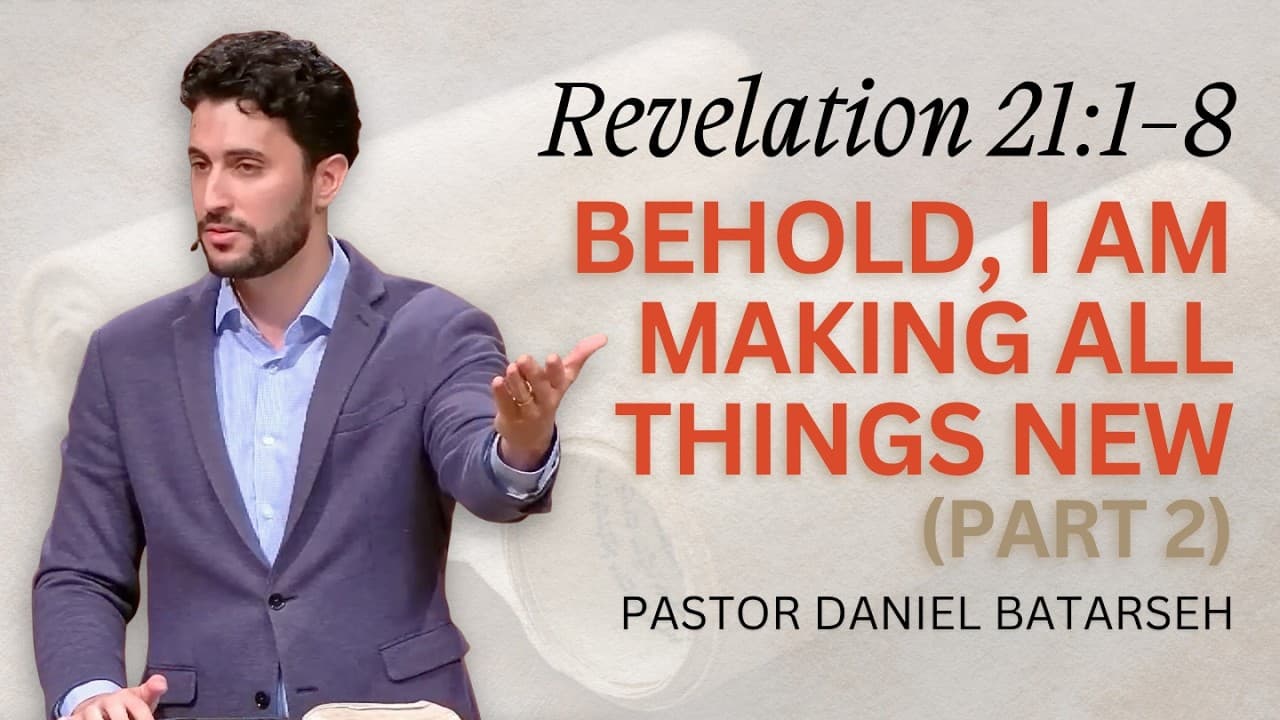
This is the second part of Pastor Daniel Batarseh's teaching through Revelation 21:1-8, and it covers four breathtaking realities about our eternal future that go far beyond golden streets and pearly gates. What emerged from this text was less a tour of heaven and more a confrontation — with our complacency, our vague imaginations about eternity, and the comfortable lie that this present life is the main event.
A City, Not a Cloud — And That Changes Everything
Most people, if they think about eternity at all, picture something hazy. Clouds. Harps. An endless worship service. But John doesn't see any of that. He sees a city — the New Jerusalem — descending from heaven, and the word carries weight.
Cities mean people. Infrastructure. Activity. Responsibility. Recreation. Bustling life. The eternal state is not a spiritual coma where disembodied souls float in bliss. It is a place of tangible community, real interaction, and purposeful existence. Your eternal life will have texture and substance.
But cities also carry darker associations — crime, corruption, pollution, loneliness. You can live in a city of millions and feel utterly alone. That's why the Spirit is careful to call this a holy city. Revelation 21:27 drives it home: "Nothing unclean will ever enter it, nor anyone who does what is detestable or false, but only those who are written in the Lamb's book of life."
Imagine a city with zero suspicion. No locked doors. No looking over your shoulder in a parking garage. No wondering if someone's motives are genuine. No isolation despite being surrounded by people. This is what God is building — and the text is explicit that He alone is the architect. As the sermon pressed: the foolishness of humanity thinking it can create a utopia while rejecting God is "utterly laughable." Every political system, every commune, every idealistic community has eventually fractured under the weight of human sin. A perfect city requires a perfect Builder — and glorified citizens to inhabit it (watch at 51:48).
This longing for the city isn't optional for believers. It's actually a mark of saving faith. Hebrews 11:10 tells us Abraham endured a life of tents because "he was looking forward to the city that has foundations, whose designer and builder is God." And Hebrews 13:14 extends the application beyond the patriarchs: "For here we have no lasting city, but we seek the city that is to come." That pronoun — we — includes every believer. The question isn't whether you know about this city. The question is whether you're seeking it.
And here's the diagnosis that stings: one of the reasons we get so agitated, so covetous, so flustered by life's inconveniences is that we've confused the hotel for the house. As Pastor Batarseh put it: "Currently your living situation, your life in this very body, is you staying in a hotel. Your house is in heaven. But we think the hotel is our house" (watch at 54:16). That reframe alone could change how you respond to the next disappointment that knocks on your door.
The Presence That Functions Like Sunlight
Verse 3 contains what may be the last shout in the book of Revelation. John has recorded loud voices throughout the book — each one amplifying something critical. But this is the final one. And what does heaven want to announce with maximum volume? "Behold, the dwelling place of God is with man. He will dwell with them and they will be his people and God himself will be with them as their God."
Notice the holy repetition. The dwelling place of God is with man. He will dwell with them. God himself will be with them. The same truth, said three times in a single breath, because this is the most thrilling reality of the new creation. Not the architecture. Not the absence of pain. Him.
Every manifestation of God's presence in redemptive history — the pillar of fire, the glory in the temple, the incarnation itself — was either momentary or confined to a single location. In the new heaven and new earth, His presence will be unhindered, unfiltered, and endless. Revelation 21:23 gives us a clue about how this works practically: "The city has no need of sun or moon to shine on it, for the glory of God gives it light, and its lamp is the Lamb."
That analogy is stunning in its simplicity. Have you ever seen the sun shine on one person at a time? Of course not. Sunlight is simultaneously available to everyone under a clear sky. God's presence in the new creation will function the same way — so powerful, so pervasive, that every citizen of that city will bask in it at once (watch at 62:30).
And the choice of title matters. The text doesn't say "its lamp is the King" or "its lamp is the Creator." It says the lamp is the Lamb. That title carries the fragrance of sacrifice — of blood poured out, of a life laid down. The atmosphere of eternity will be saturated with the knowledge that you are there because of what He did. The air you breathe in that world will be love itself.
Which raises an uncomfortable question: what do you envision when you imagine standing before Jesus Christ for the first time? A scowl? An emotionless stare? A checklist of your failures? Consider what Jesus himself prayed in John 17:24: "Father, I desire that they also, whom you have given me, may be with me where I am, to see my glory." He desires your presence. He made it a formal request before the Father, hours before His own death. As the sermon declared: "Jesus Christ eagerly anticipates my arrival. He's ready to welcome me in the same way a father is waiting for his son to get home after a very long journey" (watch at 1:09:34).
God is excited about eternity with you. The real question is whether you are.
No More Sighing — And What That Actually Means
Revelation 21:4 is the verse people embroider on pillows and read at funerals: "He will wipe away every tear from their eyes, and death shall be no more, neither shall there be mourning, nor crying, nor pain anymore." It's beautiful. It's also so familiar that we can read it without feeling anything.
So slow down. What does a world without pain actually look like on a Tuesday afternoon? No hospitals. No ambulance sirens cutting through traffic. No phone calls where someone on the other end is fighting to hold back tears because they just received devastating news. No sitting across a table from a broken brother or sister weeping over the consequences of a foolish sin. No fatal car accidents. No news tickers scrolling with horror.
These are the only conditions we've ever known. Every human being who has ever lived has lived under the regime of death and sorrow. We cannot even imagine its absence — which is precisely why we need the Spirit to make these promises real to our hearts.
Isaiah 35:10 takes it even deeper than John does: "And the ransomed of the Lord shall return and come to Zion with singing. Everlasting joy shall be upon their heads. They shall obtain gladness and joy, and sorrow and sighing shall flee away." That last phrase — sighing shall flee away — is devastating in its tenderness. A sigh is the smallest unit of grief. It's the exhale you release when you check your bank account, when you see the news, when you remember what you lost. And God says even that will be gone (watch at 1:14:42).
In its place: everlasting joy upon their heads — worn like a crown, visible to everyone. No more Christians walking through the door with droopy eyes after a brutal week. No more barely holding it together in the parking lot after service. Every face you see, every room you enter — joy. Visible, uninterrupted, permanent joy.
The Word John Never Used for You — Until Now
This is the detail that stopped me cold. Throughout the Gospel of John and 1 John, the apostle consistently calls believers children of God (John 1:12, 1 John 3:1). He consistently reserves the word son — singular, specific — for Jesus Christ alone. It's a deliberate linguistic choice to protect the uniqueness of Christ's relationship with the Father.
But in Revelation 21:7, something shifts. God himself speaks: "The one who conquers will have this heritage, and I will be his God and he will be my son." This is the only place in all of John's writings where that term is applied to a believer.
Why here? Why now? Because the context is eternity — the new heaven and the new earth, after glorification. The shift in language signals a shift in reality. In the eternal state, we will share in Christ's likeness in a way we have never experienced. Not divinity — never that. Not worship — absolutely not. But complete conformity to His moral perfection, His glorious character, His spotless nature. What is now only positional — our righteousness credited through faith — will become experiential and eternal.
1 John 3:2 confirms it: "We are God's children now, and what we will be has not yet appeared. But we know that when he appears, we shall be like him, because we shall see him as he is."
This answers the question people love to debate: can we sin in heaven? The answer isn't about free will or divine restriction. It's about nature. Can Christ sin? No. And we will be like Him. Not a single passing thought of lust. Not a flicker of envy when someone else is honored. Not one selfish impulse. As Pastor Daniel Batarseh declared with palpable relief: "There's a time coming when you and I will retire from this battle for eternity" (watch at 1:26:48).
If you're truly saved, you don't want to sin. You hate it even as you do it. The war is real, and it's exhausting. But a day is coming when you will be clothed with righteousness — not just legally, but internally and eternally. The battle will be over. And you will finally, fully, look like your Elder Brother.
What to Remember
- The new heaven and new earth is not a vague spiritual realm — it's a real city, built by God, filled with community, activity, and purpose, where nothing unclean will ever enter.
- God's presence in eternity will function like sunlight — simultaneously available to every person, permeating everything, with the sacrificial love of the Lamb as its atmosphere.
- Jesus prayed in John 17:24 for you to be with Him. He is not dreading your arrival — He is eagerly anticipating it.
- Even the faintest sigh of sorrow will be absent from the new creation. Everlasting joy will be visible on every face, worn like a crown.
- The shift from "children" to "son" in Revelation 21:7 signals that in eternity, your conformity to Christ will move from positional to experiential — you will share His moral perfection permanently.
- You cannot earn entrance to this city. But you must be thirsty for it. God extends the cup freely — He will not force it down your throat.
Questions to Sit With
- If you truly believed your current life was a hotel stay and your real home was being prepared by God, what would you stop gripping so tightly?
- When you imagine standing before Jesus for the first time, what is the default emotion you feel — and does John 17:24 challenge that instinct?
- What would change in your daily life if you genuinely believed that every sigh, every grief, every battle with sin has an expiration date?
- Are you seeking the city that is to come — or have you settled into this one as though it's permanent?
- If someone asked you today whether you're thirsty for what God offers, could you answer honestly — or have you been drinking from other wells and calling it satisfaction?
Scripture Referenced
- Revelation 21:1-8 (primary text)
- Revelation 21:23
- Revelation 21:27
- Hebrews 11:10
- Hebrews 11:16
- Hebrews 13:14
- John 17:20, 24
- John 1:12
- 1 John 3:1-2
- Isaiah 35:10
- Psalm 47:1-9
- 1 Timothy 2:1-2
This summary was generated by AI from the sermon "Behold, I Am Making All Things New (Part 2) | Revelation 21:1-8 | Pastor Daniel Batarseh (10/11/26)" preached by Pastor Daniel Batarseh at Maranatha Bible Church Chicago. Watch the full sermon →
Preached by
Pastor Daniel BatarsehSenior Pastor
This summary was generated by AI from the sermon transcript.
Based on the sermon
Behold, I Am Making All Things New (Part 2) | Revelation 21:1-8 | Pastor Daniel Batarseh (10/11/26)
Watch Full SermonRelated Articles
What Revelation 21 Says About Eternity (It's Not What You Picture)
Pastor Daniel Batarseh · October 11, 2026
Hebrews 9 and Why Christ's Second Coming Isn't About Sin
Pastor Daniel Batarseh · October 4, 2026
Hebrews 9: Why Christ's Blood Secures What Animal Blood Never Could
Pastor Daniel Batarseh · October 4, 2026