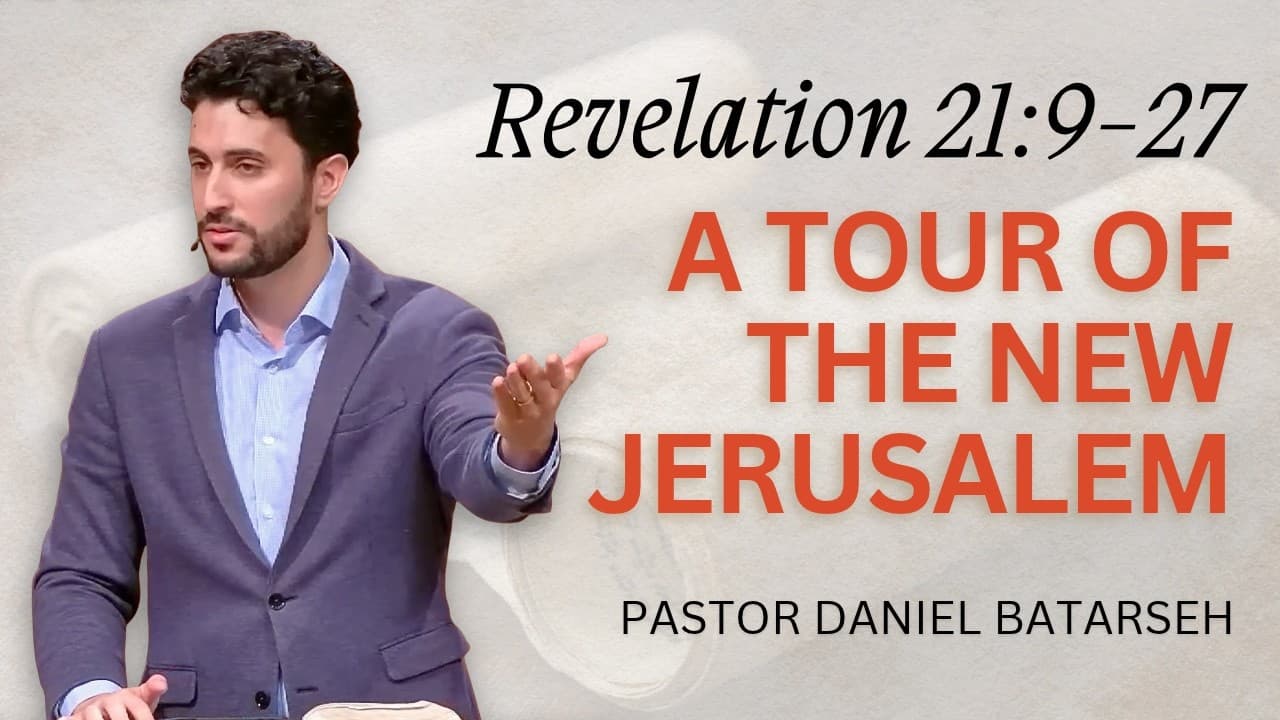
The most detailed description of eternity in all of Scripture isn't about our resurrected bodies or heavenly activities — it's a sketch of a city. And that changes everything.
The most detailed description of your eternal future in all of Scripture is not about what your resurrected body will look like. It's not about the activities you'll enjoy or the people you'll meet. It's a sketch of a city.
That's remarkable — and it's exactly what Revelation 21:9–27 delivers. John, carried by the Spirit to a great high mountain, is given a guided tour of the New Jerusalem, the capital city of the renewed earth. And the sheer volume of detail — dimensions, walls, gates, foundations, streets, even the ecosystem — is staggering. But this isn't architectural trivia. Every measurement, every gemstone, every inscription carries a message about who God is and what it means to dwell with Him forever. Pastor Daniel Batarseh walked us through this passage with the kind of awe it demands, and what emerged was a vision of eternity that dismantles our thin, foggy assumptions about what comes next.
The Mark of the Wicked Is Thinking This World Is as Good as It Gets
Before we ever reached the gates of the New Jerusalem, the sermon opened with a gut-check from Psalm 17 — a passage most of us wouldn't naturally connect to Revelation 21. David, under threat of persecution, draws a sharp line between two kinds of people. On one side are those he calls "men of the world whose portion is in this life" (Psalm 17:14). On the other side is David himself, who makes this astonishing declaration: "As for me, I shall behold Your face in righteousness. When I awake, I shall be satisfied with Your likeness" (Psalm 17:15).
Here's what stops you cold: David doesn't merely say worldly people are distracted or misguided. He calls them wicked. And the defining characteristic of their wickedness? As Pastor Daniel Batarseh put it: "One of the marks of somebody who is an unbeliever is that they believe their greatest contentment can only be found in this world" (watch at 3:17).
That sentence should rattle every one of us who has ever caught ourselves living as though retirement, or the next vacation, or financial security is the summit of human satisfaction. David says if you think the greatest ecstasy available to you is located somewhere in this life — in this economy, in this body, in this timeline — you are thinking like someone who doesn't know God.
And then David offers the contrast. "When I awake" — a reference to death, which he likens to sleep, the same metaphor Paul uses in the New Testament — "I shall be satisfied with Your likeness." Notice the architecture of that sentence. Beholding God's face is connected to satisfaction. Seeing Him as He is produces a gratification that nothing in this world can replicate. Not approximate. Not rival. Cannot replicate.
This is the lens through which we're meant to read the rest of Revelation 21. The New Jerusalem isn't just a place. It's the environment in which that satisfaction becomes permanent.
Beauty That Makes a Sunset Look Like a Rough Draft
There's a moment in the sermon that I haven't been able to shake. It came when the teaching turned to the question of beauty — specifically, the connection between beauty and glory.
Try to define beauty. Seriously, try it. You know it when you see it. A sunset arrests you mid-sentence. A mountain range makes you forget your phone. A piece of music puts a lump in your throat before you can explain why. Beautiful things awaken something in us — praise, delight, a strange stabilizing peace. We don't just observe beauty; we are changed by encountering it.
Now carry that logic to its source. "If a sunset has a way of keeping us on our feet and staring at the sky uninterruptedly — to talk about it, to take pictures of it so that we can show others — what about the Creator Himself?" (hear this moment). That's the question that reframes everything. Every beautiful thing you've ever encountered is derivative. A copy. A faint echo of the One who made it. And the New Jerusalem is the place where the echo gives way to the Voice.
This is why John, standing on that mountain, reaching for language, keeps stammering the same two words: It's like. It's like a most rare jewel. It's like jasper, clear as crystal. He can't land on a description because nothing in his experience — and John has seen things no other human has seen — is adequate. He's a man trying to paint the sun with a candle.
And here's the promise that should keep you awake tonight: "After a thousand years go by, ten thousand years after that, and a million years, you will never know a moment where your soul feels empty" (watch at 7:26). No diminishing returns. No boredom. No restless scrolling through eternity looking for the next thing. The beauty of God doesn't fade with familiarity. It deepens.
Why the Most Detailed Description of Eternity Is a City
Here's where the sermon confronted one of the most widespread — and most damaging — misconceptions in the church. Ask the average Christian what eternity looks like, and you'll get some version of floating spirits in a cloudy, immaterial dimension. Harps optional. Bodies discarded. Earth destroyed.
That is not what the Bible teaches. Not even close.
The fact that the Holy Spirit dedicates the most extensive, detailed description of the afterlife to the physical architecture of a city is itself a theological statement. Walls. Gates. Foundations. Streets. Measurements in cubits. This is not metaphor piled on metaphor to describe a feeling. This is God telling you that your future is tangible.
"Many people, including Christians, have this idea that the story with the redeemed ends with us becoming disembodied spirits, removed from this planet that will be pummeled by God's judgment as we now abide in some immaterial dimension forever and ever. That is not how the Bible describes your future and mine" (watch at 11:16).
The Lord is going to glorify your body. He is going to renew this universe — totally and completely. He is going to create a perfect physical environment. And then He is going to come and live in it with you. Forever.
The New Jerusalem is the capital city of that renewed creation. It descends from heaven to the new earth — not the other way around. Heaven comes down. God moves in. And the level of detail John provides — the dimensions, the materials, the layout — is the Spirit's way of saying: this is real. As real as the chair you're sitting in. More real, actually, because it will never decay.
The Inscriptions That Tell the Whole Story of Redemption
John zooms in from the mountain panorama to the gates and foundations of the city, and what he sees there is quietly explosive. The city has twelve gates, each bearing the name of one of the twelve tribes of Israel. Below, the wall rests on twelve foundation stones, each inscribed with the name of one of the twelve apostles of the Lamb (Revelation 21:12–14).
Walls, gates, and foundations — standard features of any ancient city. But the inscriptions transform them into a theological statement. The gates bear the names of Israel — the Old Covenant people of God, the nation through whom God's promises came into the world. The foundations bear the names of the apostles — the men who carried the gospel of Jesus Christ to the nations. Old Testament and New Testament. Promise and fulfillment. Israel and the Church. All of it held together in one structure.
And notice the critical detail at the end of verse 14: the twelve apostles of the Lamb. Not the twelve apostles of Jesus the teacher, or Jesus the miracle-worker. The Lamb. The sacrificial, sin-bearing, wrath-absorbing Lamb. The entire city — its entry points and its structural base — is built on the redemptive work of Christ. You cannot enter this city, you cannot stand on its ground, apart from the Lamb who was slain.
This is not decorative symbolism. It's a declaration. Every person who walks through those gates — whether they came through the covenant promises to Israel or through the apostolic gospel to the nations — comes in on the same basis: the blood of the Lamb. The city itself preaches the gospel.
The angels stationed at each gate are worth noting too. Angelic security measures, yes — but also a reminder that this city is protected, guarded, set apart. Nothing impure enters. Nothing broken slips through. The peace of that place is not fragile. It is fortified by the power of God Himself.
Eternity Will Not Bore You — It Will Complete You
Perhaps the most pastorally significant thread running through this entire passage is the quiet demolition of a fear that most Christians won't admit they carry: the fear that eternity might be boring.
We are so conditioned by a world of diminishing returns — where every pleasure fades, every thrill requires escalation, every relationship hits a ceiling — that we unconsciously project that pattern onto forever. We imagine eternity as an infinite Sunday afternoon with nothing to do.
But the logic of Psalm 17:15 and Revelation 21 runs in the opposite direction. David says beholding God's face produces satisfaction — not the temporary satisfaction of a good meal that fades by evening, but the kind that fills you so completely that the word "more" loses its meaning. And the New Jerusalem, with its cascading beauty and the unmediated presence of God's glory, is the environment in which that satisfaction becomes your permanent atmosphere.
You will be surrounded by His beauty no matter which direction you turn. Not as a spectator watching from a distance, but as a resident breathing it in. The city's radiance is not electric light or solar light — it is the glory of God Himself, and the Lamb is its lamp. You will live inside the light of God's own beauty.
And it will always be enough. That is the promise. Not just enough to survive eternity, but enough to thrive in it — to be perpetually filled, perpetually awed, perpetually home.
What to Remember
- If you believe the greatest satisfaction available to you exists in this life, David says you are thinking like someone who doesn't know God — no matter how many Sundays you attend.
- The most detailed description of eternity in all of Scripture is not about spiritual experiences but about a physical city — because your future involves a glorified body in a renewed, tangible creation.
- Every beautiful thing you've ever encountered is a faint echo of the Creator. The New Jerusalem is where the echo gives way to the source.
- The gates inscribed with Israel's tribes and the foundations inscribed with the apostles' names tell one unified story: every redeemed person enters eternal life on the same basis — the Lamb who was slain.
- Eternity will not operate on diminishing returns. A million years in, your soul will be fuller than it was at the start — because the beauty of God deepens with every moment of beholding.
Questions to Sit With
- If David calls it wicked to believe your greatest contentment is found in this life, how much of your daily energy is spent chasing exactly that?
- What would change about your anxiety, your ambition, and your grief if you truly believed your future was a physical, glorified existence in a renewed creation — not a disembodied spiritual fog?
- The New Jerusalem's gates and foundations unite Israel and the Church under one banner: the Lamb. How should that shape the way you read the Old Testament?
- When was the last time beauty — a sunset, a piece of music, a face — stopped you in your tracks? What if that moment was an invitation to long for the One who made it?
- Be honest: does the idea of eternity excite you, or quietly terrify you? What does your answer reveal about what you believe God is actually like?
Scripture Referenced
This summary was generated by AI from the sermon "A Tour of The New Jerusalem | Revelation 21:9-27 | Pastor Daniel Batarseh (10/18/26)" preached by Pastor Daniel Batarseh at Maranatha Bible Church Chicago. Watch the full sermon →
Preached by
Pastor Daniel BatarsehSenior Pastor
This summary was generated by AI from the sermon transcript.
Based on the sermon
A Tour of The New Jerusalem | Revelation 21:9-27 | Pastor Daniel Batarseh (10/18/26)
Watch Full SermonRelated Articles
What the New Jerusalem Reveals About Your Future (Rev 21)
Pastor Daniel Batarseh · October 18, 2026
What Revelation 21 Says About Heaven That You've Never Noticed
Pastor Daniel Batarseh · October 11, 2026
What Revelation 21 Says About Eternity (It's Not What You Picture)
Pastor Daniel Batarseh · October 11, 2026