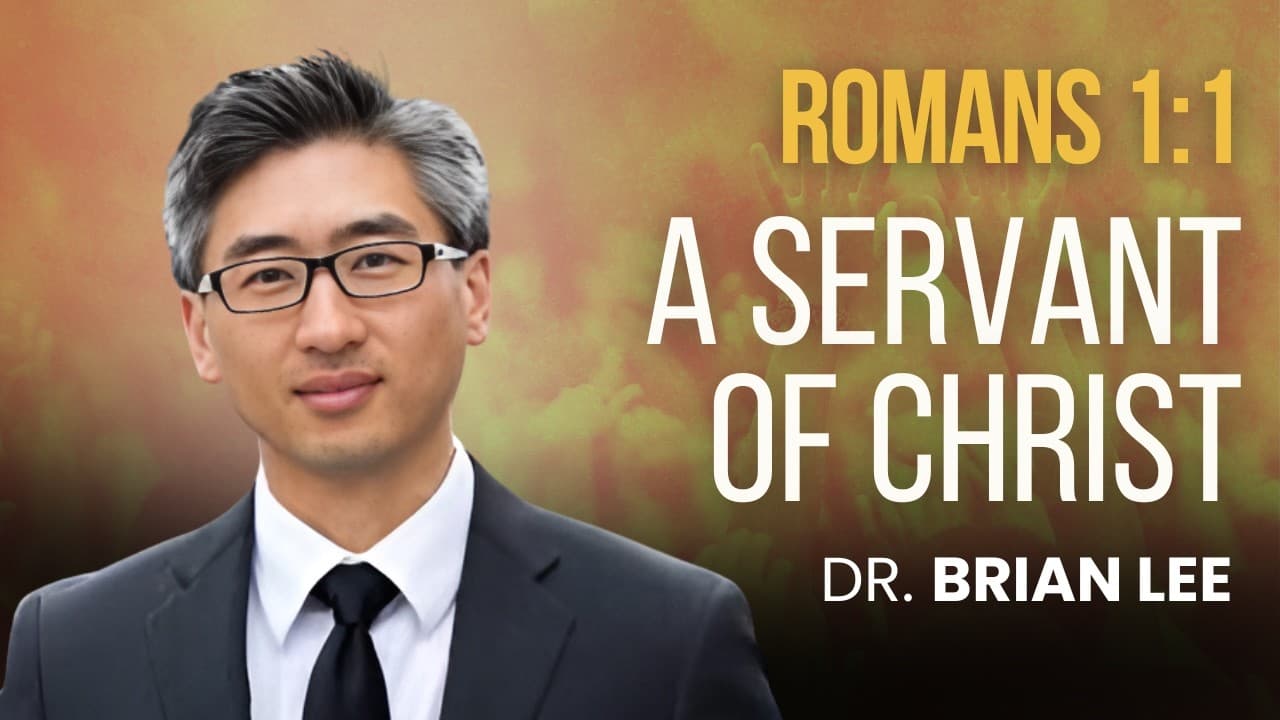
Paul could have led with his credentials. Instead, he called himself a servant. Romans 1:1 reveals what it means to belong wholly to one Master.
Paul had every credential a first-century Jewish leader could want. Trained under Gamaliel. A Pharisee of Pharisees. A Hebrew of Hebrews. Yet when he sat down to write the most theologically dense letter in the New Testament, he did not open with his résumé. He opened with a chain: "Paul, a servant of Christ Jesus, called to be an apostle, set apart for the gospel of God" (Romans 1:1). The word translated "servant" is doulos — a bondslave, someone who belongs entirely to another. Before Paul was an apostle, before he was set apart, before he was anything else, he was owned. And that single word reframes everything we think we know about Christian identity, calling, and service.
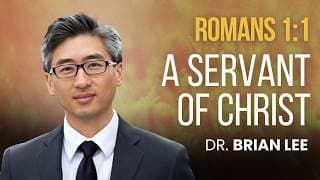
Dr. Brian Lee walked a Friday evening congregation through this opening verse of Romans and pulled back layers most of us breeze past on the way to the meatier chapters. What emerged was a sermon that asked a deceptively simple question: Do you know who your Master is — and do you live like it?
Before the Calling Came the Surrender
We love the drama of Paul's conversion. The blinding light. The voice from heaven. The three days of darkness. But there is a detail in Acts 9 that often gets swallowed by the spectacle. When Jesus knocked Saul to the ground on the road to Damascus, He did not hand him a ministry plan. He gave him a single instruction: "Rise and enter the city, and you will be told what you are to do" (watch at 3:09).
That is not a calling. That is a command to wait.
Paul's specific calling — to carry the gospel to the Gentiles, to kings, and to the children of Israel — came later, delivered through a disciple named Ananias. And notice how Ananias addressed him: "Brother Saul." Paul was already saved. He was already a brother. But he had not yet received his assignment. Salvation came first. Surrender came first. The specific calling followed.
This sequence matters because we have inverted it. We treat calling as the prerequisite for obedience. We say, "Once I know what God wants me to do, I'll do it." But Paul did not wait for clarity before he obeyed. He obeyed — blind, disoriented, led by the hand into a city he had planned to terrorize — and the clarity came after.
As Dr. Brian Lee put it: "Paul was saved, but yet he was yet to receive his specific calling, and he received that from Ananias, the words that Jesus gave him" (watch at 3:36). The lesson is uncomfortable in its simplicity. You do not need to know your calling to start obeying your Master. You need to know your Master to receive your calling.
Three Years in the Desert to Confirm What God Already Said
Here is where the sermon drew an unexpected connection. After receiving his calling through Ananias, Paul did not launch a preaching tour. According to Galatians 1:17, he went to Arabia — and stayed for three years (watch at 4:29).
Three years. No platform. No audience. No epistles. Just a man who had spent his entire life mastering the Hebrew scriptures, now rereading them with new eyes — the eyes of someone who had met the Author face to face.
The picture painted here was vivid: Paul, the Hebrew of Hebrews, sitting in the Arabian wilderness, turning the pages of Isaiah and Deuteronomy and the Psalms, hearing the voice of his new Master in texts he had memorized under his old one. He was not learning new information. He was learning a new Lord. Every messianic prophecy he had studied now had a face. Every sacrificial lamb now had a name.
This was not wasted time. This was the foundation of Romans.
And it speaks directly to a modern restlessness that infects the church. We want our calling confirmed by Friday so we can start by Monday. We treat spiritual discernment like a drive-through window. But Paul — chosen, elected, called by the risen Christ Himself — still needed three years in the word and in prayer to confirm what God had already spoken. If Paul needed that, what makes us think we can skip it?
"He will show us to the degree we hear his voice in his word and in prayer, to the degree we walk close with him" (watch at 2:23). The degree of clarity is proportional to the degree of closeness. There is no shortcut.
One Master, One Lord — Scan the Text and See
The first principle drawn from Romans 1:1 is almost too obvious to state, which is exactly why it needs to be stated: a servant of Christ serves only one Master.
But the sermon did not leave it at the level of principle. It invited the congregation to scan the first six verses of Romans 1 and watch the text do something remarkable. Verse one: Christ Jesus. Verse three: concerning his Son. Verse four: the Son of God... Jesus Christ our Lord. Verse five: for the sake of his name. Every verse orbits the same center. There is no other name in the gravitational field.
This is not just literary style. This is theology embedded in grammar. Paul is not writing about Christ the way a biographer writes about a subject. He is writing from within Christ the way a branch writes the story of the vine. The entire letter — all sixteen chapters, every doctrine, every ethical command — flows from this single reality: Jesus is Lord, and Paul belongs to Him.
The challenge lands here: we live in a culture of divided loyalties. We serve Christ on Sunday and our ambition on Monday. We call Him Lord but consult our comfort before we consult His word. Paul's opening line is a rebuke disguised as an introduction. He does not say, "Paul, a servant of Christ and also a tentmaker and also a Roman citizen and also a Pharisee." He says servant of Christ Jesus. Full stop. Everything else is downstream.
The Problem with Paul's Words Is a Problem with Christ
The sermon took a sharp turn before entering the text of Romans, and it was the kind of turn that made the room go quiet. There is a growing trend — not outside the church, but inside it — of Christians who criticize Paul's writings. They find his words on marriage too restrictive, his teaching on gender roles too patriarchal, his stance on sexual ethics too narrow. And so they do what humans have always done with inconvenient authority: they try to diminish the messenger so they can dismiss the message.
The response was direct and unflinching: "If anyone has a problem with the words of Paul, they have a problem with Christ himself" (watch at 7:16).
This is not rhetorical overreach. It is grounded in John 16:13, where Jesus promises that the Spirit of truth will come and guide the apostles into all truth — not their own truth, but His truth. Paul's letters are not Paul's opinions sanctified by tradition. They are Christ's words delivered through the Spirit of Christ. To dismiss Romans is to dismiss the One who authored it through His apostle.
And Paul did not merely write truth. He lived it. In Philippians 4:9, he writes with breathtaking confidence: "What you have learned and received and heard and seen in me, practice these things, and the God of peace will be with you" (watch at 9:00). This is a man whose life matched his letters. He did not ask people to follow his theology in the abstract. He said, Look at my life. That kind of invitation is only possible for someone who has genuinely surrendered to one Master.
Do You Know What Your Calling Is?
The sermon circled back to Romans 12:4-8, where Paul describes the body of Christ and its many members, each with different gifts — prophecy, service, teaching, exhortation, generosity, leadership, mercy. The passage is familiar. But the question that followed was not academic. It was pastoral, and it was personal.
"What is your calling? Do you know what your calling is here tonight as you sit here and receive God's word?" (watch at 1:39).
Not "what do you wish your calling was." Not "what calling would look most impressive on a ministry bio." What has God actually shown you? And have you received confirmation of it — not from your own desires, but from His word, from His Spirit, from the community of believers who know you?
The reassurance offered here was tender, and it mattered: "The Lord sees our hearts above all else in wanting to know what our gifting is and surrendering that to him that we might serve him faithfully in whatever calling he has for us" (watch at 1:39). If you are in doubt, if you are uncertain, if you have been waiting and it feels like nothing is coming — God is not frustrated with you. He sees the posture of your heart. The willingness to serve is itself a form of service. And the clarity will come to the degree you walk close to Him.
The unique thing about Romans among Paul's letters is that it is the only letter addressed to a church where Paul introduces himself alone as a servant — not paired with Timothy, not bundled with other titles. Just Paul. Just a servant. Just Christ. That simplicity is the whole sermon in a single verse.
What to Remember
- Paul received his salvation and his calling at different moments — surrender to Christ comes before clarity about your assignment, not after.
- Paul spent three years in Arabia confirming what God had already spoken, proving that discerning your calling is not instant but proportional to how closely you walk with God in His word and prayer.
- Romans 1:1-6 mentions Christ in every verse — Paul's identity, theology, and mission all orbit one center, and so must ours.
- Dismissing Paul's writings is not intellectual courage — it is a rejection of the Spirit of truth whom Christ promised would guide the apostles into all truth (John 16:13).
- Not knowing your specific calling yet is not failure — God sees the heart that wants to know, and He honors the posture of surrender above the precision of the plan.
- Being a servant of Christ means having one Master, not Christ plus your comfort, your ambition, or your cultural preferences.
Questions to Sit With
- If someone read the first six verses of your life the way Paul opens Romans, how many masters would they find?
- Are you waiting for clarity about your calling before you obey what God has already told you to do — and is that waiting actually disobedience dressed in spiritual language?
- Paul went to Arabia for three years. When was the last time you stayed in one passage of scripture long enough for it to change you rather than just inform you?
- Is there a passage in Paul's letters that you quietly resist — and have you honestly asked yourself whether your resistance is with Paul or with Christ?
- What would it look like to introduce yourself — not on paper, but in the way you live — as simply a servant of Christ?
Scripture Referenced
- Romans 1:1-6 — primary text
- Romans 12:4-8 — spiritual gifts and calling in the body of Christ
- Acts 9:6 — Paul's conversion and initial command
- John 16:13 — Jesus' promise of the Spirit of truth
- Philippians 4:9 — Paul's invitation to imitate his life
- Galatians 1:17 — Paul's three years in Arabia
This summary was generated by AI from the sermon "A Servant of Christ | Romans 1:1 | Dr. Brian Lee (7/10/26)" preached by Dr. Brian Lee at Maranatha Bible Church Chicago. Watch the full sermon →