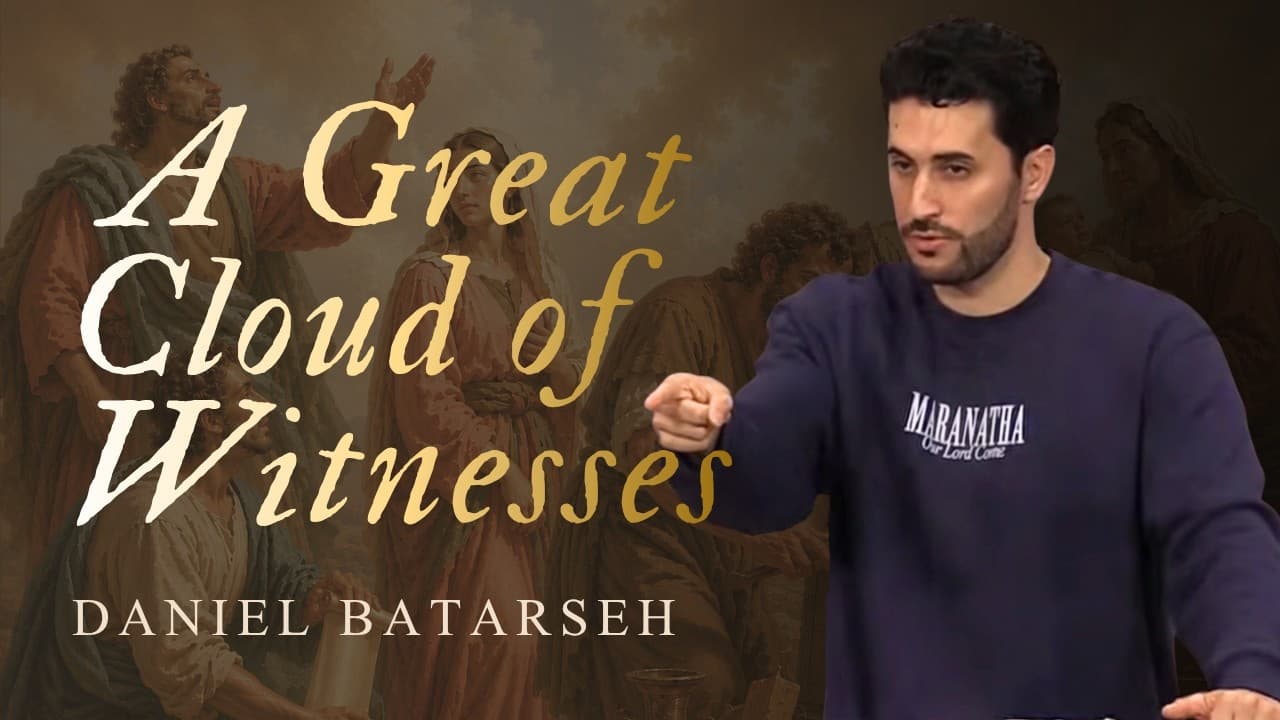
The 'cloud of witnesses' in Hebrews 12:1 isn't an audience watching you from heaven — it's a weapon for weary Christians who've lost the strength to keep running.
Most people read Hebrews 12:1 and picture a heavenly amphitheater — Abraham, Moses, David leaning over the balcony, cheering you on like fans at a marathon. It's a comforting image. It's also not the point. The "great cloud of witnesses" isn't about what they see when they look at you. It's about what you see when you look at them. And that distinction — that subtle reversal of direction — holds one of the most practical, underused weapons available to a Christian who is spiritually exhausted.
This was the opening salvo of Pastor Daniel Batarseh's introduction to the 2026 Maranatha Conference, a series titled Unsung Heroes of the Bible. But before a single hero was named, he spent an entire session diagnosing a condition that every honest believer has felt: the slow, quiet death of spiritual tiredness.
You're Not Backsliding — You're Sluggish. And That Might Be Worse.
There's a word in Hebrews 6:12 that deserves more attention than it gets. The ESV translates it "sluggish." The author warns his readers not to become sluggish but to be "imitators of those who through faith and patience inherit the promises." Sluggish doesn't mean rebellious. It doesn't mean apostate. It means numb (watch at 33:49).
And here's what makes this word so revealing: it only appears one other time in the entire New Testament. Hebrews 5:11 — "you have become dull of hearing." Same Greek word. So the Holy Spirit draws a straight line between spiritual sluggishness and an unresponsiveness to God's Word. As the sermon put it plainly: "One of the ways I know that I am becoming sluggish spiritually is that I am unresponsive to God's Word. It doesn't move me anymore, it doesn't challenge me, it doesn't excite me, it doesn't stir me, it doesn't comfort me. It's just words. It's just a guy up there speaking. It's just a book. When you get to that point spiritually, you are sluggish" (hear this moment).
That description should make you pause. Not because it's dramatic, but because it's ordinary. This isn't the person screaming at God or walking out of church. This is the person who sits in the third row every Sunday, sings the songs, nods at the right moments, and feels absolutely nothing. They've mastered the performance. They're a spiritual robot. And the terrifying thing the author of Hebrews understood is that sluggish people don't stay sluggish. They drift. The person who's numb today is the person who denies Christ tomorrow. Things usually take time before they get worse.
By the time you reach Hebrews 10:36 — "For you have need of endurance" — the diagnosis is complete. These Christians are losing steam. Their legs are heavy. Sitting down looks more attractive than running. And the prescription the author writes next is not a theological lecture. It's a story. Dozens of stories, actually — the entire Hall of Faith in Hebrews 11.
The Structural Secret of Hebrews 11 That Changes How You Read It
Here's the connection most readers miss, and it's hiding in plain sight. Hebrews 10:36 says you need endurance. Hebrews 12:1 says let us run with endurance. What sits between those two verses? An entire chapter of people who ran with endurance. Hebrews 11 is not a history lesson. It is not a detour. It is the prescription sandwiched between the diagnosis and the charge (watch at 38:57).
The word "therefore" at the start of Hebrews 12:1 is the hinge. Therefore — because of everything you just read about Abel, Enoch, Abraham, Moses, Rahab — therefore lay aside the weight, kill the sin, and run. The cloud of witnesses isn't decoration. It's ammunition.
And this is where the common interpretation gets corrected. The image people carry is of saints in heaven watching us like spectators at a track meet. But the text doesn't say we should feel watched. It says we should look. These witnesses are testifying — not observing us from above, but speaking to us from the past. They're saying something. The question is whether we're listening.
This realization opens up what amounts to a forgotten weapon in the Christian arsenal: the profound power of biographies. Not self-help books. Not podcasts about productivity. The actual stories of actual people who served God under actual pressure — and what happened when they did. As the sermon framed it: "It dawned on me that there is another weapon that you and I can wield, that we must tuck away safely in our arsenal when it comes to us finishing this race well. And it is this: the profound power of biographies" (hear this moment).
Have you ever wondered why the Bible isn't just a book of bullet-point rules? Why so much of it is people — flawed, complicated, courageous, cowardly people with Holy Spirit-inspired details preserved for millennia? This is one reason. The stories themselves are a means of grace.
Weight Is Not Sin — But It Might Be Just as Dangerous
Hebrews 12:1 makes a distinction that most Christians gloss over: "lay aside every weight and sin which clings so closely." Weight and sin are listed separately because they are not the same thing.
Sin is a rope around your ankles. It stops you from running altogether. Weight is different — it's the construction boots on a marathon runner. Not evil. Not forbidden. Just heavy. And the runner who refuses to examine what's weighing them down will always wonder why they're so slow.
Weight is the entertainment that isn't sinful but isn't helpful. It's the friendships that aren't toxic but aren't sharpening you. It's the scrolling that isn't pornography but isn't producing anything either. And the uncomfortable truth is this: if the only question you ever ask about your habits is "Is it sin?" you may be running the race of faith in steel-toed boots with dumbbells in your hands.
Now, there's a predictable objection here, and it was addressed head-on: "You might be hearing something like this and think, that sounds like legalism. That's not legalism. It's Bible." The distinction matters. Legalism is taking what convicts you and enforcing it as law upon someone else. If social media is weight for you, that's between you and the Lord. But the moment you announce from a pulpit that anyone with an Instagram account isn't a real Christian, you've crossed into legalism. The call is not to adopt someone else's convictions. The call is to actually examine your own life and ask the question you've been avoiding: Is this helpful? (watch at 50:58).
And this is where the biographies become practical. When you study the habits of men and women who bore fruit for God — their patterns, their disciplines, what they invested in and what they shed — you start to see a relationship between what they gave up and what they produced. The weight they dropped early became the ministry they carried later.
How Dead People Cure Self-Pity
One of the most devastating applications of this teaching was the way biographies dismantle the self-pity that paralyzes so many believers. Three illustrations landed like hammer blows in the room.
Charles Spurgeon preached an average of ten sermons a week in his early ministry. Ten. Most pastors agonize over one. Suddenly, Saturday night sermon prep doesn't feel so heroic.
John Flavell, the great Puritan, was married four times — not because of divorce, but because his first three wives died. The first died in childbirth, and the baby died shortly after. He married again; that wife died too. And the third. His fourth wife survived him. This man then wrote a book on suffering — and in it, he rebuked people for blaming God and refusing to emerge from spiritual darkness. He had earned the authority to say what he said.
Then there was the story of a modern church planter whose own congregation turned hostile. One Sunday, a man walked down the center aisle carrying a bag of garbage and dumped it on the stage while the pastor was mid-sermon. In the back rows, people were discovered sitting with dolls resembling the church elders, performing hexes during the service. After hearing that, as Pastor Daniel Batarseh put it with a grin, "Somebody that usually says hi to me on Sunday but didn't this last Sunday doesn't seem so bad after all" (watch at 59:51).
The point isn't to minimize your pain. The point is to recalibrate your perspective. Have family problems? Have any of your siblings thrown you into a pit and sold you into slavery? That happened to Joseph. Think your ministry task is overwhelming? Moses pastored a congregation of two million — and when things got hard, they didn't want to vote him out. They wanted to kill him.
These stories exist in Scripture for a reason. They shake you awake. They remind you that God has always used broken, limited, insufficient people — and that your insufficiency is not a disqualification. It might be the very thing God intends to work through.
Looking to Jesus — And Why the Name Matters
The sermon closed where Hebrews 12 closes: with Jesus. But there's a detail in verse 2 that most readers skip. Out of all the titles the author could have used — Christ, Lord, Son of God, the Word — he writes simply: "looking to Jesus." Full stop.
Why? To emphasize his humanity. So that you don't dismiss him as an unfair comparison. Yes, he is God. Yes, he received the Spirit without measure. But the text deliberately draws your attention to the man who took on real flesh, faced real temptation, and endured real suffering. He is not just someone to admire from a distance. He is the model for your race. The founder and perfecter of your faith — meaning he started it, and he will complete it.
The cloud of witnesses points you forward. But Jesus is the one you're running toward.
What to Remember
- Spiritual sluggishness is not a lesser danger than outright apostasy — it's the road that leads there. The person who feels nothing today is drifting toward denial tomorrow.
- The "cloud of witnesses" in Hebrews 12:1 is not a heavenly audience watching you — it's a testimony you need to hear. Their stories are weapons for your race.
- Weight and sin are not the same thing. If "Is it sin?" is the only question you ask about your habits, you may be running the hardest race of your life in the heaviest shoes possible.
- Challenging yourself to examine what's weighing you down is not legalism. Legalism is forcing your personal convictions onto someone else as a test of their faith.
- The biographies of believers — in Scripture and throughout church history — are a means of grace that most Christians have never picked up. They cure self-pity, inspire faith, and remind you that God has always chosen insufficient people.
- Jesus is called by his human name in Hebrews 12:2 for a reason: so you won't dismiss his endurance as irrelevant to yours.
Questions to Sit With
- If you're honest, when was the last time the Word of God actually moved you — not just informed you, but stirred something in your chest? What changed between then and now?
- What in your life right now is not sinful but is clearly weight — something that's slowing your stride even though no one would call it wrong?
- Can you name three people from Scripture or church history whose stories have shaped how you live? If not, what does that say about whose voices you've been listening to?
- Is there one specific area of your life where you've essentially told God, "I'll obey you everywhere except here"? What would it cost you to surrender it this week?
- If someone who knew you well — not casually, but deeply — were asked whether you're running or coasting, what would they say?
Scripture Referenced
- Hebrews 12:1-2
- Hebrews 6:11-12
- Hebrews 5:11
- Hebrews 10:36
- Hebrews 11:32
- Psalm 115:1-18
- Acts 12:13-14
- Romans 11:33-36
This summary was generated by AI from the sermon "Unsung Heroes of The Bible | Introduction | Pastor Daniel Batarseh | Maranatha Conference 2026" preached by Pastor Daniel Batarseh at Maranatha Bible Church Chicago. Watch the full sermon →
Preached by
Pastor Daniel BatarsehSenior Pastor
This summary was generated by AI from the sermon transcript.
Based on the sermon
Unsung Heroes of The Bible | Introduction | Pastor Daniel Batarseh | Maranatha Conference 2026
Watch Full SermonRelated Articles
What Revelation 21 Says About Heaven That You've Never Noticed
Pastor Daniel Batarseh · October 11, 2026
What Revelation 21 Says About Eternity (It's Not What You Picture)
Pastor Daniel Batarseh · October 11, 2026
Hebrews 9 and Why Christ's Second Coming Isn't About Sin
Pastor Daniel Batarseh · October 4, 2026