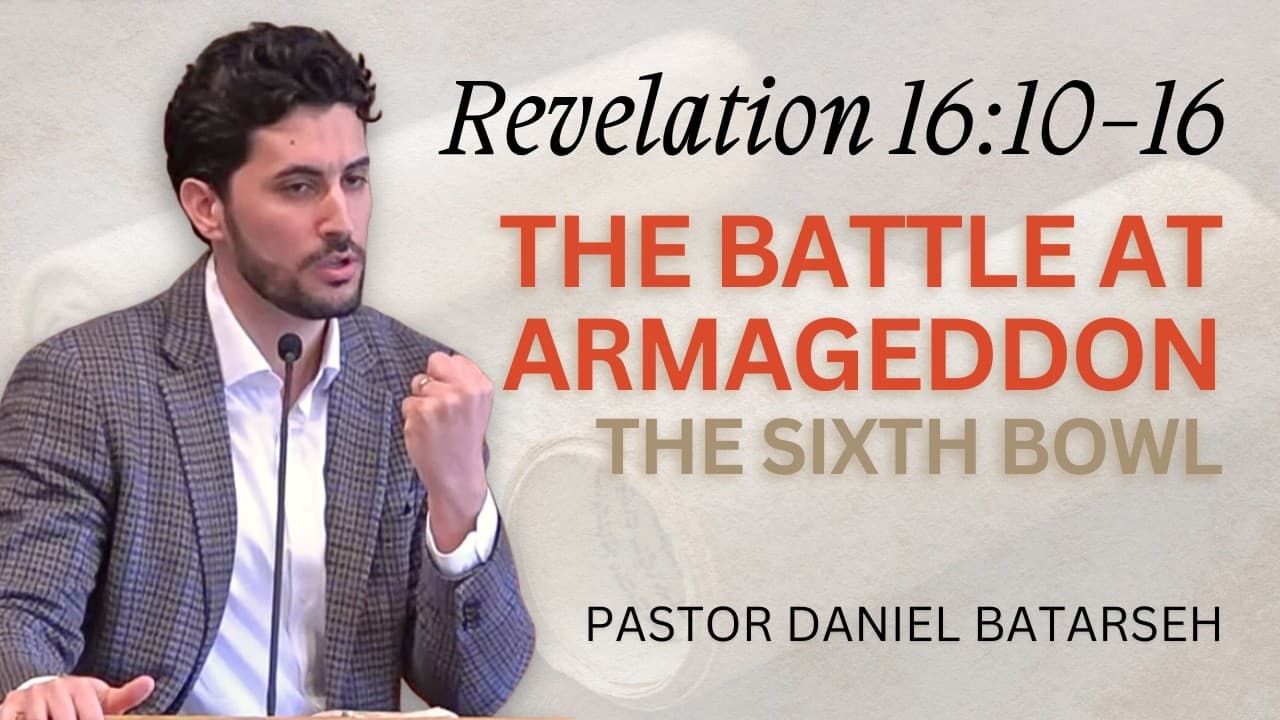
Armageddon isn't primarily a military showdown — it's a propaganda campaign. Revelation 16:10-16 reveals how demonically inspired words recruit the nations to wage war against God himself.
What the Battle of Armageddon Actually Is — And Why It Starts with Words, Not Weapons
Ask the average person what Armageddon means and they'll describe a mushroom cloud, a meteor strike, or some cinematic apocalypse. Ask the average Christian and you might get a vague reference to a final battle in the Middle East. But the actual text of Revelation 16:10–16 — the only passage in the entire Bible where the word "Armageddon" appears — reveals something far more unsettling than a military showdown. Before a single army marches, before the kings of the earth assemble on the plain of Megiddo, there is a plague. Not of locusts or boils. A plague of words. Demonically inspired propaganda that seduces the rulers of the world into believing they can defeat the Son of God. The battle of Armageddon doesn't begin with weapons. It begins with mouths.
And if that sounds uncomfortably familiar — a world drowning in persuasive voices, podcasts, platforms, and talking heads shaping what millions believe — it should.
When God Turns Off the Lights on the Antichrist's Kingdom
The fifth bowl of God's wrath doesn't strike the oceans or the sun. It strikes something far more personal: the throne of the beast. Verse 10 says the angel pours out his bowl directly on the seat of the Antichrist's power, and his entire kingdom is "plunged into darkness."
This isn't metaphorical. If we take John seriously — and he's clearly drawing from the plagues of the Exodus throughout this passage — then this is the same kind of literal, suffocating darkness that covered Egypt for three days in Exodus 10. A complete blackout. No natural light, no artificial light. Nothing.
But the darkness carries a message beyond its physical terror. The Antichrist, who already couldn't save his followers from the oozing sores of the first bowl, now can't even defend his own headquarters. The man who commanded the worship of the world can't keep the lights on. As Pastor Daniel Batarseh put it: "The power of presidents, prime ministers, dictators, kings — from our perspective is great. But from heaven's point of view, whenever God wishes, he can turn off the lights of their kingdoms" (watch at 43:19).
He referenced Nebuchadnezzar — the most powerful ruler on earth who, in a single moment, was reduced to eating grass like an animal. God can turn off the lights in a kingdom. He can turn off the lights in a mind. He can veil the moon and shut down the power grid. Psalm 2 warned rulers centuries ago: "Be wise, O kings. Be warned, O rulers of the earth. Serve the Lord with fear and rejoice with trembling." The Antichrist and his subjects will not take that ancient counsel.
Instead, they gnaw on their tongues. The word means to chew — a visceral, agonized response. And with those same tongues, they curse God. They don't cry out for mercy. They blaspheme.
The People Who Experience Hell on Earth and Still Won't Repent
Here is where the text becomes genuinely haunting. Notice the resemblance between the fifth bowl and Jesus's own descriptions of hell. Christ said repeatedly that the condemned would be cast into "outer darkness" where there is "weeping and gnashing of teeth." And here, under the fifth bowl, the world is plunged into darkness, gnawing their tongues in anguish. They are being brought to the brink of the eternal reality — tasting hell on earth.
And they don't repent.
This demolishes a common objection people raise against the doctrine of eternal punishment — the idea that if people in hell could just experience God's full fury, they'd realize their mistake and cry out for mercy. They'd repent if given another chance.
But who says everyone in hell will cry out for mercy? "Where did you get that idea from?" the sermon pressed. "Because here you have the world experiencing hell on earth and instead of crying out for forgiveness, they're cursing God. You think everybody in hell is gonna ask God to deliver them? Some will weep and some will gnash their teeth. 'You brought me here. I curse you.' And they will do so forever and ever and ever" (watch at 46:08).
There's a devastating detail buried in the progression of these bowl judgments. In the fifth bowl, verse 11 says, "They did not repent of their deeds." This is the last time the word "repent" appears in the entire Bible. And it appears as a refusal. By the time the seventh bowl falls in Revelation 16:21 — hundred-pound hailstones crashing from the sky — the people still curse God, but repentance isn't even mentioned anymore. Not even as something they rejected. It's gone from their vocabulary. The hearts have calcified beyond the point where the concept even registers.
That trajectory should terrify anyone who treats repentance casually. Every refusal hardens the heart a little more. There is a point — and scripture shows it — where the capacity to turn simply disappears.
Armageddon Is a Propaganda Campaign Before It's a Battle
The sixth bowl shifts from darkness to military mobilization. The angel pours out his bowl on the great River Euphrates and it dries up, "to prepare the way for the kings from the East." But this isn't just geography. The Euphrates has deep biblical significance. God told Abraham in Genesis 15:18 that this river would mark the eastern boundary of the Promised Land. Throughout Israel's history, every major enemy invasion came across the Euphrates — Assyria, Babylon, Persia. The river became a symbol of enemy approach. And now God himself dries it up, removing the last natural barrier.
But here's what should stop you cold. Consider the condition of these nations at this point: their people are covered in sores, they can't find drinkable water anywhere, they've been scorched by the sun, and they're sitting in total darkness. And the top priority of their leaders? Gather whatever energy and resources remain and march to war — against God.
How is this possible? Verse 13 tells us plainly. John sees three unclean spirits — described as resembling frogs — proceeding from the mouths of the dragon (Satan), the beast (the Antichrist), and the false prophet. These are demonic spirits, and their method is not brute force. Their method is persuasion.
Notice the word "mouth" appears three times in verse 13. The mouth of the dragon. The mouth of the beast. The mouth of the false prophet. The repetition is intentional. The primary means of recruiting the world to march against Jerusalem and her King is demonically inspired propaganda. And the frog imagery isn't random — it recalls the plague of frogs in Egypt, a plague that infested every corner of life. This is a plague of indoctrination. A plague of disinformation. And it works.
As the sermon made devastatingly clear: "I wanna remind you today through God's word that demons use words. That there is demonic activity not just in the future but even now in the realm of government, in the political arena. And more than that, demons very much capitalize on those who use their mouths to shape the opinions of the public" (watch at 59:13).
This isn't a warning only for the tribulation period. It's a warning for right now. "Oh, they might have wonderful personalities. They may be witty. They may receive the wider applause. And yet, their arguments, their theories, their messages, their podcasts can very well be rooted in demonic deception, and people are eating it up."
The only defense? Know your Bible. Not as a cliché — as a survival strategy.
The Old Testament Saw This Coming for Centuries
What makes this passage even more staggering is how precisely it aligns with prophecies written centuries before John ever picked up his pen on Patmos. The battle described in Revelation 16 is not a New Testament invention. The prophets saw it coming.
Joel 3:1–3 declares: "I will gather all the nations and bring them down to the Valley of Jehoshaphat" — a name that means "the Lord judges" — "and I will enter into judgment with them there on behalf of my people and my heritage Israel, because they have scattered them among the nations and have divided up my land."
Zechariah 12:2–4 says God will make Jerusalem "a cup of staggering to all the surrounding peoples" and "a heavy stone for all the peoples. All who lift it will surely hurt themselves, and all the nations of the earth will gather against it."
Zechariah 14:1–3 goes further: "I will gather all the nations against Jerusalem to battle... Then the Lord will go out and fight against those nations as when he fights on a day of battle."
Count the number of times God says "I will" in these prophecies. He is not reacting. He is orchestrating. The demons think they're recruiting. The kings think they're conquering. But God is laying a trap. The drying of the Euphrates looks like an opportunity to the armies of the earth — a clear path to Jerusalem. They don't realize they're walking into their own judgment.
And this raises a question that was posed with striking honesty from the pulpit: "Doesn't the devil read the Bible? He does. He knows it more than most Christians actually. I'm sure he read Revelation 16. Has that ever dawned on him — this is my fate?" The answer? "Pride is a powerful thing... Satan is so filled with arrogance that he actually thinks even though this has been inscribed from eternity past that he can change it" (watch at 1:10:04).
Pride convinces you that you're the exception to the rule. Even when the rule is written by God himself.
"Blessed Is the One Who Stays Awake"
Buried between the sixth and seventh bowls, in a pattern consistent with the seal and trumpet judgments, there's an interlude. But this one is remarkably brief — just a single verse. Jesus himself speaks: "Behold, I am coming like a thief. Blessed is the one who stays awake, keeping his garments on, that he may not go about naked and be seen exposed."
Why so short? Because events are moving at breakneck speed now. The bowls are overlapping, cascading. There's barely time for a pause. And the brevity carries its own message: Christ is coming back soon. The encouragement doesn't need to be long because the wait won't be either.
But the application reaches beyond the tribulation saints and grabs us by the collar. "Clothing" here represents righteousness, character, deeds. "Staying awake" means maintaining an active awareness that Christ is returning. Not uninterrupted thoughts about it — but regular ones. And if that awareness has faded, if the return of Christ is something you haven't genuinely considered in weeks or months, the diagnosis is simple: you're asleep.
Paul warned in Romans 11:25 — and the first half of that verse is almost always ignored — "Lest you be wise in your own sight, I do not want you to be unaware of this mystery." The Holy Spirit doesn't want you to settle for "I just don't know" on matters He's revealed. Ignorance about God's plan for Israel, about the end times, about the trajectory of history — this isn't humility. It's negligence. And it leaves you vulnerable to every persuasive voice that comes along.
What to Remember
- The fifth bowl judgment strikes the Antichrist's throne directly — proving that no political power, no matter how global, can withstand a single act of God's will.
- The last time the word "repent" appears in the Bible, it describes people refusing to do it. By the seventh bowl, repentance isn't even mentioned. Hearts can harden beyond recovery.
- Armageddon is not primarily a military event — it is a propaganda event. Demonic spirits use words, persuasion, and signs to recruit the nations for a war they cannot win.
- God is sovereign over every detail of the end times. The prophets said "I will" over and over. The demons think they're orchestrating; God is the one laying the trap.
- Jesus's command to "stay awake" is not about obsessing over end-times charts — it's about letting the reality of His return shape how you filter everything else in your life.
- The only defense against demonically inspired deception — then and now — is saturation in the Word of God. Not as a cliché. As a lifeline.
Questions to Sit With
- If the people under the fifth bowl experienced literal hell on earth and still refused to repent, what does that reveal about the human heart's capacity for self-destruction — and about the urgency of repenting today?
- How much of what you currently believe about Israel, the end times, and world events comes from the Bible versus from podcasts, news outlets, or social media voices you trust? Have you done the work to know the difference?
- When was the last time the return of Christ genuinely affected a decision you made — how you spent your time, what you worried about, what you pursued?
- If demons primarily work through persuasive words and compelling personalities, how would you even recognize demonically influenced content in your media diet?
- Satan knows the Bible and still believes he can win. Where in your own life has pride convinced you that you're the exception to what God has clearly said?
Scripture Referenced
- Revelation 16:10-16 (primary text)
- Revelation 16:21
- Revelation 17:12-14
- Revelation 12
- Psalm 2:10-12
- Psalm 111
- Genesis 15:18
- Joel 3:1-3
- Zechariah 12:2-4
- Zechariah 14:1-3
- Romans 11:25
- Philippians 2:25-27
This summary was generated by AI from the sermon "The Battle at Armageddon | Revelation 16:10-16 | Pastor Daniel Batarseh (4/26/26)" preached by Pastor Daniel Batarseh at Maranatha Bible Church Chicago. Watch the full sermon →
Preached by
Pastor Daniel BatarsehSenior Pastor
This summary was generated by AI from the sermon transcript.
Based on the sermon
The Battle at Armageddon | Revelation 16:10-16 | Pastor Daniel Batarseh (4/26/26)
Watch Full SermonRelated Articles
What Revelation 21 Says About Heaven That You've Never Noticed
Pastor Daniel Batarseh · October 11, 2026
What Revelation 21 Says About Eternity (It's Not What You Picture)
Pastor Daniel Batarseh · October 11, 2026
Hebrews 9 and Why Christ's Second Coming Isn't About Sin
Pastor Daniel Batarseh · October 4, 2026