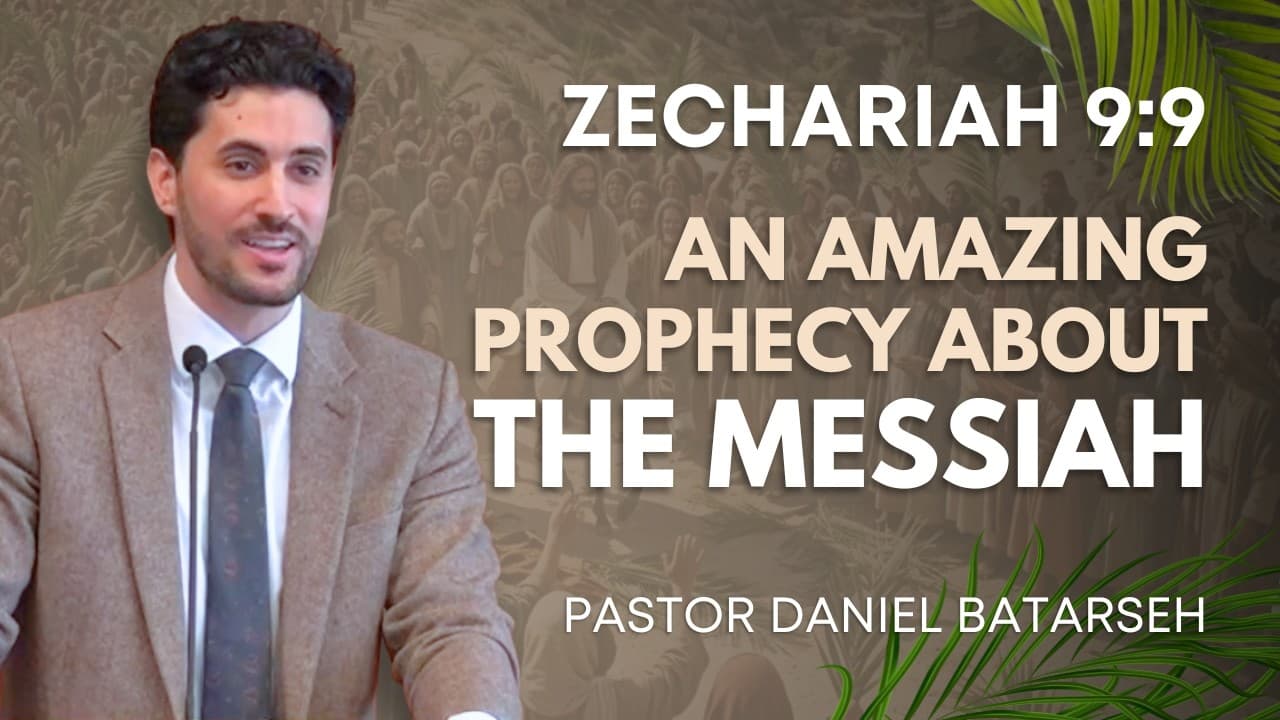
Zechariah 9:9 is far more than a prediction about a donkey. When you trace the prophetic thread from Genesis to Ezekiel to the triumphal entry, the full picture is staggering.
What Zechariah 9:9 Really Tells Us About the Messiah
Most of us know the Palm Sunday script. Jesus rides into Jerusalem on a donkey. Crowds wave branches. They shout Hosanna. We read Zechariah 9:9, nod at the fulfillment, and move on to the cross. But what if the prophecy Christ fulfilled that day is far more explosive than a display of humility — and what if we've been reading it in a vacuum, disconnected from the prophetic thread that makes it truly breathtaking?
Here's what most people miss: when Zechariah told his audience that their king was coming, those people hadn't had a king in decades. The monarchy was dead. Their own prophets had stopped referencing Israelite kings altogether. And another prophet — Ezekiel — had already declared that the throne would remain empty until a very specific person arrived. The next king wouldn't be just another ruler in the Davidic line. He would be the last one. The final one. The one to whom all judgment and all authority belongs.
Jesus didn't accidentally ride a donkey into Jerusalem. He was making a claim so audacious that it threads together prophecies spanning from Genesis to Ezekiel to Zechariah — and it changes the way you read every one of them.
The Post-Exilic Authors Stopped Naming Their Own Kings — and That's a Clue
To feel the weight of Zechariah 9:9, you have to understand what his audience had lost. Zechariah was not preaching to people in the glory days of David and Solomon. He was preaching to a remnant — Jews who had returned from Babylonian exile to a Jerusalem that was a shadow of what it had been. The last king Judah ever knew was Zedekiah, and his reign ended in catastrophe. After that, nothing. No throne. No crown. No monarchy.
And here's a subtle but stunning detail. After the exile, the biblical authors changed how they dated their writings. Before the exile, prophets like Isaiah and Jeremiah anchored their prophecies to the reigns of Judah's kings. But afterward? Zechariah 1:1 reads, "In the eighth month, in the second year of Darius." Haggai 1:1 — same thing: "In the second year of Darius the king." Ezra 1:1: "In the first year of Cyrus king of Persia" (hear this moment).
Do you see it? These writers are dating their work by foreign kings. Not because they admired Persia, but because there was no Israelite king to reference. The throne was empty. The office had ceased to function. God did raise up leaders — Ezra the priest, Zerubbabel and Nehemiah as governors — but none of them were kings. Not one.
So imagine being in that audience when Zechariah opens his mouth and says: "Behold, your king is coming to you." A king? Coming to us? From where? It had been generations. Their own prophets had given up dating anything by a Jewish monarch. And now this?
Ezekiel Predicted the Throne Would Stay Empty — Until He Comes
This is where the prophecy gains its full voltage, and it's a passage most Christians have never been shown. In Ezekiel 21:25–27, the prophet — writing from Babylon during the exile — addresses Zedekiah, the last king. But notice: he doesn't even honor him with the title. He calls him "oh profane wicked one, prince of Israel" (watch at 45:05). Then comes the devastating decree: "Remove the turban and take off the crown. Things shall not remain as they are."
The turban represents the priestly office. The crown represents the royal one. Both would be stripped. Both would cease to function as they had. And that's exactly what happened historically — the monarchy ended entirely, and though the priesthood had a brief resurgence, it was never restored to its former glory.
But Ezekiel doesn't stop there. Verse 27: "A ruin, ruin, ruin I will make it. This also shall not be until he comes, the one to whom judgment belongs, and I will give it to him."
As Pastor Daniel Batarseh put it: "The crown is gonna be removed. The throne will be unoccupied. There will be no monarchy in Israel until he comes. And when he comes, I'm gonna give it all to him" (watch at 47:37).
That phrase — until he comes — is not random. It's an echo of one of the oldest messianic prophecies in Scripture. Genesis 49:10, where Jacob blesses Judah: "The scepter shall not depart from Judah, nor the ruler's staff from between his feet, until Shiloh comes, and to him shall be the obedience of the peoples." The Hebrew word rendered "Shiloh" in some translations can also mean "the one to whom it belongs" — which is exactly the language Ezekiel uses centuries later. Scripture is interpreting Scripture across hundreds of years.
So the prophetic picture assembles itself: Genesis says a king from Judah's line will come and the nations will obey him. Ezekiel says the throne will be deliberately emptied — ruined — until that person arrives. And then Zechariah, preaching to people who have no king and can't imagine having one again, says: You'll know him when you see him. He'll be righteous. He'll bring salvation. And he'll be riding on a donkey.
Five hundred years later, Jesus of Nazareth requisitioned a colt and rode into Jerusalem.
Why the Crowd Greeted Him Like a Conquering King (Even Though He Hadn't Conquered Anything Yet)
The common objection — especially from Jewish scholars — is straightforward: even if Zechariah 9:9 is messianic, you Christians conveniently ignore verse 10. That verse promises the Messiah will cut off war chariots, speak peace to the nations, and rule from sea to sea. Did Jesus do any of that?
Some Christians try to solve this by spiritualizing verse 10 — treating it as metaphor for the gospel's transformative power while keeping verse 9 literal. But as the sermon made clear, the context won't bear that. You can't pick and choose what's literal based on what's convenient. The better answer is one that runs throughout Old Testament prophecy: there are gaps between prophetic declarations. Isaiah 61:2 puts "the year of the Lord's favor" and "the day of vengeance" in the same breath — but Jesus, reading it in the Nazareth synagogue in Luke 4, stopped mid-sentence after "the year of the Lord's favor." Why? Because the day of vengeance belongs to a different advent. Isaiah 9:6–7 does the same thing: "To us a child is born" and "his government will have no end" — one sentence spanning two comings separated by millennia.
Zechariah's prophecy works the same way. Verse 9: first coming. Verse 10: second coming. Same Messiah. Two advents.
But here's the layer that made the room go quiet. When Jesus fulfilled verse 9, he didn't leave verse 10 with zero evidence. He gave a preview. John 12:17–18 tells us why the crowd was so frenzied that day: Jesus had just raised Lazarus from the dead. Word had spread. And the logic of the crowd was visceral and immediate — as Pastor Daniel Batarseh described it: "Hold on. This Jesus raised somebody from the grave? If death obeys him, what nation, what army, what foreign power can stand against him?" (watch at 1:05:47).
They weren't caught up in a spontaneous parade. They had calculated — wrongly in their timing, but rightly in their instinct — that a man who commands death itself could surely command the nations. Even the Pharisees, panicking in John 12:19, blurted out an unintentionally prophetic line: "Look, the world has gone after him." They meant it as a complaint. It was actually a prediction.
So the triumphal entry wasn't just a humble king on a donkey. It was a demonstration of power restrained. A king who could have unleashed verse 10 but chose instead to ride toward a cross — because there was another mission that had to come first.
You Have More Clarity Than the Prophets Ever Did
John 12:16 contains a confession that should stop us cold: "His disciples did not understand these things at first, but when Jesus was glorified, then they remembered that these things had been written about him and had been done to him." The disciples were there. They walked beside Jesus. They heard the crowds. They watched him mount the donkey. And they didn't get it.
1 Peter 1:10–11 takes it further. The prophets themselves — the ones who received the revelation — "searched and inquired carefully, inquiring what person or time the Spirit of Christ in them was indicating." They wrote the words and then researched their own prophecies, trying to figure out who the Messiah would be and when he would come. They weren't in trances. They were fully conscious, fully engaged — and still left without the complete picture.
Consider what that means for you. The prophets had pieces. The apostles had proximity but not yet understanding. You have the completed canon. You can hold Genesis 49 next to Ezekiel 21 next to Zechariah 9 next to John 12 and see the thread that the men who wrote those books could only glimpse. As the sermon pressed home: "We are more blessed on this side of the cross" — and we just proved it by putting scripture with scripture and watching a single prophetic promise unfold across two thousand years of redemptive history (hear this moment).
That's not trivia. That's the ground beneath your feet. Your faith has roots that go deeper than you realized, anchored in a consistency that no human author could have engineered.
"Rejoice Greatly" — The Command We Rush Past
We spend so much time on the king and the donkey that we skip the first word of the prophecy: Rejoice. Not just rejoice — rejoice greatly. Shout aloud. The arrival of this king is supposed to produce something in you.
And that's where the sermon turned from exposition to examination. The news of a new king isn't always good news. It can be terrifying. Who is he? Is he a tyrant? Is he power-hungry? What will he demand? But Zechariah says you can rejoice greatly because this king is righteous, humble, and he comes to save. He's not like the kings catalogued in 1 Kings and 2 Kings. He's not like the rulers of history.
So here's the honest question: does the kingship of Jesus over your life produce actual joy? Not theological assent. Not a bumper sticker. The kind of joy 1 Peter 1:8 describes — inexpressible and filled with glory, directed toward a king you've never seen with your eyes but who is more real to you than anything you can touch.
If that joy is absent, Pastor Daniel Batarseh offered two diagnoses. First, maybe you've never actually made Jesus king. "To some, whether they wanna admit it or not, he's more like a butler. And he's there in the margins and whenever you're ready to call him, Jesus, I need you, and he comes and does your bidding. He's not a butler. He's a king" (watch at 1:15:09). Second, maybe you crowned him once but your gaze drifted. Some other sparkling crown grabbed your attention. Some other throne promised protection or pleasure.
Either way, the remedy is the same: look again at who this king is. A king who extends his scepter so you can approach freely. A king who rules the universe and still cares about your Tuesday. A king who didn't just claim a throne — he earned it by dying on a cross.
Rejoice greatly. Your king has come. And he is coming again.
What to Remember
- After the Babylonian exile, the biblical authors stopped dating their writings by Israelite kings because there were none left — making Zechariah's promise of a coming king electrifying to his audience.
- Ezekiel 21:25–27 prophesied that the throne would remain empty until a specific person arrived — the one to whom all judgment belongs — linking directly to the messianic promise of Genesis 49:10.
- The crowd at the triumphal entry didn't spontaneously erupt — they greeted Jesus as king because he had just raised Lazarus from the dead, and they reasoned that a man whom death obeys could conquer any earthly power.
- Zechariah 9:9 and 9:10 describe two advents of the same Messiah, not one event — a pattern found throughout Old Testament prophecy, including Isaiah 61:2 and Isaiah 9:6–7.
- You have more prophetic clarity than the prophets who wrote the words or the apostles who witnessed the events — the completed Scripture is one of the great privileges of the new covenant.
Questions to Sit With
- If someone asked you why Christians celebrate Palm Sunday — not just what happened, but why it matters prophetically — could you walk them through it?
- The prophets searched their own prophecies trying to understand what God had revealed through them. When was the last time you searched Scripture with that kind of hunger?
- Is Jesus functioning as king of your life — or as someone you summon when you need something? Be brutally honest.
- The crowd hailed Jesus because they saw his power over death but missed his mission to suffer. Are there parts of who Jesus is that you celebrate while ignoring others that make you uncomfortable?
- Zechariah says the proper response to this king is to "rejoice greatly." On a scale of dutiful compliance to inexpressible joy, where does your relationship with Christ actually land?
Scripture Referenced
- Zechariah 9:9–10 — The primary prophecy of the coming king
- Matthew 21:1–16 — The triumphal entry account
- Zechariah 1:1 — Dating by the reign of Darius
- Haggai 1:1 — Post-exilic dating by foreign kings
- Ezra 1:1 — Post-exilic dating by Cyrus of Persia
- Ezekiel 21:25–27 — The removal of the crown until "he comes"
- Genesis 49:10 — The scepter of Judah and the coming of Shiloh
- John 12:12–19 — The triumphal entry and the Lazarus connection
- 1 Peter 1:10–11 — The prophets searching their own prophecies
- Isaiah 61:2 — Prophetic gap between favor and vengeance
- Isaiah 9:6–7 — Birth and eternal government in one breath
- Psalm 126:1–3 — The Lord has done great things for us
This summary was generated by AI from the sermon "Zachariah's Amazing Prophecy About the Messiah | Zachariah 9:9 | Pastor Daniel Batarseh (3/29/26)" preached by Pastor Daniel Batarseh at Maranatha Bible Church Chicago. Watch the full sermon →
Preached by
Pastor Daniel BatarsehSenior Pastor
This summary was generated by AI from the sermon transcript.
Based on the sermon