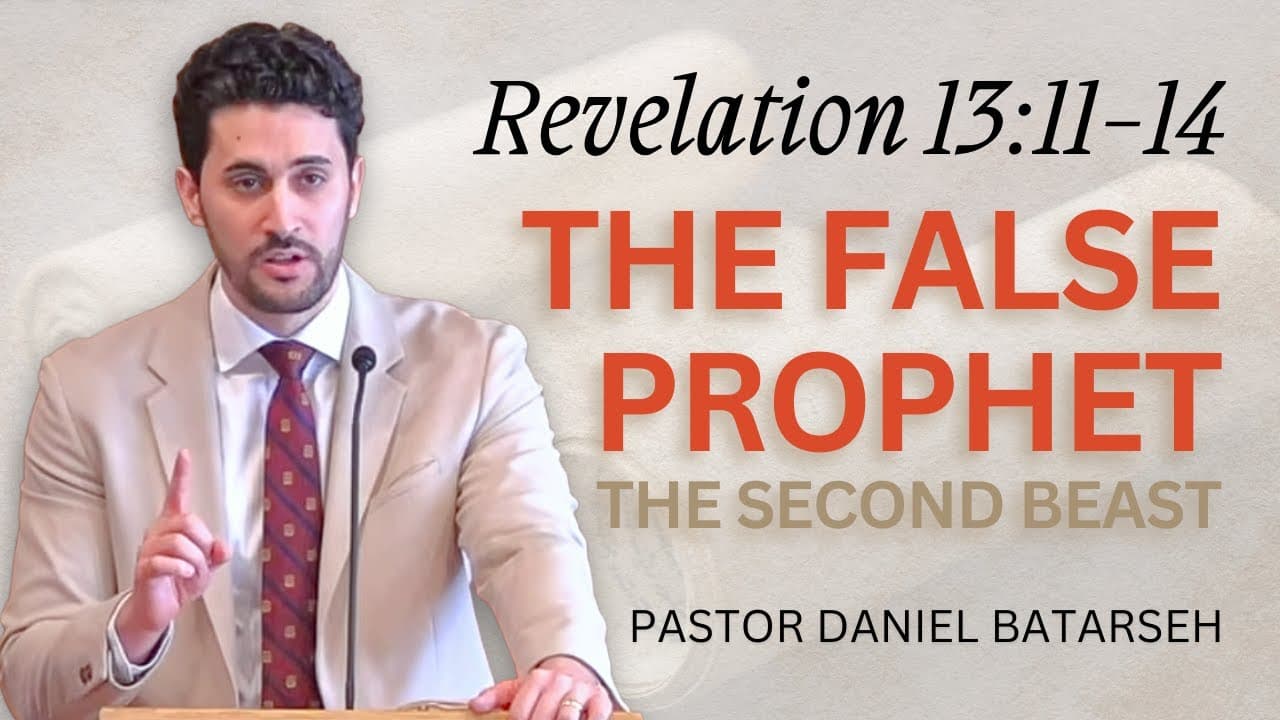
The second beast of Revelation 13 looks like a lamb but speaks like a dragon — and that contrast reveals exactly how Satan's most dangerous deception works.
Satan's most terrifying weapon isn't the dictator who openly blasphemes God. It's the gentle voice that sounds like a lamb.
In Revelation 13:11-14, John's apocalyptic vision introduces a second beast — distinct from the Antichrist, yet working in lockstep with him. This figure looks harmless. He carries an air of spiritual authority. He performs miracles that leave crowds breathless. And when the rest of Revelation identifies him by name, it calls him the false prophet — not a false prophet, but the final and most devastating one in human history. His mission? To convince the entire world to worship a man. And the way he does it exposes a pattern of deception that is already at work today.
Pastor Daniel Batarseh walked through this passage in careful detail, and what emerged wasn't just a lesson in eschatology — it was a mirror held up to every age, including ours.
A Lamb That Roars: Why the Second Beast Is More Dangerous Than the First
The first beast of Revelation 13 is grotesque — multiple heads, multiple horns, a composite of terrifying animals. You see it and recoil. But the second beast? John describes it simply: "It had two horns like a lamb and it spoke like a dragon" (watch at 2:27).
That contrast is the whole point. This figure will present himself as meek, winsome, trustworthy. He possesses authority — the horns tell us that — but unlike the first beast, his horns carry no crowns. His power isn't political. It's spiritual. He's the kind of person you'd feel safe around. His voice soothes. His presence reassures. In a world falling apart under divine judgment, war, and chaos, this man will seem like exactly what humanity needs.
But the moment he opens his mouth, the dragon speaks.
As Pastor Daniel Batarseh put it: "He fulfills exactly what the Lord Jesus warned about in Matthew 7:15 — 'Beware of false prophets who come to you in sheep's clothing, but inwardly they are ravenous wolves.' And this man will be more than a wolf. He will be a dragon" (watch at 13:15).
This is what makes the second beast more terrifying than the first. The Antichrist is open in his blasphemy. He hunts Christians. He declares himself God. You can see the evil. But the false prophet conceals his evil beneath a veneer of gentleness and spiritual credibility. He is the lie dressed as the truth.
And that distinction tells us something critical about how Satan operates — not just in the future, but right now. He works both ways. Sometimes he's brazen: open mockery of God on award show stages, cultural celebration of what Scripture calls evil. But his more effective strategy has always been subtler — wrapping satanic doctrine in religious packaging, making it feel warm, inviting, even righteous.
Tears Are Not the Mark of Truth
Here's where the sermon pressed hardest against the way many Christians evaluate spiritual teaching. We tend to judge teachers by how they look, how they sound, how passionately they deliver their message. A preacher weeps while talking about Jesus and we assume sincerity. A speaker fills an arena and we assume anointing. A voice on a podcast moves our emotions and we assume truth.
But the second beast had the appearance of a lamb. The giveaway was never his appearance — it was his words. As the sermon made plain: "What was the giveaway? When the lamb opened its mouth. From the external, from distant observation — harmless, innocent, cute. The moment it began to speak, it revealed where it actually came from" (watch at 17:25).
This is a principle that applies far beyond end-times prophecy. It's about how you and I evaluate any voice that claims to speak for God — whether on a platform, in a living room, or on a screen in your pocket.
Romans 16:17-18 lays it bare. Paul warns that false teachers "do not serve our Lord Christ, but their own appetites, and by smooth talk and flattery they deceive the hearts of the naive." Notice who falls victim: the naive. Not the unintelligent — the undiscerning. People who listen without evaluating. People who feel without thinking. People who let charisma substitute for content.
The antidote Paul offers isn't suspicion. It's doctrine. "Watch out for those who cause divisions and create obstacles contrary to the doctrine that you have been taught. Avoid them" (Romans 16:17). The standard isn't how the teaching makes you feel. The standard is whether it aligns with what God has already said.
And then there's the example of the Bereans in Acts 17:11 — believers who eagerly received Paul's teaching but also "daily examined the scriptures to see if what this missionary team was saying was according to the word of God." They didn't check their brains at the door. They opened their Bibles. And the Holy Spirit calls them noble for it.
The choice, then, is stark: noble or naive. You can investigate the substance of what someone teaches, or you can be swept along by the style of their delivery. One path leads to discernment. The other makes you exactly the kind of person the false prophet will exploit.
A story from the sermon drove this home with uncomfortable clarity. During his college years, a Christian campus group struggled to get permission to hold public ministry events. The administration made it difficult at every turn. But one day in the cafeteria, there were long lines of students — a waitlist, even — for fortune tellers with tarot cards that the school had invited. Students were giving their phone numbers to be texted when a spot opened up (hear this moment).
The lesson? People are desperate for the supernatural. There is something hardwired into the human soul that reaches for transcendence, for worship, for contact with something beyond the material world. The question was never whether people will worship. It's what they'll worship. And when that hunger isn't directed toward the true God, it will find an idol — even a man who claims to have conquered death.
The Satanic Trinity: How the Devil Mimics God
One of the most striking insights in this passage is how the introduction of the false prophet completes a dark mirror image of the Trinity.
Think about the structure of the vision. First, the dragon — Satan himself — who empowers everything. He functions as a counterfeit Father. Then the first beast, the Antichrist — the devil incarnate, a false son. And now the second beast, the false prophet, whose entire mission is to point people toward the Antichrist and inspire their worship of him. A counterfeit Holy Spirit.
This isn't coincidence. It's imitation. Satan is so desperate, so consumed with his ancient ambition to "be like the Most High" (Isaiah 14:14), that he constructs a perverted trinity to rival the real one.
Consider what Jesus said about the Holy Spirit's role in John 16:14: "He will glorify me, for he will take what is mine and declare it to you." The Spirit's mission is singular — to magnify Christ, to make people love Him more, to draw every heart toward the Son. And in a sick inversion of that mission, the false prophet will attempt the same thing for the Antichrist. He will use every tool at his disposal — rhetoric, miracles, the spectacle of a faked resurrection — to draw the world's allegiance toward a man who is not God.
This is also, by the way, one of the clearest tests for whether the Holy Spirit is genuinely at work in a church or a ministry: how much is Jesus Christ exalted? Not emotional experiences. Not signs and wonders. Not the personality of the leader. Christ. "Do you want to know if the Holy Spirit is working in your life?" the sermon asked. "You will love Christ more and more and more" (watch at 29:43).
The Miracles Are Real — And That's the Point
Verses 13-14 describe the false prophet performing "great signs, even making fire come down from heaven to earth in front of people." This raises an obvious question: Are these genuine miracles or elaborate tricks?
The text suggests they are genuinely supernatural — demonic in origin, but real in their power. And the reason God permits them is not weakness or indifference. It's judgment.
2 Thessalonians 2:9-12 provides the commentary. Paul writes that the lawless one comes "with all power and false signs and wonders, and with all wicked deception for those who are perishing, because they refused to love the truth and so be saved." And then the devastating conclusion: "Therefore God sends them a strong delusion, so that they may believe what is false."
Notice the sequence carefully. God does not arbitrarily deceive people. He sends delusion upon those who have already refused to love the truth. After every opportunity, every manifestation of His existence, every act of mercy — after the unprecedented supernatural displays of the tribulation period itself — there will be people who still spit in God's face. And at some point, He says: Fine. You want darkness? Here it is. Here is a messiah who will not save you and a prophet who will damn you.
This is terrifying. But it is not unjust. As the sermon pressed: "How can you charge God of being wrong for simply giving people what they want?" If He convicts, people call Him unloving. If He lets them go, people call Him unfair. "No matter what way you look at it, God always gets the blame. This is how evil we are" (watch at 41:25).
And this carries a principle that reaches beyond the tribulation into this very moment. It is a dangerous thing to be repeatedly exposed to truth and repeatedly push it away. Each refusal doesn't just leave you where you were — it hardens you further. It makes you more susceptible to the next lie. The person who suppresses conviction today is building the callus that deception will exploit tomorrow.
But before God ever sends delusion, He sends something else first. He sends His Son. Two thousand years ago, mercy took on flesh and walked among us. Grace bled on a cross. Love absorbed the wrath that belonged to you. That is God's heart — not judgment, but rescue. The strong delusion is what happens when rescue is refused long enough.
The table is still set. The invitation still stands. Today.
What to Remember
- The false prophet's greatest weapon is not raw power but the appearance of innocence — he looks like a lamb, and that's precisely what makes him lethal.
- Tears, passion, and charisma are not evidence of truth. The only reliable test for any teacher is whether their content aligns with Scripture — not how their delivery makes you feel.
- Satan constructs a counterfeit trinity — dragon, beast, and false prophet — mirroring Father, Son, and Holy Spirit, revealing how desperately he wants to be worshiped as God.
- God sends strong delusion not on the ignorant but on those who persistently refuse the truth — judgment comes as giving people exactly what they've chosen.
- Every human being is wired to worship; the question is never whether you worship but whom — and misdirected worship is what the Bible calls idolatry.
- The Holy Spirit's signature work is making much of Jesus Christ. Any ministry, any movement, any teacher that consistently points you away from Christ and toward something else — no matter how spiritual it feels — is not operating in the Spirit.
Questions to Sit With
- If the false prophet's deception works because people evaluate teachers by appearance and emotion rather than doctrine, how do you currently evaluate the voices you listen to? What would change if you applied the Berean standard this week?
- What are you worshiping? Not in theory — in practice. Where does your greatest affection actually go? What is the supreme authority that determines your decisions? Be honest enough to let the answer unsettle you.
- Is there a conviction from God's Word that you've been hearing repeatedly and pushing away? What does 2 Thessalonians 2:10-12 suggest happens when that pattern continues unchecked?
- If the mark of the Holy Spirit's presence is an increasing love for Jesus Christ, what does that say about the spiritual health of the churches, podcasts, and teachers you follow?
- The false prophet will exploit humanity's innate hunger for the supernatural. Where do you see that hunger being exploited — or misdirected — in your own life or culture right now?
Scripture Referenced
- Revelation 13:11-14 — Primary passage: the second beast introduced
- John 8:23 — Jesus distinguishes Himself from worldly religious leaders
- Matthew 7:15 — Jesus warns of false prophets in sheep's clothing
- Romans 16:17-18 — Paul warns about smooth-talking false teachers
- Acts 17:11 — The Bereans examine Scripture daily
- Revelation 16:13 — The false prophet named alongside the dragon and beast
- Revelation 19:20 — The beast and false prophet thrown into the lake of fire
- Revelation 20:10 — The devil joins them in eternal torment
- John 16:14 — Jesus describes the Holy Spirit's mission to glorify Him
- 2 Thessalonians 2:9-12 — God sends strong delusion on those who refuse the truth
This summary was generated by AI from the sermon "The False Prophet (The Second Beast) | Revelation 13:11-14 | Pastor Daniel Batarseh (Series)" preached by Pastor Daniel Batarseh at Maranatha Bible Church Chicago. Watch the full sermon →
Preached by
Pastor Daniel BatarsehSenior Pastor
This summary was generated by AI from the sermon transcript.
Based on the sermon
The False Prophet (The Second Beast) | Revelation 13:11-14 | Pastor Daniel Batarseh (Series)
Watch Full SermonRelated Articles
What Revelation 21 Says About Heaven That You've Never Noticed
Pastor Daniel Batarseh · October 11, 2026
What Revelation 21 Says About Eternity (It's Not What You Picture)
Pastor Daniel Batarseh · October 11, 2026
Hebrews 9 and Why Christ's Second Coming Isn't About Sin
Pastor Daniel Batarseh · October 4, 2026