Revelation 17:14 crowns Jesus with a title the Old Testament reserves for Yahweh alone. That's not a coincidence — it's a declaration of war and deity.
It would have made more sense if John had written "the Lion will conquer them." Ten kings. A global regime. The full fury of the Antichrist's empire marshaled for war against Jesus Christ. If ever there was a moment for the roaring, terrifying Lion of Judah to appear, this was it.
But that's not what Revelation 17:14 says.
"They will make war on the Lamb, and the Lamb will conquer them."
The Lamb. The sacrificial, slaughtered, seemingly weak Lamb. And tucked inside that same verse is a title so explosive that it quietly settles one of the most debated questions in all of theology — whether Jesus Christ is truly God. Because "Lord of lords and King of kings" is not a New Testament invention. It is a crown taken straight from the head of Yahweh in the Old Testament and placed squarely on Jesus. If you've ever wanted to know how to demonstrate the deity of Christ from a single verse, Revelation 17:14 hands it to you on a platter.
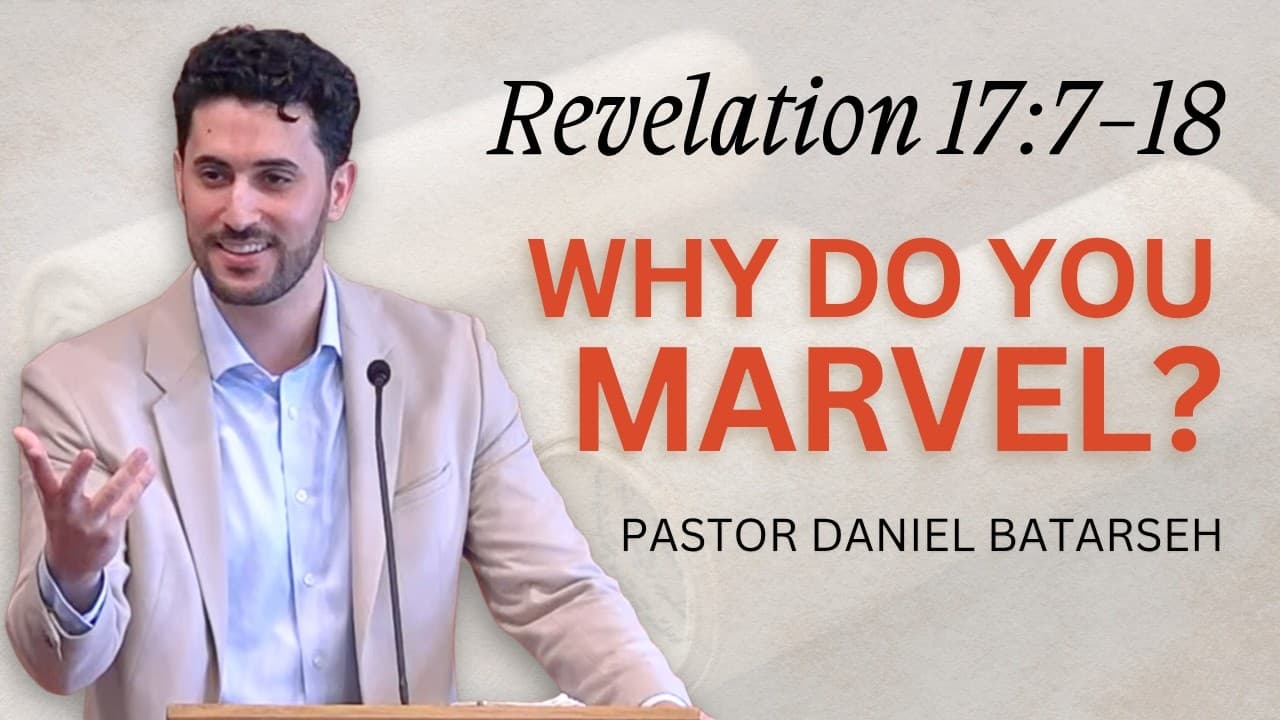
That's where Pastor Daniel Batarseh took us in his exposition of Revelation 17:7–18 — into the deep end of this apocalyptic vision, where grotesque beasts and political machinations give way to a staggering theological claim about who Jesus really is.
A Title That Belongs to Yahweh Alone
Here is where you need to slow down and pay attention, because this is the kind of cross-reference that changes how you read your Bible.
In Deuteronomy 10:17, Moses declares: "For the LORD your God is God of gods and Lord of lords, the great, the mighty, and the awesome God." This is Yahweh speaking about himself — the covenant God of Israel, the one who tolerates no rivals. The title "Lord of lords" is his exclusive property (watch at 2:33).
In Daniel 2:47, even the pagan king Nebuchadnezzar confesses: "Truly your God is God of gods and Lord of kings." In Psalms 136:2–3, the psalmist calls Israel to worship: "Give thanks to the God of gods... Give thanks to the Lord of lords, for his steadfast love endures forever" (watch at 3:14).
Now hold those passages in your mind and turn to Revelation 17:14. John — a Jewish man steeped in the Hebrew scriptures, a man who walked with Jesus, who leaned against his chest at the Last Supper — dares to take this Yahweh-exclusive title and apply it without flinching to the Lamb. "He is Lord of lords and King of kings."
Some will object. They'll point out that Jesus isn't called "God of gods" here, only "Lord of lords" and "King of kings." But that objection collapses under its own weight. As the sermon made clear, nowhere in the entire New Testament is even the Father called "God of gods." The phrase simply isn't repeated in the new covenant writings. What is repeated — and applied directly to Jesus — is the functional equivalent: the supreme lordship and kingship that the Old Testament reserved for Yahweh and Yahweh alone (hear this moment).
This isn't a matter of Jesus receiving an honorary title. It's an ontological claim. John is saying: the Lamb who was slain is the same God who thundered from Sinai.
The Lamb Conquers What the Lion Wouldn't Need To
There is something almost absurd about the scene Revelation 17 describes. Ten kings — real political rulers, administrators of the Antichrist's global regime — will surrender their authority to the beast and actually take up arms against Jesus Christ. They will stand on a battlefield, weapons in hand, and attempt to fight the Son of God.
Think about the delusion required for that. These are not ignorant peasants swept up in mob frenzy. These are heads of state, sophisticated rulers governing designated zones of the Antichrist's empire. They are organized. They are unified. And they are utterly, catastrophically deceived.
As Pastor Daniel Batarseh put it: "You have to remember the Antichrist is going to be really Satan incarnate, and he will understand, he will have some idea of when Christ's return will come about. And so he will recruit these ten kings, they will surrender their authority to him, and they will actually stand side by side against Jesus Christ — which will be an utter and complete failure" (watch at 0:59).
An utter and complete failure. Not a narrow defeat. Not a hard-fought battle. An utter failure. And notice — it's the Lamb who wins. Not the Lion roaring them into submission with brute force, but the Lamb. The one who conquered first by dying. The one whose primary weapon is sacrificial love. The one who looked weakest at the exact moment he was doing his greatest work.
That word choice is not accidental. John could have used any christological title. He chose "Lamb" because it reveals something about the nature of divine power that the world has never understood and never will: God's strength is most fully displayed not in domination but in sacrifice. The cross was not Plan B. It was the strategy. And the Lamb who bled on Calvary is the same Lord of lords who will dismantle the most powerful human empire ever assembled.
If that doesn't stir something in you, check your pulse.
Ten Horns, Seven Heads, and Why the Details Matter
Revelation 17 is admittedly the deep end of the pool. The imagery is dense — a beast with seven heads and ten horns, a prostitute riding on top of it, and an angel who essentially says, "Let me explain what you're seeing." It would be easy to get lost in the symbolism and miss the substance.
But the angel's explanation follows a deliberate structure. Four things are laid out for us: the identity of the beast, the meaning of the seven heads, the significance of the ten horns, and the nature of the prostitute. Each layer peels back another dimension of the Antichrist's system.
The ten horns represent ten kings — real political rulers who will work under the Antichrist's authority. The sermon was careful to note that this suggests the Antichrist will divide his regime into zones, each governed by a subordinate ruler. It's an administration, not chaos. It's organized evil with a chain of command (watch at 0:00).
And here is where pastoral wisdom showed itself: "Now if we go further than that, then we're just entering into the land of speculation, so I will stay away from it." That restraint matters. Revelation attracts wild-eyed speculation the way a porch light attracts moths. But responsible teaching knows where the text speaks clearly and where it doesn't. The ten kings are real future rulers. Their exact geographic assignments are not revealed. To pretend otherwise is to add to the text what God chose to leave out.
What is clear is that their unity with the Antichrist will be total — and totally futile. They will pool their authority, their military might, their political capital, and hurl it all against Christ. And it will shatter like glass against granite.
The Foolishness of Preaching Without the Spirit
One of the most striking moments in this sermon had nothing to do with eschatology. It came during the prayer.
Before diving into the exposition, the pastor paused and prayed with a kind of raw honesty that you don't always hear from pulpits: "Foolish is the preacher who depends on his eloquence. Ignorant is the man who thinks that he can do this without your help" (hear this moment).
That's not a throwaway line. That's a theological conviction about the nature of preaching itself. We live in an age of polished communicators, TED-Talk-style sermons, and pastors who are celebrated more for their delivery than their doctrine. But here is a man standing at the deepest, most complex section of the Bible's final book, and his first instinct is not confidence in his preparation but desperation for the Spirit's help.
And notice — he didn't just call himself foolish for self-reliance. He extended it to the congregation: "And Lord, we are equally foolish for thinking that we can hear and..." The sentence trails off in the transcript, but the implication is clear. Hearing the Word of God is not a passive act. It requires divine illumination just as much as preaching does. You can sit in a pew with your Bible open and your pen ready and walk away having heard nothing — if the Spirit doesn't open your ears.
That should humble every one of us. The next time you sit down to read Revelation — or Romans, or Genesis, or any page of Scripture — do you pray first? Do you actually ask God to show you what you cannot see on your own? Or do you trust your intellect, your study tools, your commentary collection?
The deep end of Revelation will drown the self-sufficient reader. It was designed to.
What to Remember
- The title "Lord of lords" belongs to Yahweh in the Old Testament and is applied directly to Jesus in Revelation 17:14 — this is one of the clearest proofs of Christ's deity in all of Scripture.
- The Antichrist's regime will be organized and sophisticated, not chaotic — ten kings ruling designated zones under his authority — and it will still be dismantled effortlessly by the Lamb.
- John deliberately chose "Lamb" over "Lion" in Revelation 17:14 because God's power is most fully displayed through sacrifice, not brute force. The cross was the strategy, not the setback.
- Responsible Bible teaching knows where the text speaks and where it doesn't. Speculation about prophetic details God chose to leave vague is not faithfulness — it's addition.
- Neither preaching nor hearing the Word of God can be done in self-reliance. The Spirit who inspired the text must illuminate it, or we walk away having understood nothing.
Questions to Sit With
- If the Lamb conquers the most powerful empire in human history, what does that say about the battles in your own life that feel impossible — and about how God might choose to win them?
- The ten kings were sophisticated, organized, and completely deluded. What forms of sophisticated delusion exist today that make people confident they can stand against God?
- Do you actually pray before you read Scripture — not as a ritual, but out of genuine dependence on the Spirit to show you what you'd miss on your own?
- If Revelation 17:14 proves the deity of Christ by applying Yahweh's title to Jesus, how does that change the way you worship him — not just as a good teacher or moral example, but as the eternal God?
- Where in your life are you trusting in the "lion" approach — raw power, control, domination — when God is calling you to the way of the Lamb?
Scripture Referenced
This summary was generated by AI from the sermon "Why Do You Marvel? | Revelation 17:7-18 | Pastor Daniel Batarseh (5/17/26)" preached by Pastor Daniel Batarseh at Maranatha Bible Church Chicago. Watch the full sermon →
Preached by
Pastor Daniel BatarsehSenior Pastor
This summary was generated by AI from the sermon transcript.
Based on the sermon