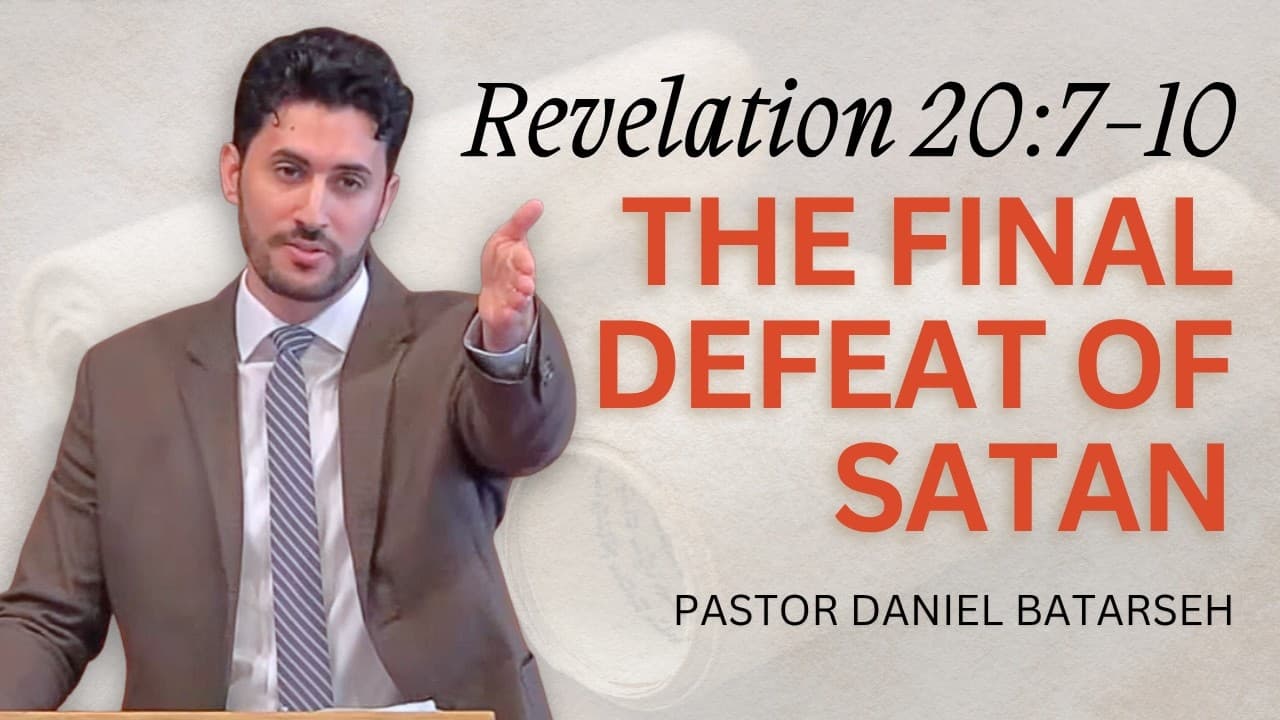
A perfect government under Christ for 1,000 years — and humanity still revolts. Revelation 20:7-10 reveals what no law, no leader, and no ideal environment can fix.
Why the Millennium Proves Laws Can't Save Us (Revelation 20:7-10)
Imagine the most perfect government in human history. Not a theoretical one — a real, physical kingdom ruled by Jesus Christ himself from Jerusalem, enforcing flawless justice, eliminating war, restoring the earth to Edenic conditions. Now imagine that after a thousand years of this paradise, an innumerable multitude of people choose to rebel against that King. Not because they were oppressed. Not because they lacked anything. But because their hearts were never changed.
That is exactly what Revelation 20:7-10 describes. And if that doesn't unsettle you — if it doesn't force you to reconsider where you've placed your hope for the future of your family, your nation, your own soul — you haven't yet grasped what the text is saying.
The Most Shocking Rebellion in All of Scripture
The passage is breathtakingly brief for an event of such magnitude. After a thousand years of Christ's visible, bodily reign on earth, Satan is released from the abyss where he has been imprisoned. He goes out to the nations at the four corners of the earth, and he deceives them. He gathers them for war. Their number? "Like the sand of the sea" (watch at 7:00).
Let that settle. This isn't a small fringe uprising. This is an ocean of humanity that has lived under perfect government, breathed the air of a restored creation, witnessed the glory of Christ with their own eyes — and chosen to march against him.
How is this possible? Because the millennium will enforce peace through swift justice and perfect righteousness, but for many people, that holy environment will produce outward conformity only. As Pastor Daniel Batarseh put it with striking clarity: "Laws may restrain corruption in the unregenerate heart, but laws do not transform the heart" (hear this moment).
This is the great unveiling of the millennium's end. Not a failure of Christ's government, but a final, devastating exposure of what the human heart is capable of apart from regeneration. You can remove every external excuse — poverty, injustice, Satan's influence, corrupt leadership — and the heart of man will still manufacture rebellion from the raw materials of its own depravity.
And notice: Satan doesn't force anyone. He suggests. He deceives. But the fuel was already there. He just strikes the match.
Gog and Magog: Not What You Think
When John writes that Satan will gather "Gog and Magog" for this final battle, many readers assume he's describing the fulfillment of Ezekiel 38-39 — the famous prophecy of a massive invasion of Israel led by a mysterious northern power. The names are the same. Both involve a coalition of nations. Both end with God's decisive intervention. Case closed, right?
Not so fast.
A careful comparison of the two passages reveals at least four critical differences that make it very difficult to claim they describe the same event.
First, the scope is different. In Ezekiel, a specific coalition of identifiable nations — Persia (modern Iran), Cush (Ethiopia), Put (Libya) — is led by an individual from the "uttermost parts of the North" (Ezekiel 38:15). In Revelation 20, Satan goes to the nations at the four corners of the earth and gathers an innumerable multitude. The scale is global, not regional.
Second, the target is different. Ezekiel's prophecy focuses specifically on "my people Israel" (Ezekiel 38:16). But Revelation 20 says the nations surround "the camp of the saints and the beloved city" — a company that includes all believers, both Jewish and Gentile, who share in Christ's millennial reign.
Third, the aftermath doesn't align. After the war in Ezekiel, Israel spends seven years burning weapons and seven months burying the dead (Ezekiel 39:9-12). But after the battle in Revelation 20, the narrative moves immediately into the Great White Throne judgment and the new heavens and new earth. There's no seven-year cleanup before eternity begins (watch at 25:35).
Fourth, and perhaps most telling, the purpose of Ezekiel's war is to open Israel's eyes to recognize the Lord: "The house of Israel shall know that I am the Lord their God from that day forward" (Ezekiel 39:22). But at the end of the millennium, Israel already knows. Christ has been reigning from Jerusalem for a thousand years. What awakening would be necessary?
So why does John use the name at all? Because Scripture frequently uses the names of historical figures and regions to draw thematic connections. Just as Revelation 2:20 invokes "Jezebel" — not the literal queen from 1 Kings, but a woman operating in the same spirit of corruption — and just as "Babylon" throughout Revelation represents the return of an anti-God system rather than a single ancient city, so "Gog and Magog" in Revelation 20 is a thematic echo. John is saying: Something like Ezekiel's prophecy — but greater, more global, more final — will rise at the end of the millennium. The same defiant spirit. The same foolish ambition. The same swift destruction.
From Sodom to the Beloved City
One of the most moving observations in this study is a connection most readers would never notice on their own.
In Revelation 20:9, the city that the rebellious nations surround is called "the beloved city." The beloved city. That's Jerusalem — a designation confirmed throughout the Psalms. "He chose the tribe of Judah, Mount Zion, which he loves" (Psalm 78:67-68). "The Lord loves the gates of Zion more than all the dwelling places of Jacob" (Psalm 87:1-2). "The Lord has chosen Zion; he has desired it for his dwelling place" (Psalm 132:13).
But now go back to the last time Jerusalem was mentioned in Revelation before this passage. In Revelation 11:8, during the tribulation, the city where God's two witnesses are killed is described as "the great city that symbolically is called Sodom and Egypt, where their Lord was crucified."
Sodom. Egypt. That is how God describes Jerusalem at the height of its rebellion — sunk to such moral degradation that it earns the names of history's most infamous symbols of perversion and oppression.
And then Christ returns. He establishes his throne. He redeems his people. And the city that was called Sodom is now called the beloved city.
"When Jesus Christ becomes king, not just of a place, but of our hearts, he transforms our identity," Pastor Batarseh said. "And no matter how hideous and shameful your current condition may be, this king is willing to conquer your heart and as a result create something of lasting beauty and glory which will display his love for you" (watch at 42:50).
That trajectory — from Sodom to beloved — is not just Jerusalem's story. It's the offer extended to every person in this room, in every room, today. You may have labels you've worn for years, labels you've earned, labels that describe real and ugly things about your history. But the one who renamed a city can rename you.
Two Paths, Day and Night, Forever
The sermon closed with a contrast that should keep anyone awake at night — or rather, for all of eternity's nights.
Satan's judgment is described in Revelation 20:10: he will be "tormented day and night forever and ever." Notice the phrase: day and night. The same phrase appears earlier in the book to describe his activity as the accuser of the brethren — he accuses believers before God's throne "day and night" (Revelation 12:10). There is a terrible symmetry here. The one who accused without ceasing will now suffer without ceasing.
But that same phrase — day and night — describes something else entirely in other parts of Revelation. In Revelation 4:8, the four living creatures praise God "day and night," crying "Holy, holy, holy." In Revelation 7:15, those who came out of the great tribulation serve God "day and night in his temple."
Two paths. Both eternal. Both unceasing. One of endless torment. One of endless worship and service — and notice, service in eternity is not drudgery. If you have ever tasted the joy of serving God now, in this broken world with your broken motives and limited energy, that joy is merely a preview. In eternity, you will serve with perfect strength, perfect purity, perfect delight.
The question is not whether you will spend eternity doing something day and night. You will. The question is which one.
As Pastor Daniel Batarseh pressed the point: "Many of us plan for what we're gonna do the next weekend. Some of us plan for what we're gonna do in the next year, next winter. But have you ever factored in — have you ever meditated on — hold on, what will I be doing day and night forever and ever?" (hear this moment).
And that choice, John 3:36 tells us, hinges on a single person: "Whoever believes in the Son has eternal life. Whoever does not obey the Son shall not see life, but the wrath of God remains on him." True belief leads to obedience. It is not a name tag. It is not a cultural identity. It is a supernatural transformation where the deepest part of who you are testifies: I am a child of God.
If you cannot point to a moment — not necessarily a date written in a Bible, but a living knowledge that you have passed from death to life — why would you wait another day?
What to Remember
- The millennium proves that humanity's fundamental problem is not an unfair environment, corrupt politics, or even Satan — it is the unregenerate human heart, which can rebel even under the perfect reign of Christ.
- Laws restrain evil but never transform souls. Christians who place more hope in legislation than in the gospel have misunderstood both the millennium and the Great Commission.
- John's reference to "Gog and Magog" in Revelation 20 is a thematic echo of Ezekiel 38-39, not its direct fulfillment — the same spirit of rebellion, but on a global and final scale.
- Jerusalem's transformation from "Sodom and Egypt" in Revelation 11 to "the beloved city" in Revelation 20 is a portrait of what Christ does to every life he claims: he replaces our worst identity with his love.
- Eternity offers two unceasing realities — torment day and night, or worship and service day and night. The difference is determined by what you do with Jesus Christ today.
Questions to Sit With
- If even a thousand years of Christ's perfect reign can't change the human heart without regeneration, what does that say about your confidence in political solutions to spiritual problems?
- Is there an area of your life where you are outwardly conforming to Christian expectations without any inward transformation — and what would it take to be honest about that?
- What labels have you worn — given by others or earned by your own choices — that you've accepted as permanent? What would it mean to let the one who renamed Jerusalem rename you?
- If someone asked you to describe the moment you passed from death to life, could you? Not a date, but a living certainty — do you have it?
- You plan your weekends, your vacations, your retirement. Have you genuinely considered what you will be doing day and night, forever and ever?
Scripture Referenced
- Revelation 20:7-10 — Primary passage: Satan's release, final rebellion, and eternal judgment
- Revelation 20:3 — Satan must be released "for a little while"
- Matthew 12:28 — Christ's authority over demons as a sign of the kingdom
- Ezekiel 38:1-16 — The prophecy of Gog and Magog
- Ezekiel 39:9-22 — Aftermath of the war: weapons burned, dead buried, Israel awakened
- Psalm 78:67-68 — God chose Mount Zion, which he loves
- Psalm 87:1-2 — The Lord loves the gates of Zion
- Psalm 132:13 — The Lord has chosen Zion for his dwelling
- Revelation 2:20 — "Jezebel" as a thematic name in Thyatira
- Revelation 11:8 — Jerusalem called "Sodom and Egypt"
- Revelation 4:8 — The living creatures praising God day and night
- Revelation 7:14-15 — Tribulation saints serving God day and night
- Revelation 12:10 — Satan accusing the brethren day and night
- Jeremiah 3:17 — Jerusalem as the throne of the Lord
- Romans 1:16 — The gospel as the power of God unto salvation
- John 3:36 — Belief in the Son and eternal life
This summary was generated by AI from the sermon "The Final Defeat of Satan | Revelation 20:7-10 | Pastor Daniel Batarseh (9/20/26)" preached by Pastor Daniel Batarseh at Maranatha Bible Church Chicago. Watch the full sermon →
Preached by
Pastor Daniel BatarsehSenior Pastor
This summary was generated by AI from the sermon transcript.
Based on the sermon