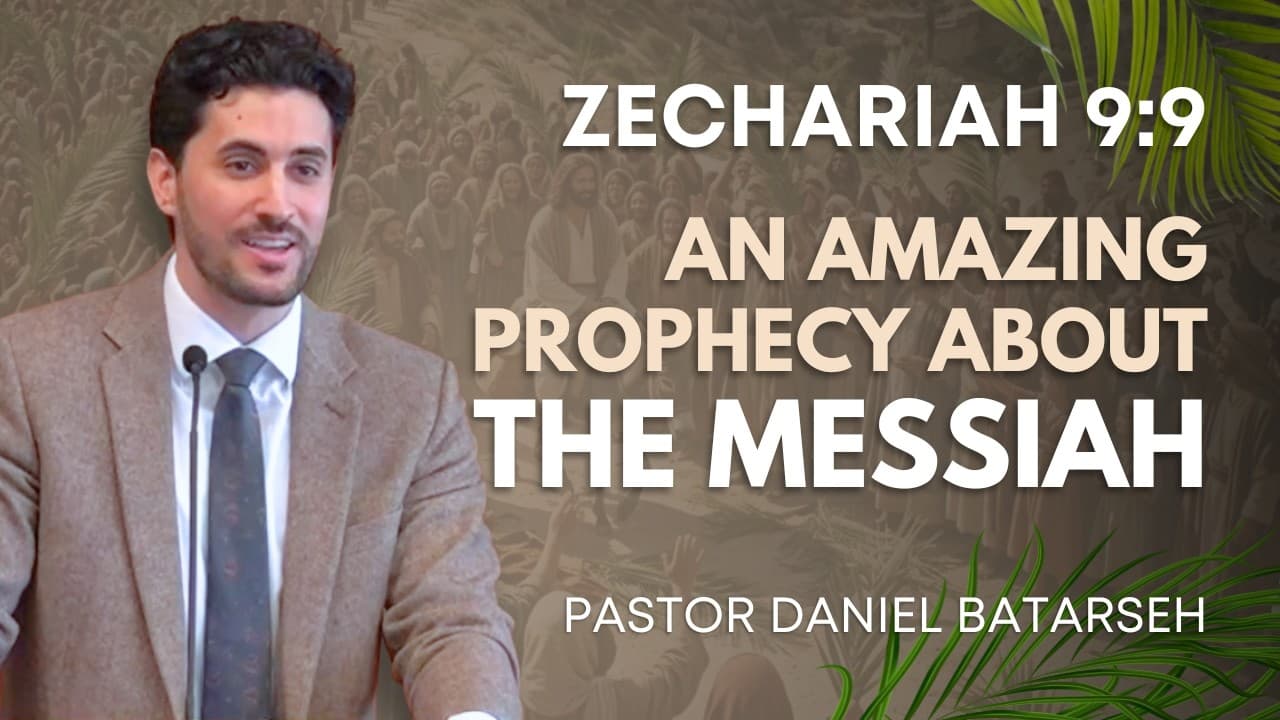
Zechariah 9:9 isn't just about humility on a donkey. It's a promise spoken to a people who hadn't had a king in centuries — and Jesus fulfilled it with breathtaking intentionality.
Zechariah 9:9 — Why 500 Years of No King Made This Prophecy Explosive
Most people read Zechariah 9:9 and see a nice picture of humility — Jesus on a donkey instead of a warhorse. That's true, but it barely scratches the surface. The real power of this prophecy only detonates when you understand who Zechariah was speaking to: a nation that had not had a king for generations, whose own prophets had stopped referencing Israelite kings entirely, and whose scriptures had predicted the royal office would lie dormant until one specific person arrived. When Zechariah told these people "your king is coming to you," it wasn't a gentle devotional thought. It was a thunderclap. And when Jesus of Nazareth deliberately orchestrated his entry into Jerusalem to match this prophecy detail for detail, he wasn't just being humble. He was declaring, in the most public act of his entire ministry, I am the one you've been waiting for since the throne went dark.
A Prophet Speaking to a Kingless People
The timing of Zechariah's ministry changes everything about how we hear his words. Open Zechariah 1:1 and notice the timestamp: "In the eighth month, in the second year of Darius." That's Darius the Persian. Not a king of Judah. Not a king of Israel. A foreign emperor (watch at 38:03).
This detail is easy to gloss over, but it reveals something remarkable once you see the pattern. After the Babylonian exile, every biblical author dates their writing by foreign rulers. Haggai 1:1 — "in the second year of Darius the king." Ezra 1:1 — "in the first year of Cyrus king of Persia." Before the exile, prophets like Isaiah and Jeremiah anchored their prophecies to the reigns of Judah's own kings. After the exile? There were no kings to reference. The monarchy was gone. The throne was empty. The crown had been removed.
The people who returned to Jerusalem had leaders — Ezra was a priest, Zerubbabel and Nehemiah were appointed governors — but none of them sat on David's throne. As Pastor Daniel Batarseh put it: "None of them were kings. Ezra was a priest. Zerubbabel and Nehemiah were appointed governors, nothing more. Nothing more" (hear this moment).
So imagine yourself among these returned exiles. You're back in Jerusalem, but the city is a shadow of its former glory. You have no monarchy. Your prophets date their messages by the calendars of pagan empires. And then Zechariah stands up and says: "Behold, your king is coming to you."
A king? Coming to us? From where? We haven't had a king in decades upon decades. Even our prophets have stopped pretending we do. And you're telling us one is coming?
That's the voltage behind this verse. It's not a general promise about a nice leader. It's a specific, shocking announcement to a people living in a royal vacuum — and the weight of it only increases when you trace where this promise originated.
The Crown Removed — Until He Comes
There's a prophecy in Ezekiel 21 that most people have never noticed, and it functions like a key that unlocks the full meaning of Zechariah 9:9.
Ezekiel was prophesying from Babylon during the exile itself. He was addressing the final king of Judah, Zedekiah — and notice the contempt dripping from the divine address: "And you, O profane wicked one, prince of Israel, whose day has come, the time of your final punishment" (Ezekiel 21:25). God didn't even grant him the title "king." He called him "prince." The demotion had already begun (watch at 45:05).
Then comes the devastating decree in verse 26: "Remove the turban and take off the crown. Things shall not remain as they are." The Hebrew word rendered "turban" in modern translations (the King James has "diadem") refers to the headpiece of a priest. So both offices — priestly and royal — are being stripped. The crown is coming off, and it's not going back on. Not for a long time.
But then verse 27 takes your breath away: "A ruin, ruin, ruin I will make it. This also shall not be until he comes, the one to whom judgment belongs, and I will give it to him."
Did you catch that? The throne will remain empty. The crown will gather dust. There will be no king — until he comes. And when he arrives, God himself will hand him everything.
That phrase — "until he comes" — is an echo. It reaches all the way back to Genesis 49:10, where the patriarch Jacob, blessing his son Judah, declared: "The scepter shall not depart from Judah, nor the ruler's staff from between his feet, until Shiloh comes, and to him shall be the obedience of the peoples." The Hebrew behind "Shiloh" is complex — it can mean a proper name or "the one to whom it belongs" — but the meaning is unmistakable either way. There is a person coming from the tribe of Judah. A king among kings. And this king won't just rule Israel. The nations will obey him (watch at 49:12).
Now stack these prophecies together. Genesis says a supreme ruler will come from Judah. Ezekiel says the throne will be vacant until that ruler arrives. And then Zechariah, speaking to a people living in that exact vacancy, says: "Behold, your king is coming to you — righteous, having salvation, humble, mounted on a donkey."
This is not three unrelated promises. This is one storyline, centuries in the making, converging on a single person. And when Matthew and John record Jesus riding into Jerusalem on a donkey and explicitly quote Zechariah, they aren't proof-texting. They're announcing: the vacancy is over. The throne has its occupant. The one to whom it belongs has arrived.
"If Death Obeys Him, What Army Can Stand Against Him?"
There's a common Jewish objection to Jesus fulfilling this prophecy, and it deserves a serious answer. The objection goes like this: Christians love to quote Zechariah 9:9, but they conveniently ignore Zechariah 9:10, which says the Messiah will "cut off the chariot from Ephraim and the war horse from Jerusalem" and "speak peace to the nations" with a rule stretching "from sea to sea and from the river to the ends of the earth." Did Jesus do that? Did he establish universal peace and global dominion? Obviously not. So how can he be the Messiah?
Some Christians try to solve this by spiritualizing verse 10 — treating it as a metaphor for the spread of the gospel. But as the sermon pressed honestly: "The context doesn't allow that. And you and I have to be careful of determining what's literal and what's allegorical whenever it suits us" (hear this moment). That's a convicting word for anyone who handles Scripture. We don't get to toggle between literal and figurative based on what's convenient.
The better answer — the one that respects the text — is that Old Testament prophecy frequently contains gaps between declarations that appear in the same breath. Isaiah 61:2 speaks of "the year of the Lord's favor" and "the day of vengeance of our God" in a single sentence. But when Jesus read this passage in Luke 4, he stopped after "the year of the Lord's favor." He rolled up the scroll. The day of vengeance belongs to a different advent. Isaiah 9:6-7 does the same thing: "To us a child is born" — that's Bethlehem — and in the very next clause, "his government will have no end" — that's the age to come. Same Messiah. Two arrivals. One prophecy.
But there's an added layer that the sermon surfaced from John 12, and it's brilliant. Why did the crowds greet Jesus the way they did? It wasn't spontaneous excitement at a Passover parade. John tells us plainly: the crowd came because Jesus had just raised Lazarus from the dead, and word had spread like wildfire (John 12:17-18). These people had heard eyewitness testimony that a dead man walked out of a tomb at Jesus' command.
Think about what that does to your calculations. As Pastor Daniel Batarseh put it: "If death obeys him, what nation, what army, what foreign power can stand against him? If death obeys him, then we have a chance" (watch at 1:05:47). The crowd wasn't delusional. They were doing the math. A man who commands death itself could certainly command nations. The power described in Zechariah 9:10 was clearly present in the person riding that donkey. He simply hadn't unleashed all of it yet — because there was another mission first. A cross. A tomb. A resurrection of his own.
Even the Pharisees, in their panic, accidentally prophesied. "Look, the world has gone after him" (John 12:19). They meant it as hyperbole. God meant it as a preview.
The Prophets Searched, the Disciples Missed It, and You Have It All
Here's something that should humble and thrill you simultaneously. 1 Peter 1:10-11 tells us that the prophets who wrote these messianic predictions "searched and inquired carefully" about their own prophecies. They received the revelation, and then they researched it. They compared it to other prophecies. They asked, "Who is this person? When will this happen?" They were not passive instruments in a trance. They were thinking men grappling with divine truth — and they didn't fully understand what they'd been given.
Then you come to the apostles. John 12:16 is startlingly honest: "His disciples did not understand these things at first." They were there. They were in the parade. They heard the shouts and felt the energy. And they didn't get it. It wasn't until after the resurrection and ascension that the pieces fell into place.
So the prophets who wrote the revelation didn't fully grasp it. The disciples who lived the revelation didn't fully appreciate it in the moment. And here you sit — with a completed Bible in your hands, with the full witness of the apostolic writings, with two thousand years of the Spirit's illuminating work in the church — and you can read Zechariah 9:9 alongside Ezekiel 21:27 alongside Genesis 49:10 alongside John 12 and say, I see it. It all fits. This is true.
You are more blessed than you realize. Not because you're smarter than Isaiah or more spiritual than Peter. But because you live on this side of the cross, with the full counsel of God available to you. The question is whether you treat that privilege with the weight it deserves — or whether your Bible collects dust while you scroll for lesser things.
Does This King Produce Joy in You?
Zechariah 9:9 doesn't begin with the donkey. It begins with a command: "Rejoice greatly, O daughter of Zion. Shout aloud, O daughter of Jerusalem." The arrival of this king is supposed to produce something in you. Not dread. Not indifference. Joy — and not a polite, measured joy, but the kind that makes you shout.
The news of a new king isn't always good news. It can mean tyranny, war, uncertainty. But this king is different. He's righteous. He's humble. And he comes armed not with a sword but with salvation.
So here's the question that pressed into the room as the sermon closed: Does the kingship of Jesus produce real, actual joy in your life? Not a theological concept of joy. Not a bumper-sticker joy. The 1 Peter 1:8 kind — "you rejoice with joy that is inexpressible and filled with glory."
If the answer is no, it might be for one of two reasons. First, you may have never actually made Jesus king. He might be more like a butler — waiting in the margins until you summon him for a crisis, then dismissed when things stabilize. That's not a king. That's a servant you control. And controlled servants don't produce joy; they produce anxiety, because deep down you know the arrangement is backward.
Or second, you did crown him once — genuinely, consciously — but somewhere along the way, another throne caught your eye. Another crown sparkled. Another promise of protection or pleasure pulled your gaze. And now the joy has drained out, and your faith feels like a thread you're hanging from rather than a foundation you're standing on.
As Pastor Daniel Batarseh said in the closing moments: "There's no other king who wants to be my friend. There's no other king who constantly extends his scepter so I can freely come before the throne of grace and talk to him whenever I need to. I don't need to set an appointment with this king. I can wake up at three in the morning, get on my knees on the side of my bed, and have his full attention" (watch at 1:16:46).
The throne that Ezekiel said would be empty until he comes — it's occupied now. And the one sitting on it is not a tyrant. He's a shepherd with a scepter who knows your name.
What to Remember
- Zechariah 9:9 was spoken to a people who hadn't had a king in decades — making the promise of a coming king not a gentle platitude but a seismic announcement to a nation living in royal vacancy.
- After the exile, biblical authors stopped dating their writings by Israelite kings because there were none — a subtle but devastating shift that shows just how thoroughly the monarchy had ended.
- Ezekiel 21:25-27 predicted both the removal of the crown and its restoration to a single future person — "until he comes, the one to whom judgment belongs" — linking directly to the messianic promise of Genesis 49:10.
- The crowd at the triumphal entry wasn't swept up in random excitement; they greeted Jesus as king because he had just raised Lazarus from the dead, demonstrating the kind of power that Zechariah 9:10 describes.
- The prophets who wrote messianic predictions didn't fully understand them, and the apostles who witnessed their fulfillment didn't grasp it in real time — but you hold the completed revelation in your hands. That's a privilege that demands response.
- The arrival of this king is supposed to produce joy. If it doesn't, the problem isn't the king.
Questions to Sit With
- If you had been among the returned exiles in Jerusalem — no king, no sovereignty, your calendar marked by foreign rulers — what would Zechariah's promise have stirred in you? Hope? Skepticism? Both?
- Have you treated Jesus more like a butler than a king — someone you summon in crisis and dismiss in comfort? What would change this week if you actually let him rule?
- The prophets searched their own prophecies to understand them better. When was the last time you searched Scripture with that kind of hunger — not for a devotional feeling, but for understanding?
- If someone asked you why Christians celebrate Palm Sunday and then pointed out that Jesus didn't fulfill Zechariah 9:10, could you give them a real answer? What would you say?
- What "sparkling crown" has been competing for your attention — and what would it look like to turn your gaze back to the only king who extends his scepter so you can approach freely?
Scripture Referenced
- Zechariah 9:9-10 — Primary text: the prophecy of the coming king
- Matthew 21:1-16 — The triumphal entry narrative
- John 12:12-19 — John's account of the triumphal entry and the Lazarus connection
- Zechariah 1:1 — Zechariah's dating by the reign of Darius
- Haggai 1:1 — Post-exilic dating by foreign kings
- Ezra 1:1 — Post-exilic dating by Cyrus of Persia
- Ezekiel 21:25-27 — The removal of the crown and the promise of restoration
- Genesis 49:10 — The scepter promise to Judah
- 1 Peter 1:10-11 — The prophets' searching of their own prophecies
- Isaiah 61:2 — Prophetic gap: the year of favor and the day of vengeance
- Isaiah 9:6-7 — Prophetic gap: the child born and the government without end
- Psalm 126:1-3 — The joy of God's restored people
This summary was generated by AI from the sermon "Zachariah's Amazing Prophecy About the Messiah | Zachariah 9:9 | Pastor Daniel Batarseh (3/29/26)" preached by Pastor Daniel Batarseh at Maranatha Bible Church Chicago. Watch the full sermon →
Preached by
Pastor Daniel BatarsehSenior Pastor
This summary was generated by AI from the sermon transcript.
Based on the sermon