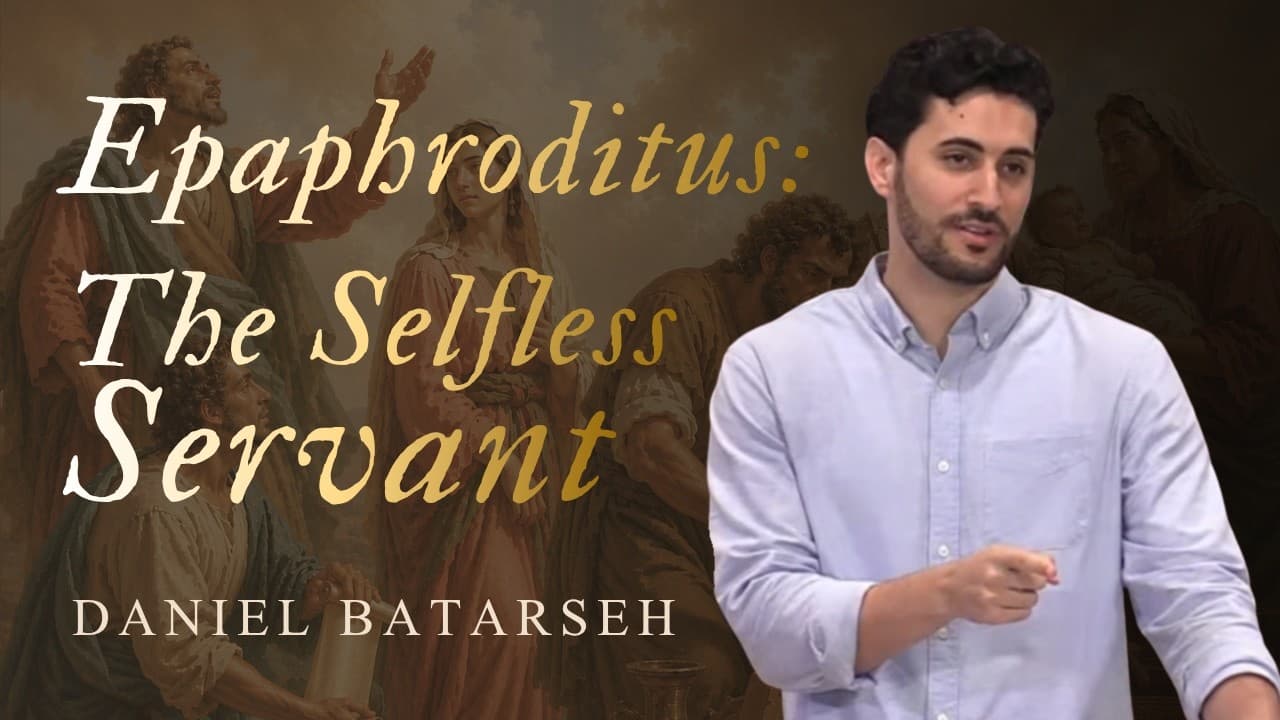
Epaphroditus wasn't upset about his own illness. He was anguished because his church found out and worried about him. His story redefines what selfless love looks like.
Most people read Philippians 2:26 and assume Epaphroditus wanted to go home because he was homesick. He was ill, far from his church, stuck in Rome — of course he wanted to leave. But look at the verse again: "He has been longing for you all and has been distressed because you heard that he was ill." He wasn't distressed because he was sick. He was distressed because they found out he was sick. The anguish eating him alive wasn't about his own suffering. It was about theirs — the worry he knew was gnawing at a congregation hundreds of miles away, with no way to send a text message saying, "I'm okay."
That single detail changes everything about how we read this passage. And it reveals a kind of love so foreign to our instincts that the Greek word used to describe Epaphroditus's distress appears only two other times in the entire New Testament — both describing Jesus in the Garden of Gethsemane.
Five Titles and Not a Single Sermon on Record
Paul opens his commendation of Epaphroditus with a staggering pile of honors. Five titles in a single verse. "My brother and fellow worker and fellow soldier, and your messenger and minister to my need" (Philippians 2:25). Three from Paul's own heart, two reflecting how the Philippian church viewed their representative.
Notice the word fellow. Paul doesn't call Epaphroditus "my worker" or "my soldier." He says fellow worker, fellow soldier. This is an apostle — a man who saw the risen Christ in blinding glory on the Damascus road — and he refuses to place himself above this man. As Pastor Daniel Batarseh observed, "Even in Paul's language, he does not give a hint that he is superior. That he is someone more significant, more to be appreciated, more to be praised, more to be admired. He brings Epaphroditus up to his level" (watch at 39:01).
That's instructive for anyone who holds spiritual authority. Paul understood something he spelled out plainly in 2 Corinthians 10:8 — that the authority God gives leaders exists "for building you up and not for destroying you." A true leader in the church makes people feel more confident in their walk with Christ after being under their care, not less. If your leadership consistently leaves people feeling diminished, smaller, unsure of their worth — that's not the ministry of the Holy Spirit. That's ego wearing a ministry badge.
And here's what stops you cold about Epaphroditus: there is no record of a sermon he preached. No miracle he performed. No theological treatise he authored. Just selfless love. Five titles, and every one of them earned by showing up, serving, and caring more about others than himself.
The Word That Links Epaphroditus to Gethsemane
The emotional center of this passage is verse 26, and it's easy to read past it. Epaphroditus "has been distressed because you heard that he was ill." The English word distressed flattens what's happening in the Greek. This isn't mild concern. This isn't a passing worry. The word used here — adēmoneō — appears only two other times in the New Testament, both in Mark 14:33, describing what Jesus experienced in the Garden of Gethsemane: "He began to be greatly distressed and troubled."
The Holy Spirit reaches for the same word to describe what Epaphroditus felt when he learned that the Philippian church knew about his illness. This was deep anguish. Turmoil. The kind of thing that keeps you staring at the ceiling at three in the morning. Paul could see it written all over his face.
And what was the source of this anguish? Not his own sickness — he was "ill, near to death" (v. 27), and yet that's not what tormented him. Not the feeling of being forgotten — he wasn't upset that no one had checked on him. He was tormented by the knowledge that his church was anxious about him. He couldn't send a quick update. Letters took weeks. Messengers moved slowly. And in that silence, he knew his brothers and sisters were suffering under the weight of not knowing whether he was alive or dead.
Who thinks like this? A man consumed by the mind of Christ. Paul had already told the Philippians in chapter 2, verse 4: "Let each of you look not only to his own interests, but also to the interests of others." Epaphroditus didn't just hear that instruction. He embodied it so thoroughly that his own near-death experience ranked below the emotional well-being of his congregation.
A Symphony of Selflessness Nobody Could Solve
What makes this passage extraordinary isn't just one selfless person. It's three parties — Epaphroditus, Paul, and the Philippian church — all tripping over each other in their concern for the others. The result is a beautiful, almost comedic, gridlock of love.
Epaphroditus is worried about the church. Paul is worried about the church. The church wants Epaphroditus to stay with Paul. Nobody is thinking about themselves. And nobody can figure out what to do because everyone keeps deferring to everyone else.
Paul breaks the tie. "I am the more eager to send him therefore, that you may rejoice at seeing him again, and that I may be less anxious" (v. 28). Think about what this costs Paul. He's under house arrest. He's chained. Epaphroditus was his brother, his companion, his practical lifeline — someone who could go get him parchment, bring him a meal, sit and pray with him through the long hours. And Paul gives him up. If sending Epaphroditus back would bring relief to the Philippians, then Paul would absorb the loss.
As Pastor Daniel Batarseh put it: "Do you see the symphony here of selfless love? Do you see what a Christian congregation should look like? Do you see what Christian marriage should look like? ... Everybody is thinking about the other. And they can't figure it out for a little bit. You go — No, I — Because the mind of Christ" (watch at 56:33).
That image — three parties locked in a standoff of sacrificial love — is what the church is supposed to look like. Not people jockeying for position. Not leaders building platforms on the backs of volunteers. Not members keeping score of who served last and who didn't. A community where the default posture is: What do you need? How can I give it to you at my own expense?
Sorrow Upon Sorrow in the Epistle of Joy
Here's where Paul does something breathtaking in its honesty. In verse 27, after confirming that Epaphroditus was indeed near death, he writes: "But God had mercy on him, and not only on him but on me also, lest I should have sorrow upon sorrow."
Pause on that. Philippians is universally recognized as the epistle of joy. "Rejoice in the Lord always; again I will say, rejoice." And yet right here, in the middle of this letter, Paul admits that if Epaphroditus had died, he would have known compounded grief — not a passing sadness, but a season of severe, layered sorrow.
Isn't this the same man who wrote in Philippians 1:21, "For to me, to live is Christ, and to die is gain"? If death is gain, wouldn't Epaphroditus's death have been good? Paul doesn't flinch from the tension. He holds both truths simultaneously: death is gain for the believer, and the loss of a beloved brother would have shattered him.
This is freeing. The Bible does not ask you to pretend grief doesn't exist. It doesn't demand you walk into a funeral quoting "Rejoice in the Lord always" to a mother who just buried her child. "That's not being spiritual," the sermon pressed. "That's being insensitive. There's a time and place for such things... If somebody is broken and shattered at the loss of somebody, weep with them. Weep with them. That's the best thing you can do" (hear this moment).
Christians grieve. Deeply. But we don't stay there. Sorrow does not get the final word. The rest of Philippians shows us how joy anchors us even when grief is real. Both things are true, and Paul refuses to pretend otherwise.
Notice also what Paul calls Epaphroditus's recovery: mercy. Not a miracle. There's no indication Paul laid hands on him or performed a supernatural healing. Epaphroditus got better — slowly, naturally, sovereignly. And Paul recognized that every additional day of breath is mercy from God. You woke up this morning. That's mercy. It doesn't have to be a miracle for you to see God's hand.
The Gamblers Who Took Their Name from This Text
The word translated "risking" in verse 30 — "risking his life to complete what was lacking in your service to me" — means in the original Greek to expose oneself to danger. It carries the sense of premeditation. Epaphroditus calculated the cost before he left Philippi. He knew the journey to Rome was dangerous. He knew proximity to a prisoner of the empire carried risk. He went anyway.
In the third and fourth centuries, a group of early Christians in Alexandria, Egypt took this word and made it their identity. They called themselves the Parabolani — derived from the same Greek root used here in Philippians 2:30. They were the risk-takers. The gamblers. When epidemics swept through the Roman Empire and civil authorities abandoned the sick, when family members refused to touch their own dying relatives, the Parabolani walked straight into the plague zones. They collected the sick, tended their wounds, buried the dead, and preached the gospel to anyone who would listen — all while exposing themselves to the very diseases killing everyone around them.
And one of their primary inspirations? The testimony of Epaphroditus. This "unsung hero" of the New Testament — a man with six verses to his name — birthed a movement of radical, costly love that the watching world could not explain. The pagans saw these Christians walking toward death instead of away from it and asked: Who are these people?
The question still stands. Would anyone ask that about us?
What to Remember
- Epaphroditus wasn't distressed by his own near-fatal illness — he was anguished because his church found out and worried about him. The Greek word for his distress is the same one used for Jesus in Gethsemane.
- Paul called Epaphroditus his fellow worker and fellow soldier. True spiritual authority never inflates itself at others' expense — it exists to build people up, not to make them feel small.
- You can hold grief and joy at the same time without being a hypocrite. Paul admitted he would have known "sorrow upon sorrow" if Epaphroditus had died — and this is in the epistle of joy.
- Every additional day you wake up and breathe is mercy from God. It doesn't require a miracle for you to recognize God's compassion in your life.
- The early church movement called the Parabolani — Christians who risked their lives serving plague victims — took their name from the Greek word describing Epaphroditus's willingness to expose himself to danger for Christ's sake.
- Selflessness is not a personality trait reserved for extraordinary people. Paul said the mind of Christ "is yours" — it's available, attainable, and commanded.
Questions to Sit With
- If your church needed to send one person to represent their love and character to someone in crisis, would you be a candidate — or would something about your temperament, your language, your consistency disqualify you?
- When was the last time you were genuinely more distressed about someone else's worry than about your own suffering? What would it take for that to become your default?
- Paul admitted that losing Epaphroditus would have caused him compounded grief. Is there someone in your life whose friendship you've never recognized as God's mercy to you? Have you told them?
- Do you treat your fellow believers like family you chose — or family you're stuck with until heaven fixes them?
- What would it look like, in your specific context this week, to "not account for your own life" for the sake of someone else?
Scripture Referenced
- Philippians 2:25-30 — Primary passage on Epaphroditus
- Philippians 4:18 — Paul's acknowledgment of the gift Epaphroditus delivered
- Philippians 2:4-5 — The call to have the mind of Christ
- Philippians 1:21 — "To live is Christ, to die is gain"
- 2 Corinthians 10:8 — Authority given for building up, not tearing down
- Mark 14:33 — Jesus "greatly distressed and troubled" in Gethsemane
- Psalm 23:1-6 — The Lord is my shepherd
- Hebrews 4:14-16 — Drawing near to the throne of grace
This summary was generated by AI from the sermon "Epaphroditus: The Selfless Servant | Philippians 2:25-30 | Pastor Daniel Batarseh | Maranatha 2026" preached by Pastor Daniel Batarseh at Maranatha Bible Church Chicago. Watch the full sermon →
Preached by
Pastor Daniel BatarsehSenior Pastor
This summary was generated by AI from the sermon transcript.
Based on the sermon