Peter's command about beauty isn't a dress code — it's a call to an indestructible identity that makes a woman fearless. Here's what most people miss.
The world spends billions of dollars every year telling women that their value lives on the surface of their skin. And the church, too often, responds with a dress code. But 1 Peter 3:3-6 is doing something far more radical than either side imagines. It is not handing out hemline measurements. It is offering women an identity so unshakeable, so rooted in the eternal character of God, that it produces something the beauty industry can never manufacture: fearlessness.
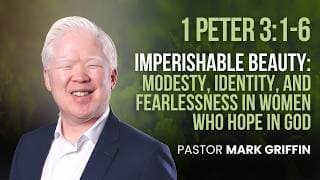
This is the heart of what Pastor Mark Griffin laid open in a sermon that refused to reduce modesty to a list of rules — and refused to let anyone off the hook by pretending the text doesn't matter. The result was a teaching that convicted and liberated in the same breath.
Modesty Is Not a Dress Code — It's a Heart Diagnosis
Most modesty conversations start in the wrong place. They start with the closet. Peter starts with the soul.
"Do not let your adorning be external — the braiding of hair and the putting on of gold jewelry or the clothing you wear. But let your adorning be the hidden person of the heart with the imperishable beauty of a gentle and quiet spirit, which in God's sight is very precious" (1 Peter 3:3-4).
The passage is not a prohibition on earrings. Peter is not banning hairstyles any more than he is banning clothing — the text mentions "the clothing you wear" in the same breath, and nobody reads that as a command to go naked. The structure is comparative, not absolute: not this, but that. Not the external as your primary investment, but the internal as your true adornment.
But here's where the teaching cut deep. If modesty starts in the heart — and it does — then so does immodesty. It is a heart issue before it ever becomes a wardrobe issue. And the reasons women fixate on outward appearance are not merely cultural. They are spiritual.
Four root causes surfaced in the sermon, and each one landed differently across the room. First, some women have simply never been taught what the Bible says about beauty and modesty — no father, no mother, no pastor, no mentor ever opened the Scriptures on this subject, so they default to whatever the culture around them is doing. Second, some dress to win the approval of others — they know the outfit makes them uncomfortable, there's a hesitation in their heart, but the fear of rejection is louder than the conviction. Third, pride — manifesting as "I look good and I want everyone to know it," or as a defiant "It's just clothes, preacher. If you have a problem, that's your problem, not mine" (watch at 19:29). And fourth, some women know — consciously or not — that the way they dress gives them power, influence, leverage over others.
Notice: three of those four reasons are entirely internal. They have nothing to do with a particular neckline or skirt length. They have everything to do with what a woman believes about her own identity, her worth, and where her security comes from. That's why a mere dress code will never produce true modesty. You can cover every inch of skin and still be adorning the external if your heart is consumed with how you look.
As Pastor Mark Griffin put it: "Without an internal radical transformation of the heart, a changing of our desires and longings in what satisfies us, there can be no true outward modesty because there is no inward modesty" (watch at 26:22).
The Word Peter Chose Links Your Beauty to Your Eternal Inheritance
The word "imperishable" in verse 4 is not decorative language. It is theologically loaded — and the connection Peter makes with it is stunning.
The same Greek word appears just two chapters earlier, in 1 Peter 1:3-4: "Blessed be the God and Father of our Lord Jesus Christ! According to his great mercy, he has caused us to be born again to a living hope through the resurrection of Jesus Christ from the dead, to an inheritance that is imperishable, undefiled, and unfading, kept in heaven for you."
Same word. Same letter. Peter is telling Christian women: adorn yourself with beauty that has the same quality as your eternal inheritance in Christ. Indestructible. Immortal. Unfading. Your skin will wrinkle. Your hair will gray. No amount of Botox or moisturizer changes the trajectory. But imperishable beauty — the beauty of a gentle and quiet spirit — only increases with time, because it is a fruit of the Holy Spirit's progressive work in your life (watch at 27:53).
Galatians 5:22-23 names gentleness as a fruit of the Spirit — which means this beauty is not something you manufacture through sheer willpower. It is cultivated. It grows as you read the Word, as you walk with God, as you mature in Christ. It gets better and better. And it is, Peter says, "very precious" in God's sight. The Lord who sees past every layer of makeup, past every carefully curated outfit, past every Instagram filter — that God looks at the hidden person of your heart and calls a gentle and quiet spirit precious.
Now, "gentle and quiet" does not mean silent or passive. The sermon was emphatic on this point. Women have ideas, opinions, aspirations, voices, hopes, and dreams. Gentleness here is meekness — not weakness, but strength under control. The supreme example is Christ himself: "Take my yoke upon you and learn from me, for I am gentle and lowly in heart" (Matthew 11:29). Jesus was the strongest person who ever lived, and he described himself as gentle. Meekness is not the absence of power. It is power that does not serve itself.
And "quiet" means tranquil, still, at rest — like a pond with no ripples. Think of the Proverbs 31 woman who "laughs at the time to come." She is not laughing because she has everything figured out. She is laughing because her confidence is not in her circumstances. Her foundation is God himself. Things around her could be falling apart — her unbelieving husband mocking her, her peers rejecting her for not dressing like the world — and she is at rest. That is quiet. That is beauty the world cannot replicate.
Sarah's Daughters Are Not Afraid
Peter does something remarkable in verses 5-6 that most readers glide past. He shifts from describing attributes of godly women to anchoring those attributes in history — and then he issues an identity claim that should stop every Christian woman in her tracks.
"For this is how the holy women who hoped in God used to adorn themselves... as Sarah obeyed Abraham, calling him lord. And you are her children, if you do good and do not fear anything that is frightening."
We are accustomed to hearing about the children of Abraham. But Peter says something different here. He says Christian women are daughters of Sarah. And the entry requirement is not a dress code. It is fearlessness.
Think about what Sarah did. She left everything — her family, her land, her people — to follow Abraham into an unknown future based on a promise from God. She was told she would conceive a child when she was old and barren. Hebrews 11:11 tells us why she could do it: "By faith Sarah herself received power to conceive, even when she was past the age, since she considered him faithful who had promised." She put her hope in God. She was a holy woman who hoped in God. And because of that, she was not afraid.
Here is the connection the sermon drew that made the room go quiet: there is a direct line between obsession with outward appearance and inner anxiety. Why do some women dress provocatively? Because of the anxiety of not being accepted. The insecurity of constantly comparing themselves to other women. The fear of not getting attention, not getting what they want. Fear and insecurity permeate everything when you fixate on external beauty, and they trap you in an endless cycle of inferiority, loneliness, and pain (watch at 40:49).
A famous singer once defended wearing sexually provocative clothing on stage by saying she wore it to "reclaim her confidence, step into her power, and celebrate her own freedom." The response from the pulpit was devastating in its simplicity: "This woman thinks she is free, but she is more bound than ever. True freedom is not skydiving out of an airplane without a parachute. That's not freedom. It's destruction" (watch at 37:10).
The world's version of liberation chains you to the approval of others, to the shifting tides of fashion, to the relentless anxiety of measuring up. If your identity as a woman is found in these temporal things, you make yourself a slave to them. But a woman who hopes in God — who has been given the spirit of adoption, not of slavery (Romans 8:15) — she is free indeed. She does not need the world's validation. She has something the world cannot give and cannot take away.
Four Questions Before You Get Dressed
The sermon did not end with theology floating in the air. It landed with four concrete questions every Christian — woman or man — should ask before getting dressed, applying makeup, or spending money on appearance. Not as legalistic checkboxes, but as honest, humble inquiries before the Lord:
One: Why am I doing this? Is it to get attention? To stroke my ego? To show off? Am I doing this because I've swallowed the world's definition of beauty without examining it?
Two: Am I considering others? Philippians 2:3 says, "Do nothing from selfish ambition or conceit, but in humility count others more significant than yourselves." Is what I'm wearing going to cause a brother to stumble? Is it going to provoke envy in a sister? The popular response — "If they have a problem, that's their problem, not mine" — is flatly wrong. We are responsible for one another.
Three: Am I revealing parts of my body that belong only to my husband? Or if unmarried, parts that belong to no one? Our culture is so casual that everything is on display, but the question remains: is this part of me private? Is this part of me sacred?
Four: Am I being a godly example? No matter your age, there are women younger than you taking their cues from you. Titus instructs older women to train up younger women. Are you training them to accept the world's definition of beauty, or to open their Bibles and discover what God finds beautiful?
These questions might mean you go home and throw away some clothes. Good. Do it with joy. Do it as an act of worship. Do it and watch what God does in the hidden person of your heart.
And to the men — husbands, fathers, single brothers — this sermon did not let you sit comfortably in the audience. Husbands: praise your wife when she dresses modestly, yes, but praise her even more when you see her in the Word, when she's praying, when she's growing closer to God. Fathers: walk your children through the lies of the culture. Help them choose biblical femininity not from self-righteousness or comparison, but from identity in Christ. Single men: don't champion biblical womanhood on Sunday and stare at the first woman in a short skirt on Monday. Seek out and cherish women who possess that imperishable beauty — because that is the woman Proverbs 18:22 is talking about when it says, "He who finds a wife finds a good thing and obtains favor from the Lord" (watch at 51:33).
The closing image of the sermon was one I haven't been able to shake. The culture lays out a table before you — glittering, seductive, promising delight and pleasure and reward. But as Pastor Mark Griffin urged: "As you approach the table of culture that is laid out before you, all the possibilities before you on this table — it is my prayer that you realize that you are being offered nothing but rancid meat, moldy bread, and infested food. Come to the table of the Lord" (watch at 52:11).
Come to the table of the Lord. Adorn the hidden person of the heart. And be beautiful — with a beauty that will never, ever fade.
What to Remember
- Modesty is not a dress code imposed from the outside — it is the overflow of a heart that has been transformed by God and no longer needs the world's approval to feel valuable.
- The word "imperishable" in 1 Peter 3:4 is the same word Peter uses for your eternal inheritance in Christ — your beauty is meant to share the same indestructible quality as your salvation.
- Gentleness is not weakness. Jesus — the strongest person who ever lived — called himself gentle and lowly in heart. A gentle spirit is strength that refuses to serve itself.
- There is a direct connection between obsession with outward appearance and inner anxiety; the woman who hopes in God is free from the endless cycle of comparison, insecurity, and fear.
- Biblical womanhood is fearless. Sarah left everything she knew, conceived when it was impossible, and laughed at the future — because her confidence was in God, not in her circumstances.
- Men are not spectators in this conversation. Husbands, fathers, and single men each have a specific role in honoring, protecting, and cultivating the imperishable beauty God values.
Questions to Sit With
- If you honestly evaluated the time, money, and emotional energy you spend on your outward appearance versus cultivating the "hidden person of the heart," what would the ratio reveal about where your identity actually rests?
- Which of the four root causes of immodesty — ignorance, people-pleasing, pride, or manipulation — hits closest to home for you? What would repentance look like in that specific area?
- Peter says a gentle and quiet spirit is "very precious" in God's sight. When was the last time you felt genuinely at rest — not because your circumstances were calm, but because your confidence was in God alone?
- If you are a man, how have you contributed — through what you praise, what you pursue, or what you consume — to the very culture that pressures women to find their worth in the external?
- What would it look like to approach the "table of culture" this week and choose to walk away — and come to the table of the Lord instead?
Scripture Referenced
- 1 Peter 3:1-6 — Primary passage
- 1 Peter 1:3-4
- Ezekiel 36:26-27
- Romans 12:2
- Matthew 11:29
- Galatians 5:22-23
- Hebrews 11:11
- Romans 8:15
- Philippians 2:3
- 1 Timothy 2
- Proverbs 18:22
- Titus 2
This summary was generated by AI from the sermon "Imperishable Beauty: Modesty, Identity, and Fearlessness in Women Who Hope in God | Mark Griffin" preached by Pastor Mark Griffin at Maranatha Bible Church Chicago. Watch the full sermon →
Based on the sermon