Israel was enslaved in Egypt, unable to free themselves — and the harder they tried, the worse it got. Sound familiar? Exodus 1 is your story too.
They were fruitful. They multiplied. They grew exceedingly strong. And they were utterly enslaved.
That paradox sits at the heart of Exodus chapter 1, and it should stop us cold. How can a people be blessed and bound at the same time? How can a nation overflow with life and still be crushed under the heel of a tyrant? And more unsettling still — why did God leave them there?
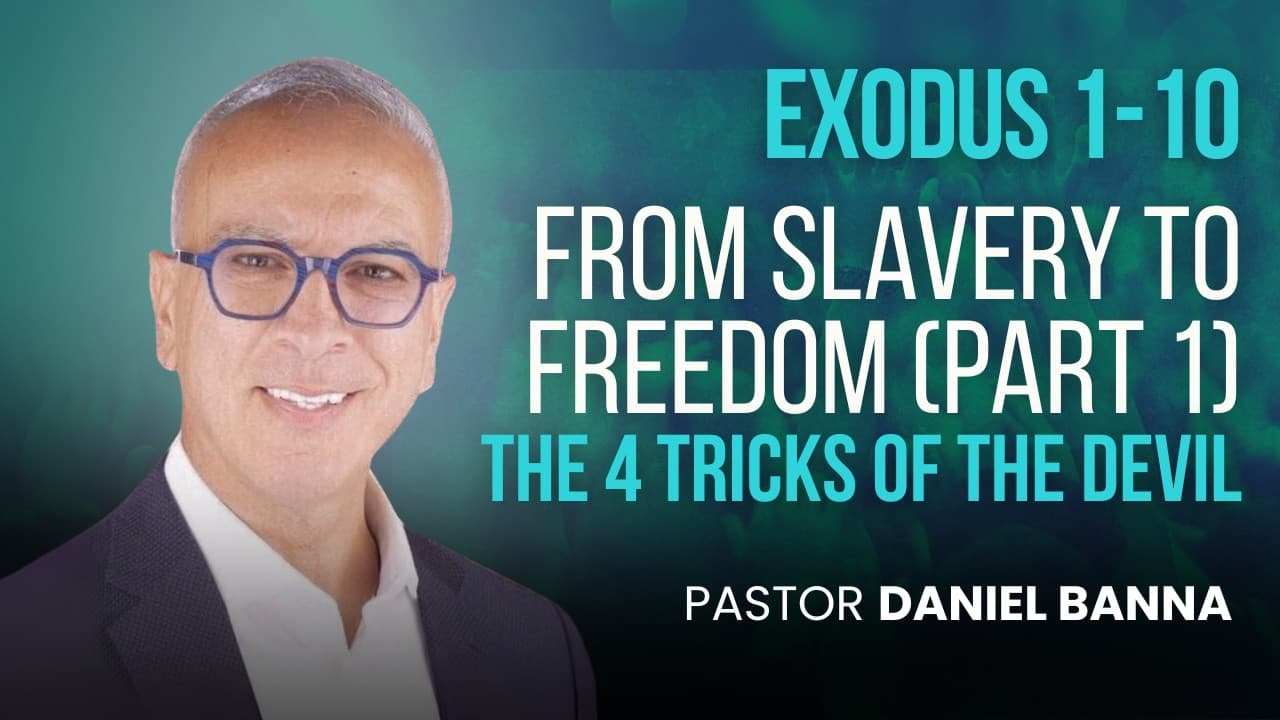
These are the questions Pastor Daniel Banna pressed into as he opened a new series through Exodus called From Slavery to Freedom. The answer he surfaced is one most of us have never considered: Israel's bondage in Egypt is not merely ancient history. It is a mirror. It reflects the exact condition of every human soul before Christ intervenes — blessed with life, yet hopelessly enslaved, and utterly incapable of self-rescue.
A People Who Had Not Yet Been Redeemed
The detail that reframes the entire Exodus narrative is easy to miss, but once you see it, you cannot unsee it. When we meet Israel in Exodus 1:7-14, these people are not yet God's redeemed community. The Passover lamb has not been slaughtered. No blood has been applied to any doorpost. No sea has been parted. They are, in the fullest sense, an unredeemed people living under an oppressor's authority.
As Pastor Daniel Banna put it: "Remember, these people had not yet been redeemed. They're not saved yet. The Passover lamb had not yet been sacrificed. The blood had not been shed or applied, yet God already purposed to save them" (watch at 4:08).
That word "yet" carries the weight of the entire gospel. God's plan to rescue preceded any action on Israel's part. Before they cried out, before Moses arrived, before the plagues fell — God had already determined their deliverance. Election preceded experience. Purpose preceded Passover.
This is not a minor theological footnote. It demolishes the popular notion that God responds to our spiritual effort with salvation, as though we earn His attention by trying hard enough. Israel didn't earn anything in Egypt. They were brick-makers. Slaves. Their hands were full of mortar, not merit. And God came for them anyway.
The Cruel Arithmetic of Oppression
Pharaoh's strategy in Exodus 1 deserves careful attention because it reveals something essential about how evil operates — not with brute stupidity, but with calculated shrewdness.
Notice the language: "Come, let us deal shrewdly with them" (Exodus 1:10). The Hebrew word here carries the idea of cunning, of crafty wisdom deployed for wicked ends. Pharaoh did not simply attack Israel. He engineered a system. He appointed taskmasters. He designed heavy burdens. He built an entire infrastructure of oppression — store cities named Pithom and Rameses — and he used Israel's own labor to construct the very system that imprisoned them.
This is precisely how sin operates in a human life. It doesn't announce itself as slavery. It presents itself as a system — habits, patterns, identities — that you build with your own hands, brick by bitter brick, until one day you look up and realize the walls you've constructed are your own prison. The alcoholic doesn't wake up one morning in chains. He builds Pithom one drink at a time. The person enslaved to pornography doesn't fall into a pit; he digs it himself, shovelful by shovelful, until the hole is too deep to climb out of.
And here is the cruel arithmetic that Exodus reveals: "The more they were oppressed, the more they multiplied" (Exodus 1:12). The Egyptians' response? They didn't ease up. They bore down harder. The text uses the word "ruthlessly" twice in two verses — as if the Holy Spirit wanted to make sure we felt the grinding, relentless weight of it. "They ruthlessly made the people of Israel work as slaves and made their lives bitter with hard service in mortar and brick and all kinds of work in the field. In all their work, they ruthlessly made them work as slaves" (hear this moment).
Bitter. The word appears here like a taste you can't get out of your mouth. And that's exactly what slavery to sin produces — not the sweetness it promised, but a bitterness that seeps into every corner of life. Relationships. Ambitions. Even your quiet moments alone. Everything tastes like mortar.
Your Story Before Page One of the Gospel
Here is where the sermon turned from historical exposition into something that felt like a hand on your shoulder. The Exodus narrative is not merely about ancient Israelites. It is a portrait of the human condition before grace.
"This is more than just Israel's story," the teaching pressed. "This is our story. It's my story and your story before we came to Christ. We were slaves to sin, to pride, to lust. We were slaves to Satan, unable to deliver ourselves. And the harder we tried, the more hopeless our condition became" (watch at 4:40).
That last line deserves to be read again slowly: the harder we tried, the more hopeless our condition became.
This is the testimony of every honest human being who has ever attempted moral self-improvement apart from God. The New Year's resolutions. The promises made at 2 a.m. with tears on your face. The white-knuckle attempts to stop doing the thing you hate. Paul described this exact experience in Romans 7: "The good that I want to do, I do not do, but the evil I do not want to do — this I keep on doing." Israel in Egypt is Romans 7 in narrative form. It is the human race trying to manufacture its own bricks of righteousness while Pharaoh — the prince of this world — stands over them with a whip.
And the genius of the Exodus story is that it doesn't leave you there. It doesn't end with chapter 1. A deliverer is coming. A lamb will be slain. Blood will be applied. And the same God who purposed salvation before Israel lifted a finger will execute that salvation with a mighty hand and an outstretched arm.
But you have to feel the weight of the slavery first. You have to taste the mortar. You have to stand in the brick pit and admit — truly admit — that you cannot climb out. That is the prerequisite to freedom: not effort, but surrender. Not self-improvement, but the honest confession that you need someone to come and get you.
No King, No Nation, No Power
The sermon's title promises an examination of the devil's four tricks, and the series through Exodus chapters 5 through 10 will unfold those in detail. But even in this opening salvo, one foundational truth was staked into the ground like a banner over the entire series:
"No king, no nation, and no power on earth could overturn God's plan" (watch at 4:08).
Pharaoh thought he was dealing shrewdly. He had the armies, the resources, the political authority, the taskmasters, the whips. He had every earthly advantage. And he was overmatched before the contest even began. God had already purposed to save His people, and the most powerful ruler on the planet was about to discover that his shrewdness was foolishness, his strength was weakness, and his gods were nothing.
This is the comfort that Exodus offers every believer who feels the pressure of spiritual opposition. The enemy is real. His strategies are cunning. His systems are sophisticated. But he is fighting a war he has already lost. The Lamb has already been slain. The blood has already been applied. The sea has already been parted. And the God who purposed your salvation before you drew your first breath will not be thwarted by any Pharaoh — internal or external — who claims authority over your life.
The series ahead promises to examine how the devil negotiates, how he offers partial freedom to prevent total liberation, how he tries to keep you close enough to Egypt that you can always be dragged back. These are the tricks the title references, and they are as active today as they were in the courts of ancient Egypt. Every believer who has ever felt the pull back toward old patterns, old identities, old sins — you are living in Exodus 5 through 10. The confrontation between God and Pharaoh is not ancient history. It is your Tuesday morning.
But the outcome is not in doubt. It never was.
What to Remember
- God purposed Israel's salvation before they did anything to deserve it — the Passover lamb had not yet been sacrificed, yet deliverance was already certain. Grace precedes effort, always.
- Sin operates like Pharaoh: it doesn't announce itself as slavery but builds a system you construct with your own hands, brick by brick, until the walls become your prison.
- The harder you try to free yourself from sin through willpower alone, the more hopeless the bondage becomes — self-rescue is not the gospel's message.
- No power on earth — no habit, no addiction, no spiritual enemy — can overturn what God has purposed for His people. The outcome was settled before the contest began.
- The bitterness of slavery is meant to drive you not to harder effort but to honest surrender — freedom begins when you stop trying to climb out and cry out for a deliverer instead.
Questions to Sit With
- What "bricks" are you still making — habits, patterns, coping mechanisms — that you built with your own hands and now cannot escape?
- If God purposed Israel's salvation before they did anything to earn it, what does that say about the guilt you carry for not being "good enough" for God to rescue you?
- Where in your life are you trying harder instead of surrendering deeper — and what would it look like to stop making bricks and start crying out?
- Pharaoh dealt "shrewdly" with Israel. Can you identify a pattern in your own temptation that feels less like a frontal assault and more like a calculated system designed to keep you productive but enslaved?
Scripture Referenced
This summary was generated by AI from the sermon "From Slavery to Freedom: The 4 Tricks of the Devil | Exodus 1 & 5-10 | Pastor Daniel Banna (7/5/26)" preached by Pastor Daniel Banna at Maranatha Bible Church Chicago. Watch the full sermon →
Based on the sermon
From Slavery to Freedom: The 4 Tricks of the Devil | Exodus 1 & 5-10 | Pastor Daniel Banna (7/5/26)
Watch Full SermonRelated Articles
Moses' Parents: The Faith That Formed a Deliverer (Hebrews 11:23)
Pastor Daniel Batarseh · August 30, 2026
Moses' Parents: The Faith That Shaped a Deliverer (Hebrews 11:23)
Pastor Daniel Batarseh · August 30, 2026
Who Was the First Person Filled with the Spirit? (Exodus 31)
Pastor Daniel Batarseh · August 28, 2026