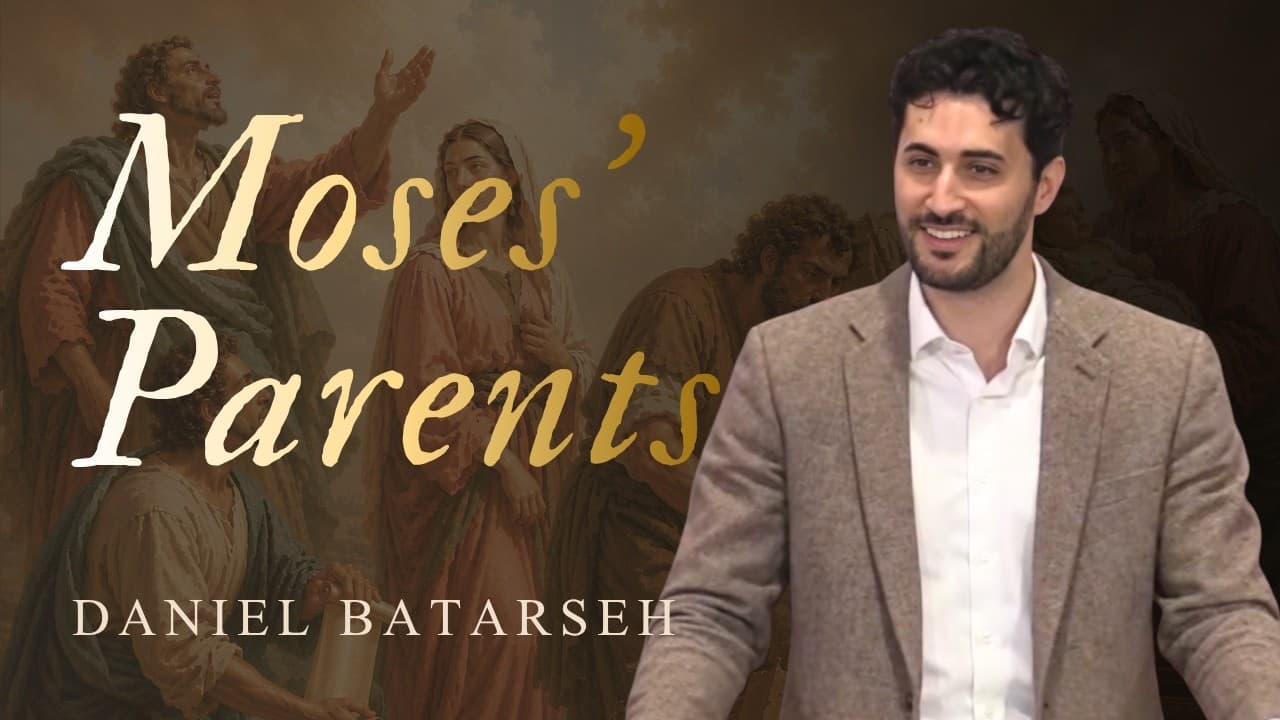
Before Moses confronted Pharaoh, his parents confronted fear. Hebrews 11:23 reveals how the home became the first school of faith — and why that changes everything for parents today.
Moses' Parents: The Faith That Formed a Deliverer (Hebrews 11:23)
Here's something most readers glide right past in Hebrews 11:23: the verse begins with "By faith Moses" — and then never talks about Moses at all. It talks about his parents. The Holy Spirit is about to launch into one of the longest faith biographies in the chapter, spanning verses 23 through 29, and before He lets us see Moses confront Pharaoh, cross the Red Sea, or keep the Passover, He stops and makes us look at a living room. A slave's quarters. A mother and father hiding a baby in the dark. The entire Exodus story — plagues, pillars of fire, a nation walking through the sea on dry ground — traces back to two people whose names most Christians can't recall, doing something so ordinary it barely registers as heroic: raising their child to know God.
The verse is Hebrews 11:23. The parents are Amram and Jochebed. And the lesson is one that every parent, grandparent, and aspiring parent in the room needed to hear.
The Verse Says "By Faith Moses" — Then Talks About His Parents
The phrasing matters more than you think. Some modern translations restructure the sentence to read more smoothly — "By faith Moses' parents" — but a faithful word-for-word rendering keeps the original order: By faith Moses, when he was born, was hidden for three months by his parents. It sounds awkward. It's completely intentional.
The Spirit of God is preparing us to consider Moses' faith, but He wants us to first acknowledge the history of that faith. The atmosphere Moses grew up in. The soil his convictions were planted in. As Pastor Daniel Batarseh put it: "It's as though the Spirit of God, by phrasing it in this manner, wants us to first acknowledge and recognize the history of Moses' faith... Moses' faith, as exemplary and as stunning as it was, would not have been possible without what we find here in this text" (watch at 59:38).
Now, this does not teach that faith is genetically inherited or automatically passed down. Plenty of godly parents have watched children walk away. But it does reveal something we cannot afford to ignore: the environment of the home creates the conditions for faith to take root. And both parents are celebrated here — his parents. Not just the father. Not just the mother. Both.
And yet, when you turn to the original account in Exodus chapter 2, one parent is spotlighted: Jochebed. She's the one who sees the child is fine. She's the one who hides him. She's the one who builds the basket, daubs it with pitch, and places it among the reeds. Why does the text highlight her?
Because of who Pharaoh dismissed.
Pharaoh's decree targeted the boys. Kill the sons. Let the daughters live. He calculated the military threat and overlooked everything else. But look at who actually dismantled his edict: the midwives Shiphrah and Puah, who feared God and refused to obey (Exodus 1:15-17). Jochebed, who hid her son and then engineered his survival. Even Miriam, the sister who stood watch. The entire early narrative of Exodus is driven by women whom a tyrant thought irrelevant. Pharaoh made a catastrophic miscalculation, and the Spirit of God seems to take delight in pointing it out.
This is not a sentimental aside. It's a theological statement. The faith of mothers and wives and sisters is not secondary. It is, in this story, the very thing that preserved the deliverer of Israel.
Faith With Legs On It — Why Hiding Moses Was an Act of Trust, Not Fear
Here's where a certain kind of Christian gets uncomfortable. If Amram and Jochebed truly trusted God, why did they hide Moses? Why not parade him through the streets and dare Pharaoh to touch him? Why not proclaim their faith publicly and let God handle the consequences?
Because that's not faith. That's presumption.
True faith made these parents wise. They defied the king's edict — that took courage. But they also concealed their son — that took prudence. They didn't tempt God by being reckless. They trusted Him by being careful. "Any kind of faith that dismisses danger or is careless where we should be cautious is not commended by God," the sermon pressed. "When Christ calls us to be Christians, he calls us to repent, but he never asks you to repent of common sense" (hear this moment).
Consider the logistics. These are slaves. Their quarters are cramped. A newborn cries at all hours. And for three months, they managed to keep the neighbors from hearing, the Egyptian patrols from noticing. It would have been exhausting, nerve-wracking, constant. And God could have intervened supernaturally — made the baby invisible, blocked the ears of passersby. This is the book of Exodus, after all. One more miracle wouldn't have seemed out of place. But even in a book of miracles, God chose to work through the daily, practical faithfulness of two ordinary people.
And there's a New Testament echo here that deepens the point. Even Jesus, in His adult ministry, knew when to withdraw. John 11:53-54 records that when the Jewish leaders made plans to kill Him, "Jesus therefore no longer walked openly among the Jews, but went from there to the region near the wilderness." The Son of God Himself practiced strategic concealment. Being practical does not mean you lack faith. Moses' parents proved it centuries before Christ demonstrated it.
What "Beautiful in God's Sight" Actually Means
Every parent thinks their baby is beautiful. So when Hebrews 11:23 says Amram and Jochebed acted "because they saw that the child was beautiful," it sounds like it's stating the obvious. Is the text really saying they risked their lives because Moses was exceptionally cute?
No. And Acts 7:20 gives us the key. Stephen, rehearsing Israel's history before the Sanhedrin, says: "At this time Moses was born, and he was beautiful in God's sight." That phrase — in God's sight — changes everything. God does not measure beauty by outward appearance. So what did He see?
The answer is in the verse just before it. Acts 7:17: "But as the time of the promise drew near, which God granted to Abraham, the people increased and multiplied in Egypt." God had promised Abraham that his descendants would be enslaved in a foreign land for four hundred years and then delivered. Stephen is telling us that clock was running out. The hour of deliverance was approaching. And then: "At this time Moses was born."
The beauty God saw in Moses was not about his face. It was about his timing. His calling. His purpose. Moses was beautiful in God's sight because he was born at the appointed hour, the child through whom the promise of deliverance would be fulfilled. And somehow — whether through direct revelation, prophetic instinct, or a tug in their spirits they couldn't fully explain — Amram and Jochebed saw it too. They aligned their perspective with God's perspective. Where Pharaoh saw a disposable Hebrew boy, a threat to be drowned in the Nile, these parents saw what God saw: something precious, something purposeful, something worth dying to protect.
This is how faith operates. It does not create its own reality. It receives God's reality. It sees what He sees. And in an age where babies are slaughtered daily, where children are treated as inconveniences or burdens, the Spirit of God still whispers over every life: beautiful in My sight.
The Seeds They Planted Outlasted Egypt's Classrooms
Here is where the sermon turned from instruction to confrontation — the kind that makes you grip the edge of your seat because you know it's aimed at you.
When Pharaoh's daughter adopted Moses, Jochebed was providentially hired — paid by Pharaoh's own household — to nurse and raise the very boy Pharaoh had ordered killed. The irony is almost too perfect. And it was during those formative years, sitting on his parents' laps, that Moses would have heard about the God of Abraham, Isaac, and Jacob. The promises. The covenant. The hope of deliverance. They poured everything they had into him because they knew the clock was ticking.
And then he went to Egypt's schools. Pharaoh's adopted grandson would have received the finest education the ancient world could offer — history, architecture, theology, political philosophy. He would have sat in classrooms that justified the enslavement of his own people. For years, graduation after graduation, Egyptian culture worked to overwrite everything his parents had planted.
Did it succeed? Hebrews 11:24 answers: "By faith Moses, when he was grown up, refused to be called the son of Pharaoh's daughter." The seeds survived. More than survived — they thrived.
And then the text delivers a detail so precise it cannot be accidental. Verse 23 says the parents "were not afraid of the king's edict." Verse 27 says Moses "left Egypt, not being afraid of the anger of the king." The same fearlessness. The same language. The mirror is deliberate. Where did Moses learn to be unafraid? He watched his mother and father do it first.
Pastor Daniel Batarseh made this personal, and it landed hard: "I'm somebody who lived in Egypt for a while and intended to stay there for the rest of my life. But something happened to me when I was living at home... I've seen enough and I've heard enough to not be able to sin comfortably... All my conscience would keep me up some nights. I could not fight it off. Why? Because of those seeds" (watch at 1:28:59).
The application was direct and unflinching: "The greatest disservice that we do for our little ones, to the next generation, is give them a faith that lasts an hour and a half on a Sunday and doesn't exist the other days of the week" (hear this moment). Faith in the home of Amram and Jochebed was not a label. It was not a weekly event. It was the air the family breathed. And the challenge for every parent listening was plain: What kind of atmosphere are you creating? Do the conversations at your dinner table arouse the flesh or build up faith? Do your children see you afraid of every headline, or do they see you fearing God instead?
From One Home to an Entire Nation
The final stroke of the sermon was breathtaking in its scope. The account of Moses' faith in Hebrews 11 begins in verse 23 with two parents protecting one child. It ends in verse 29 with an entire nation crossing the Red Sea by faith. And sandwiched between is verse 28: "By faith he kept the Passover and sprinkled the blood, so that the Destroyer of the firstborn might not touch them." An entire generation of parents, trusting God to protect their children — because one couple trusted God to protect theirs.
Amram and Jochebed never stood before the Red Sea. They never confronted Pharaoh. They never led Israel out of Egypt. They were two Hebrew slaves who hid a baby and taught him about God. And that was the catalyst for everything.
Your home is a sanctuary. That Sunday school hour can raise up a revivalist. The diaper-changing, school-driving, dinner-cooking, bedtime-praying ordinary life you live is not background noise to God's plan. It may be the opening chapter.
What to Remember
- The Holy Spirit intentionally phrases Hebrews 11:23 as "By faith Moses" and then discusses his parents — linking Moses' legendary faith directly to the home he was raised in.
- Pharaoh dismissed the women of Israel as irrelevant. God used them — midwives, a mother, a sister — to dismantle his decree and preserve the deliverer.
- Hiding Moses was not a failure of faith but an exercise of it. True trust in God includes practical wisdom; presumption is not piety.
- "Beautiful in God's sight" (Acts 7:20) refers not to Moses' physical appearance but to the divine purpose and timing of his birth — and his parents perceived it.
- A faith that exists for ninety minutes on Sunday and vanishes the rest of the week will not survive the pressures that come for your children.
- What began with two parents protecting one child ended with an entire nation trusting God to protect theirs — the ripple effect of faithful parenting is incalculable.
Questions to Sit With
- If your children could only learn about God by watching your life Monday through Saturday — never hearing a sermon, never attending a church service — what would they conclude about your faith?
- Are you creating an atmosphere in your home that amazes your children with God, or one that fills them with anxiety about the world?
- Pharaoh underestimated the women in the story. Whose faith in your family or church are you underestimating — and what might God be doing through them that you haven't noticed?
- Is there an area of your life where you've confused recklessness with faith, or where genuine prudence has been mislabeled as a lack of trust?
- If the seeds your parents planted are still alive in you — even if buried — what would it take to stop running from them?
Scripture Referenced
- Hebrews 11:23-29
- Exodus 2:1-10
- Exodus 1:15-17
- Numbers 26:59
- Acts 7:17-20
- John 11:53-54
- 1 Corinthians 1:18-31
- 1 Corinthians 2:1-2
- Genesis 49
- Psalm 144:12-15
This summary was generated by AI from the sermon "Moses' Parents | Pastor Daniel Batarseh | Maranatha 2026 (Sunday Morning 8/30)" preached by Pastor Daniel Batarseh at Maranatha Bible Church Chicago. Watch the full sermon →
Preached by
Pastor Daniel BatarsehSenior Pastor
This summary was generated by AI from the sermon transcript.
Based on the sermon
Moses’ Parents | Pastor Daniel Batarseh | Maranatha 2026 (Sunday Morning 8/30)
Watch Full SermonRelated Articles
Hebrews 9 and Why Christ's Second Coming Isn't About Sin
Pastor Daniel Batarseh · October 4, 2026
Hebrews 9: Why Christ's Blood Secures What Animal Blood Never Could
Pastor Daniel Batarseh · October 4, 2026
Nehemiah 7: Why the Biggest Group Nobody Knows About Matters
Pastor Daniel Batarseh · September 25, 2026