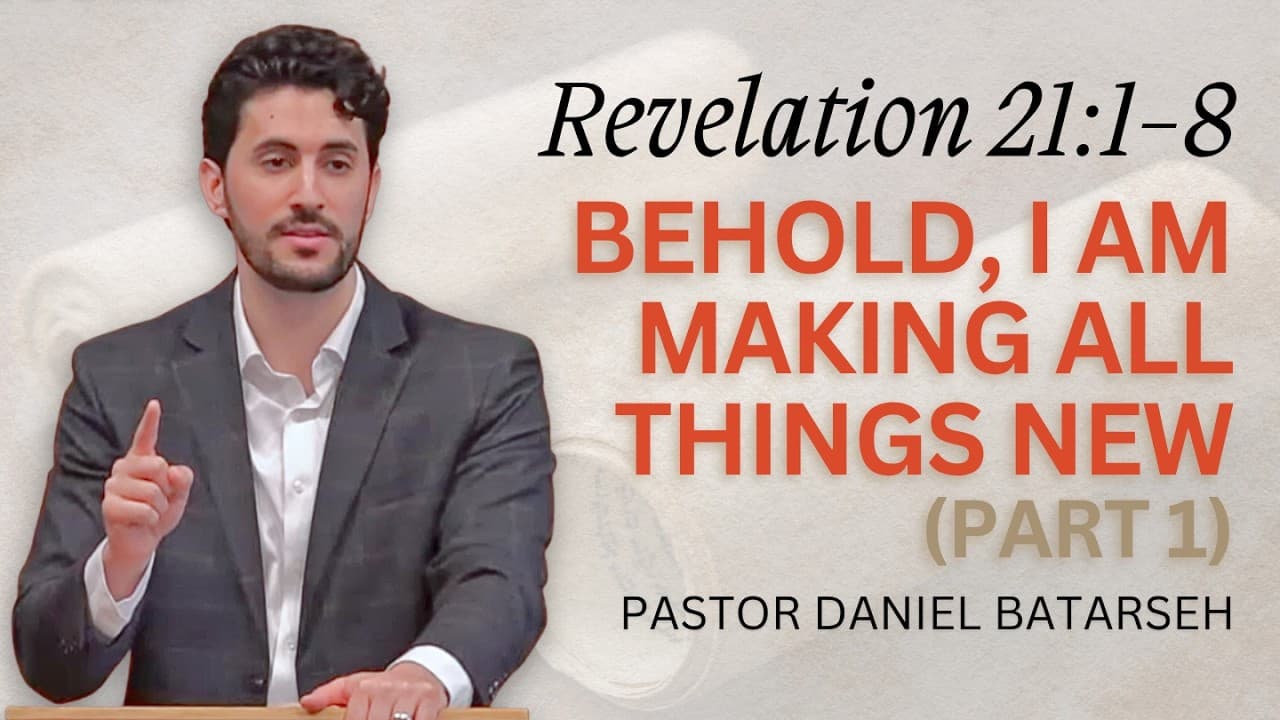
Christ's first coming dealt with sin once for all. His second coming is for something else entirely — and Hebrews 9:28 tells us who it's for.
Most people think of the second coming of Christ as a day of reckoning — fire, judgment, the settling of accounts. And it is that. But Hebrews 9:28 says something that should stop every Christian mid-breath: Christ will appear "a second time, not to deal with sin but to save those who are eagerly waiting for him." Not to deal with sin. That phrase changes everything about how we understand both the cross and the coming kingdom.
This was the text Pastor Daniel Batarseh read to open a sermon on Revelation 21:1-8 — a passage about God making all things new. But before he ever got to the new heavens and new earth, he planted this Hebrews 9 passage in the congregation's ears like a seed that would crack open everything that followed. The question he left hanging in the air before a single note of worship was sung cut straight to the bone.
The Problem That Had to Be Solved Before Anything Could Be Made New
If God is going to make all things new — if Revelation 21 promises a world without tears, without death, without mourning — then something has to happen to the thing that made the old world groan in the first place. Sin. And Hebrews 9 is the Bible's most concentrated explanation of how that problem was solved.
The argument builds like a courtroom case. Under the old covenant, the law required blood for purification. The blood of goats and bulls. The ashes of a heifer sprinkled on defiled persons. These rituals worked — but only on the surface. They "sanctify for the purification of the flesh" (watch at 1:06). Skin-deep holiness. External compliance. The conscience? Still haunted. Still carrying the weight of dead works.
Then comes the "how much more" — one of the most explosive phrases in all of Scripture. If animal blood could clean the outside, "how much more will the blood of Christ, who through the eternal Spirit offered himself without blemish to God, purify our conscience from dead works to serve the living God" (watch at 1:06).
Notice what the blood of Christ targets. Not just behavior. Not just ritual status. The conscience. That inner courtroom where you stand accused at 2 a.m. Where the memory of what you did — or what was done to you — plays on repeat. Where dead works pile up like evidence in a case you can never win. Christ's blood reaches there. It purifies the place no animal sacrifice could touch.
And the purpose of that purification isn't just relief. It's reorientation. Purified from dead works to serve the living God. Freedom isn't the destination — it's the doorway. You're cleansed so you can finally do what you were made to do: serve a God who is alive, not manage guilt before a system that can never fully acquit you.
Copies, Shadows, and the Real Thing
One of the most striking moves in Hebrews 9 is the distinction between copies and originals. The tabernacle? A copy. The holy places where priests entered year after year with borrowed blood? Copies of the true things. The entire sacrificial system — as divinely ordained as it was — was a sketch, a blueprint, a shadow cast by a reality that hadn't yet stepped into view.
As the text was read aloud: "For Christ has entered not into holy places made with hands, which are copies of the true things, but into heaven itself, now to appear in the presence of God on our behalf" (watch at 2:19).
Think about what that means. Every time an Israelite watched the high priest disappear behind the curtain on the Day of Atonement, they were watching a man walk into a room that was pretending to be somewhere else. The gold, the incense, the mercy seat — all of it was an earthly rehearsal for a heavenly reality. The real holy of holies isn't in a tent. It isn't in a temple. It's in the presence of the living God. And Christ didn't just visit. He entered. He sat down. He remains.
This is why the old system required repetition. Every year, the high priest went back in. Every year, more blood. The very fact that it had to be repeated proved it wasn't working — not ultimately. A cure you have to take every day isn't a cure. It's management. But Christ offered himself once. The word lands like a gavel. Once. Not because God is stingy with grace, but because the sacrifice was so complete, so infinitely sufficient, that repetition would be an insult to its perfection.
As the passage declares: "He has appeared once for all at the end of the ages to put away sin by the sacrifice of himself" (watch at 2:19). Put away. Not managed. Not suppressed. Not covered over for another year. Put away. The Greek word carries the sense of annulment — a legal cancellation. Sin's claim on you has been voided. The debt doesn't exist anymore. There's nothing left to pay.
The Second Appearing: What Christ Is Coming Back For
And here is where the text pivots toward something most people miss entirely. Verse 27 states the human condition with brutal simplicity: "It is appointed for man to die once, and after that comes judgment." No appeals. No second chances. No reincarnation. One life. One death. Then you stand before God.
But verse 28 mirrors that structure with a staggering parallel. Just as man dies once and faces judgment, "so Christ, having been offered once to bear the sins of many, will appear a second time, not to deal with sin but to save those who are eagerly waiting for him."
Read that again slowly. His second coming is not to deal with sin. That work is finished. Done. Accomplished on a hill outside Jerusalem two thousand years ago. When Christ returns, He is not coming back to the cross. He is not coming to make another payment. He is not coming to negotiate new terms.
He is coming to save. To complete the rescue. To bring the full inheritance that was secured by His blood but has not yet been delivered in its fullness. The resurrection of the body. The new heavens and new earth. The wiping away of every tear. The end of death itself. That's what Revelation 21 is about — the delivery of what Hebrews 9 purchased.
But notice the qualifier. He comes to save those who are eagerly waiting for him. Not those who are casually aware of him. Not those who filed him away as fire insurance. Not those who believe the right doctrines but live as if this world is all there is. Those who are eagerly waiting.
Pastor Daniel Batarseh let that phrase land with a question that hung in the room like smoke: "Are you eagerly waiting for him?" (hear this moment). No elaboration. No three-point answer. Just the question, followed by a call to stand and worship.
That's either the most comforting question in the world or the most terrifying one. It depends entirely on what you're living for.
The Question That Exposes Everything
Eager waiting reveals what you actually believe. You don't eagerly wait for something you doubt is coming. You don't eagerly wait for something you dread. You eagerly wait for what you love, for what you've been promised, for the person whose arrival will make everything right.
If you're not eagerly waiting for Christ's return, it's worth asking why. Is it because this world has become too comfortable? Because you've built a life that His return would interrupt rather than complete? Because the new creation sounds nice in theory but you'd rather have another thirty years of what you know?
The blood of Christ didn't just forgive your past. It purchased your future. A future so staggering that the entire Old Testament sacrificial system was just a rough pencil sketch of its down payment. The tabernacle was a copy. The temple was a copy. This entire created order — as beautiful as it is on its best days — is a copy. The real thing is coming.
And the one who secured it is coming with it.
That's the setup for Revelation 21. Before you can hear "Behold, I am making all things new," you have to understand what made the old things broken and what it cost to fix them. Hebrews 9 is the price tag. Revelation 21 is the receipt.
What to Remember
- Christ's blood doesn't just cover sin externally — it purifies the conscience, reaching the deepest place of guilt and shame that no ritual or self-improvement can touch.
- The entire Old Testament sacrificial system was a copy of heavenly realities; its repetition proved its insufficiency, while Christ's once-for-all sacrifice proved its completeness.
- "Put away" in Hebrews 9:26 means annulment — sin's legal claim on the believer has been permanently voided, not merely managed or suppressed.
- Christ's second coming is not to deal with sin again but to deliver the full salvation — bodily resurrection, new creation, eternal inheritance — that His first coming purchased.
- Eager waiting for Christ's return is not optional enthusiasm; it is the mark of those for whom His appearing means rescue rather than interruption.
Questions to Sit With
- If Christ's sacrifice truly "put away" your sin, why do you keep returning to the altar of your own guilt — and what would it look like to actually stop?
- What in your current life would you grieve losing if Christ returned today? What does that reveal about where your hope actually rests?
- The high priest entered the holy of holies every year because the sacrifice was never enough. Where in your spiritual life are you still repeating what God has already finished?
- "Are you eagerly waiting for him?" — answer honestly. If not, what changed since you first believed?
Scripture Referenced
This summary was generated by AI from the sermon "Behold, I Am Making All Things New (Part 1) | Revelation 21:1-8 | Pastor Daniel Batarseh (10/4/26)" preached by Pastor Daniel Batarseh at Maranatha Bible Church Chicago. Watch the full sermon →
Preached by
Pastor Daniel BatarsehSenior Pastor
This summary was generated by AI from the sermon transcript.
Based on the sermon
Behold, I Am Making All Things New (Part 1) | Revelation 21:1-8 | Pastor Daniel Batarseh (10/4/26)
Watch Full SermonRelated Articles
What the New Jerusalem Reveals About Your Future (Rev 21)
Pastor Daniel Batarseh · October 18, 2026
What the New Jerusalem Reveals About Eternity (Rev 21:9-27)
Pastor Daniel Batarseh · October 18, 2026
What Revelation 21 Says About Heaven That You've Never Noticed
Pastor Daniel Batarseh · October 11, 2026