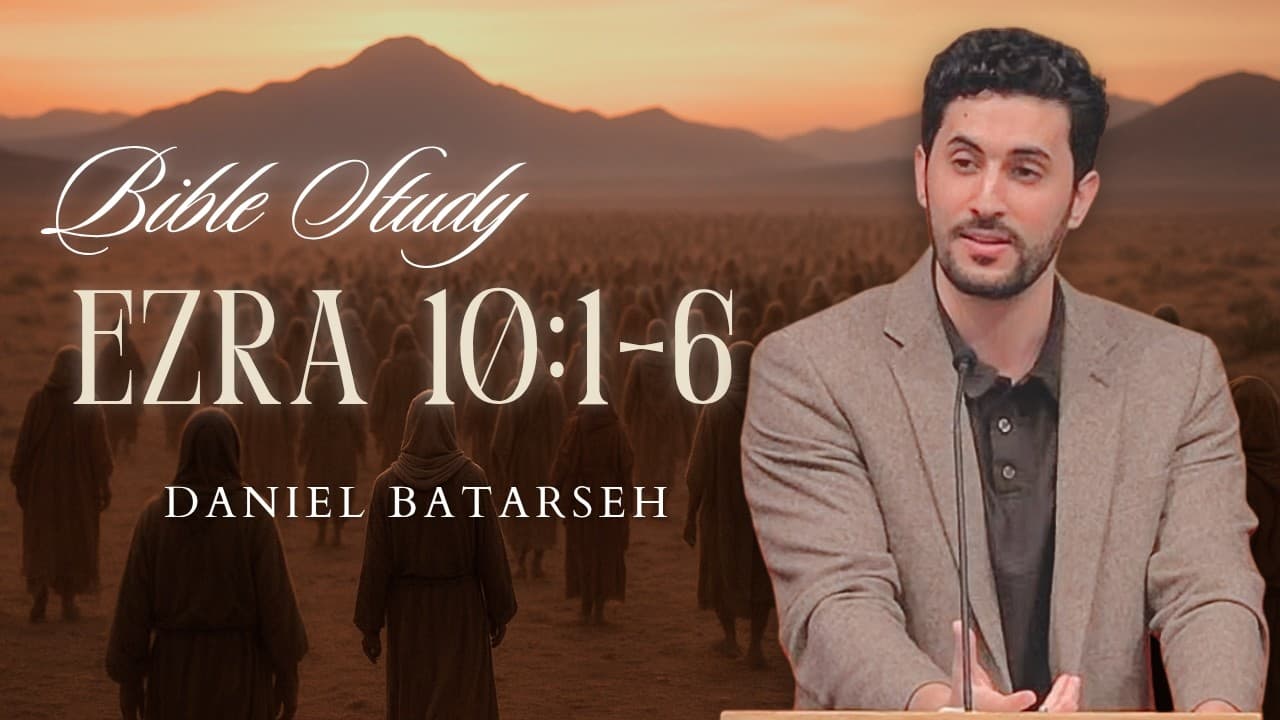
Before Ezra said a word to the people, God was already moving. And the man who finally got him off the ground wasn't a prophet or a king — he was an obscure name you've never heard of.
Before Ezra ever opened his mouth to confront the nation's sin, before he issued a single rebuke or correction, the people were already weeping. That's the part of Ezra 10 that should stop us cold. A man prostrate on the ground, pounding the dust, crying out to God — and a crowd gathering around him, their own hearts splitting open without a sermon being preached. And then, from nowhere, a man named Shechaniah — a man most of us have never heard of — steps forward and says the words that pick Ezra up off the ground and launch one of the most significant reforms in Israel's history.
What Ezra 10:1–6 reveals is not just a story about national repentance. It's a masterclass in three things the church desperately needs: the indirect power of authentic faith, the overlooked ministry of encouragement, and the courage it takes to choose God's Word over your own family.
Who You Are When Nobody's Watching Determines Your Authority When Everyone Is
Ezra had been in Jerusalem about four months. His mission, stated plainly back in Ezra 7:14, was to investigate whether the returned exiles were living according to God's law (watch at 26:48). What he found devastated him. Many of the men had married pagan wives — women who had not abandoned their false gods. This wasn't a matter of ethnicity. It was a matter of spiritual contamination. The very sin that had sent Israel into exile was already sprouting again in freshly tilled soil.
But here's what's remarkable about verse one: Ezra doesn't preach. He doesn't rebuke. He doesn't organize a committee. He prays. He weeps. He throws himself on the ground before the house of God. And while he's doing this — not after, but while — a great assembly gathers, and they begin weeping bitterly too.
Three things about Ezra drew these people in without a single word of direct confrontation: his praying, his passion, and his piety.
The praying is obvious. But the passion is worth sitting with. This wasn't a man dabbing tears from the corner of his eye. This was a dignified priest in full garments, pounding the ground, throwing himself down repeatedly. As Pastor Daniel Batarseh described it: "Imagine somebody pounding the ground with their fist, getting up on their knees and throwing themselves again, doing that over and over again. Clearly, this display of raw emotion says something about how he felt about this sin" (watch at 38:14).
But passion without character is just noise. What gave Ezra's grief its weight was his piety — his track record. In four months, he had already earned the trust and admiration of the leaders. They came to him with the bad news because they knew he could be trusted to handle it rightly. He was the real deal.
And here's the detail that clinches it. Look at verse six. After this public display of anguish, Ezra withdraws to a private chamber for the night. And what does he do there? The exact same thing. No bread. No water. Still mourning. Who he was in public, he was in private. That's the whole secret. As the sermon put it plainly: "Let this thing called faith and worship and obedience be your life. Not a part of your life, all of your life. And only then will you exude the fragrance of life" (watch at 49:17).
Contrast this with Lot. Genesis 19:14 records the moment Lot warned his sons-in-law that God was about to destroy Sodom. Their response? They thought he was joking. Not because the message was unbelievable, but because the messenger had no credibility. He'd been living in Sodom, sitting at its gate, giving his daughters to ungodly men. And now suddenly he's serious about God? The warning carried no weight because the man behind it carried no holiness. Lot's story is a devastating warning: you can be genuinely saved — Peter calls him righteous — and still lose every ounce of spiritual authority through compromise.
Shechaniah: The Obscure Man Who Got Ezra Off the Ground
Now the spotlight shifts. In verse two, a man named Shechaniah steps forward — someone we've never met and will never hear from again. At first glance, he appears to be among the guilty. He says "we have broken faith with our God and have married foreign women." But a closer look at the chapter reveals something fascinating.
Skip ahead to verse 26. There, in the official registry of men who committed this sin, you find the sons of Elam listed — including a man named Jehiel. Now go back to verse two: "Shechaniah, the son of Jehiel, of the sons of Elam." Shechaniah's own father is on the list. But Shechaniah himself is not.
So why does he say "we"? For the same reason Ezra said "our iniquities" in chapter nine when he himself was innocent. Shechaniah understood that this was a national crisis, not a private scandal. He identified with the people without self-righteousness. He was humble enough to say "we" — and brave enough to publicly name the sin his own father had committed.
That combination is rare. Humility and courage usually show up in different people. But Shechaniah held both. He didn't grandstand. He didn't distance himself from his guilty relatives with a sneer. He wept with the people. And then, with the dust still on his knees, he drew a line: this is wrong, it must be dealt with, and I will not protect my own family from accountability.
This is where the teaching hit hardest. The very ABCs of following Christ require that our allegiance to Him surpass every earthly bond. Too many believers love their family's approval more than Christ's commands. The invitations, the holidays, the peace-keeping — these become the functional lord of their lives. Shechaniah refused that trade.
The sermon traced this principle back to Deuteronomy 33:8–9, where the tribe of Levi is commended. Remember their story: after the golden calf incident, Moses stood at the gate and said, "Whoever is on the Lord's side, come to me." Only the Levites came. And what followed was brutal — they had to execute judgment on those who had sinned, including their own relatives. Deuteronomy 33:9 records the cost: "Who said of his father and mother, 'I regard them not.' He disowned his brothers and ignored his children. For they observed your word and kept your covenant" (watch at 59:32). Whatever curse Levi had inherited was reversed because of that one costly decision to stand with God.
Shechaniah stands in that same tradition. And God used him — this flash-in-the-pan figure — to ignite a national reformation.
The Fifteen-Second Voice Message That Changed Everything
Shechaniah didn't just identify the problem and propose a solution. He did something pastorally brilliant: he encouraged Ezra.
Two kinds of encouragement surface in verses two through four. First, hope in the midst of catastrophe: "But even now there is hope for Israel in spite of this" (v. 2). Whatever Ezra was feeling — despair, fury, the weight of an impossible situation — Shechaniah cut through it with a single declaration. It's bad. It's ugly. But it's not beyond God.
This echoes one of the most stunning reversals in the prophets. In Hosea 2:15, God speaks to His spiritually adulterous people — a nation He's just described in the most graphic terms of unfaithfulness — and says, "I will make the Valley of Achor a door of hope." The Valley of Achor, named for Achan's sin and execution in Joshua's day, literally means "Valley of Trouble." God's promise is that He can transform the very place of your worst failure into an entryway for hope. That's the God Shechaniah was pointing Ezra toward.
Second, solidarity: "Arise, for it is your task, and we are with you. Be strong and do it" (v. 4). This is your responsibility, Ezra. But you're not carrying it alone. We're behind you.
The next verse is three of the most important words in the chapter: "Then Ezra arose." The man who had been on the ground, shattered, unable to eat or drink — he stood up. Shechaniah's words picked him up off the dust.
Pastor Daniel Batarseh then shared a story that brought the room to a hush. Years ago, during one of the most intense stretches of his ministry — a period most people knew nothing about — he was lying in bed one night, overwhelmed. He opened a voice message from a man he'd met once at a conference and barely kept in touch with. The message was fifteen seconds long: "Daniel, keep going, brother. Keep going, brother. Keep going." That was it. He described what it did to him: "It was like a bolt of electricity hit me. And there was this gust of wind to my weak sail" (watch at 1:36:18). He sent a long response. The man never replied. He didn't need to. The work was done.
This is the ministry of encouragement — and it is, as the sermon declared, underrated to the point of neglect. A seven-minute phone call with a prayer at the end can fuel someone's ministry for three months. A heartfelt text message can keep a pastor from quitting. A sincere word — not flattery, not Christian pleasantries, but a genuine "what God is doing through you matters" — can redirect a life.
And here's the conviction that landed heaviest: don't reserve your encouragement only for the obviously weak. Even the strongest believers — especially leaders — experience moments where they need someone to say, "We're with you. Keep going." Jonathan did it for David when Saul was hunting him. Shechaniah did it for Ezra when the weight of national sin was crushing him. You may never be a pastor or missionary. But every one of us can be a Shechaniah.
The Divorce Question That Haunts This Text
We can't leave this passage without addressing the elephant in the room. Shechaniah's proposed solution — "put away all these wives and their children" — sounds like state-sanctioned mass divorce. And it raises real questions.
But the context matters enormously. These were not legitimate marriages in God's eyes. Deuteronomy 7:3 explicitly prohibited intermarriage with the surrounding nations who had not forsaken their idols. These women were not like Ruth, who declared "your God is my God." They were active worshipers of false gods, pulling their husbands into idolatry. The marriages were illegal from the start — a violation of covenant law, not just personal preference.
This was emergency protocol. Spiritual cancer that, left untreated, would destroy the barely-recovering nation.
Under the new covenant, the situation is clarified. 1 Corinthians 7:12–13 addresses believers married to unbelievers directly: stay. Don't divorce. Your presence in that home carries sanctifying power. If the unbelieving spouse wants to leave, let them go in peace. But if they consent to stay, that marriage is your mission field every morning.
The tension remains — Ezra 10 is not a comfortable text. The practical fallout of separating families is agonizing to consider, and the sermon honestly acknowledged that the debate continues among careful students of Scripture. But what's unmistakable is the urgency: when the holiness of God's people is at stake, half-measures won't do.
What to Remember
- Your private life is the engine of your public authority. If your faith looks the same when no one is watching, your words will carry weight when everyone is listening.
- Prayer doesn't replace action, but it prepares the ground for it. Ezra prayed first, and God was already softening hearts before the confrontation began.
- Encouragement is not a soft ministry — it is an atomic one. Fifteen seconds of sincere words can redirect a life, sustain a ministry, or spark a reformation.
- Choosing God's Word over family loyalty is not cruelty — it is the entry-level requirement of discipleship. Shechaniah loved his father, but he loved the truth more.
- There is always hope, even after catastrophic failure. God specializes in turning valleys of trouble into doors of hope.
- You don't have to be a leader to change the course of history. Shechaniah was an obscure man with a timely word — and Ezra arose because of it.
Questions to Sit With
- If someone watched your private devotional life for a week — no public worship, no small group, just you alone — would they see the same person who shows up on Sunday?
- Is there someone in your life right now — a pastor, a friend, a spouse in ministry — who needs a fifteen-second message of encouragement this week? What's stopping you from sending it?
- Shechaniah publicly acknowledged his father's sin without self-righteousness or cruelty. Is there a situation in your family where loyalty to a person has quietly replaced loyalty to the truth?
- When was the last time you prayed about a problem before you tried to fix it — and actually waited long enough for God to work before you intervened?
- Lot was righteous but had no credibility. Where in your life might compromise be silently eroding the weight of your witness?
Scripture Referenced
- Ezra 10:1–6 (primary text)
- Ezra 7:14
- Ezra 10:18, 26
- 1 Peter 1:13–25
- Psalm 93:5
- 2 Thessalonians 3:1
- John 2:17
- Genesis 19:14
- Deuteronomy 33:8–9
- Deuteronomy 7:3
- 1 Corinthians 7:12–13
- Hosea 2:15
- Galatians 3:1
This summary was generated by AI from the sermon "Ezra 10 (Part 1) Bible Study (The People Confess Their Sin) | Pastor Daniel Batarseh (3/20/26)" preached by Pastor Daniel Batarseh at Maranatha Bible Church Chicago. Watch the full sermon →
Preached by
Pastor Daniel BatarsehSenior Pastor
This summary was generated by AI from the sermon transcript.
Based on the sermon