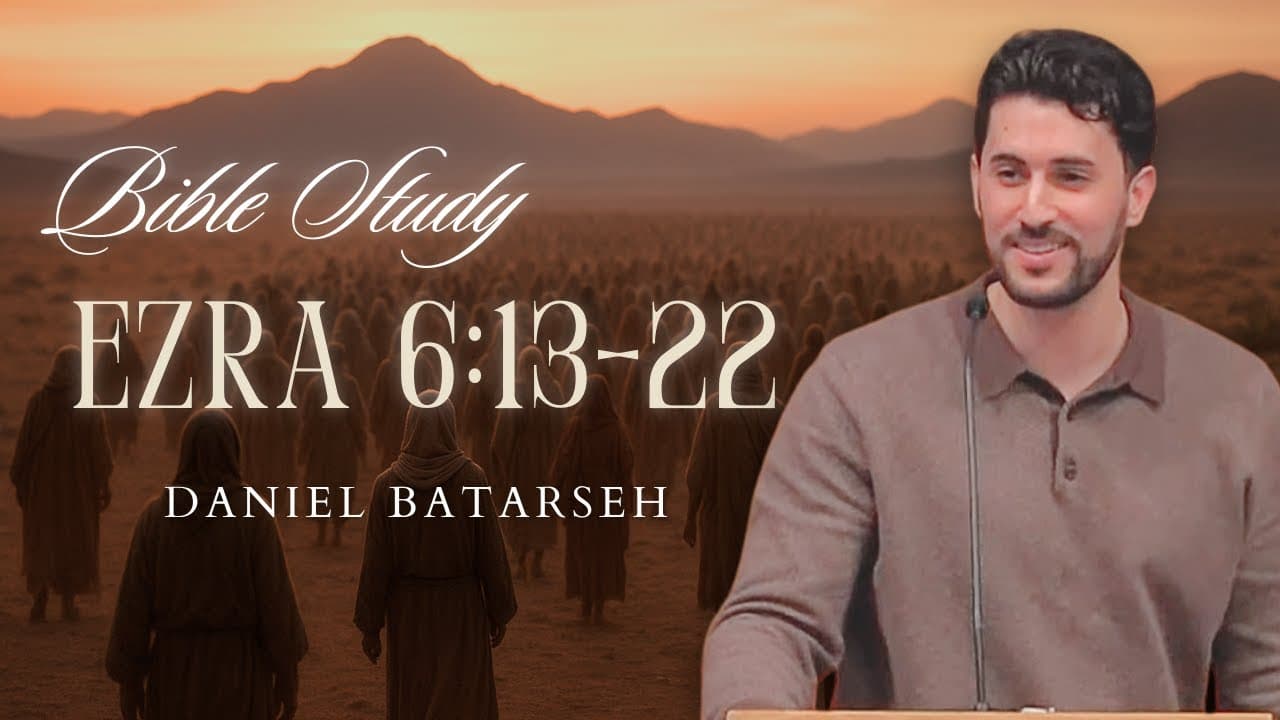
The second temple's dedication was a fraction of Solomon's — 712 animals versus 142,000. Yet both generations experienced identical joy. Ezra 6 reveals why.
The second temple was finished. Twenty years of delays, distractions, and discouragement — and finally, the house of God stood again in Jerusalem. But when the returned exiles gathered to dedicate it, they brought only 712 animals. Solomon had offered 142,000. By every measurable standard, this was a lesser moment. And yet the text says something stunning: they celebrated with joy. The same word. The same experience. How is that possible?
Ezra 6:13-22 answers that question, and the answer will confront every comfortable assumption you hold about what it takes to be genuinely happy.
Pagan Governors Put God's People to Shame
The chapter opens with a detail easy to skip. Tattenai, the Persian governor, and his associates — Gentile officials with no covenant relationship to God, no knowledge of the Torah, no spiritual inheritance — received Darius's decree and obeyed it "with all diligence" (watch at 3:44). No negotiation. No delay. No grumbling committee meetings. One word from a human king and they moved.
That word "diligence" carries weight. It means careful attention, energy, effort without reservation. And what makes it remarkable is that Darius promised these men nothing. There was no bonus, no promotion, no reward dangling in front of them. The only motivation was the king's pleasure.
As Pastor Daniel Batarseh put it: "If these men are willing to do this for a human king named Darius, how much more us for our King Christ, our Lord, our Master? No hesitation. No arguments. No debate. All diligence the first time" (hear this moment).
The comparison is devastating in its simplicity. Darius never humbled himself. He never set aside his crown to serve his subjects. He never entertained the thought of dying for his enemies. And yet he commanded total, eager obedience from his governors. We serve a King who did all of those things — who bled, who stooped, who died willingly for people who despised Him — and we bargain with Him about Sunday mornings. The text does not soften this comparison, and neither should we.
They Had Everything Going for Them — and Still Needed the Word
Here is where the passage gets uncomfortably personal. Verse 14 says the elders of the Jews "built and prospered through the prophesying of Haggai the prophet and Zechariah the son of Iddo." This is not a one-time motivational speech. The construction points to ongoing, regular, continual prophetic ministry. These people needed the Word of God delivered to them consistently — even when everything was going their way.
Consider the context. At this point in the story, there is zero opposition. The Persian government is funding the project. Kings are issuing decrees of protection. The green light could not be brighter. And the people of God still needed a supernatural force to keep them in the will of God.
"This flesh is remarkable at finding ways to drain our enthusiasm for God. Even if everything in your life is cooperating."
That is a terrifying insight. We tend to think discouragement is the primary threat to faithfulness. It is not. Comfort is. The Israelites did not abandon the temple because of persecution alone — they abandoned it because they got busy with their own houses. And even after they resumed, with royal backing and no enemies in sight, they still could not sustain spiritual momentum without regular exposure to Scripture.
This is why Zechariah 4:6 mattered so much to them: "Not by might nor by power, but by my Spirit, says the Lord." That single verse was fuel. And the prophets kept delivering it — encouragement, warning, promises, hope about the future — the full range of what God's Word does when it is faithfully taught and faithfully received.
If you are a Christian in America in 2026, you have been granted a level of religious liberty that history has rarely known. And yet spiritual inconsistency is epidemic. The diagnosis from Ezra 6 is plain: distance yourself from the Book, and it is only a matter of time before you shrivel up and give yourself to something futile and empty. "You will never be able — never be able — to point someone to me who claims to be a consistent Christian and doesn't have a consistent and humble engagement and relationship with the written word of God. You won't be able to find one. Impossible."
That is not hyperbole. That is a principle so obvious the text barely needs to argue for it. It was through the prophesying of the prophets that the remnant prospered. Remove the prophesying, and the prosperity dries up. It always has. It always will.
Twenty Years for One Temple — and the Sobering Math of Wasted Time
The temple was completed in the sixth year of Darius. The work had resumed in the second year. Four years of active construction. But zoom out. The foundation was laid shortly after the exiles returned from Babylon — and then they stopped for roughly sixteen years. Total elapsed time: twenty to twenty-one years for a single building.
"Last night, I just sat back and I thought to myself, in that same amount of time, they could have rebuilt five of these temples. But instead, because of what? Idleness and worldly ambition. They built one" (watch at 20:02).
Five temples. One temple. The difference was not talent or resources. It was sixteen years of looking the other way.
This is not an abstract historical observation. It is a mirror held up to your face. How many years have passed where you barely invested anything in building your relationship with God? No reading plan. Little time in prayer. No investment in ministry. Time is the most precious gift precisely because it is non-refundable. You cannot earn it back. You cannot negotiate for a do-over.
But the text does not leave you in guilt. The temple was still finished. God still brought it to completion. And if you are among those haunted by squandered years — wishing you had been saved earlier, wishing you had not been so foolish with the resources at your disposal, wishing you had listened — the counsel is not paralysis. It is redirection. When those regrets surface, recycle them. Let them become fuel: with whatever time I have left, I will live maximally for God.
And for anyone who makes that decision, from this moment forward, joy is promised. Joy today and joy tomorrow. That is exactly what the text reveals next.
712 Sacrifices, 142,000 Sacrifices — and the Same Joy
Now we arrive at the celebration, and here is where the theology of joy in Ezra 6 becomes extraordinary. The returned exiles dedicated the temple with 712 animals — 100 bulls, 200 rams, 400 lambs, and 12 male goats as a sin offering. Compare that to Solomon's dedication of the first temple in 1 Kings 8:62-63: 22,000 oxen and 120,000 sheep. A total of 142,000 animals.
712 versus 142,000. By any external metric, this was embarrassing. One might be tempted to think the second temple's dedication was worthless by comparison. And yet 1 Kings 8:66 says the people at Solomon's dedication went home "joyful and glad of heart." And Ezra 6:16 says this generation celebrated "with joy." Same word. Same reality. The Holy Spirit is deliberate. He writes "this house" — as if to emphasize that the apparent inferiority of this house did not determine their joy.
The secret is in verse 22: "the Lord had made them joyful." God manufactured their gladness. It was not a product of their circumstances or the impressiveness of their offering. It was a sovereign gift, poured into hearts that recognized His fingerprints on their story — the way He turned the heart of a pagan king, the way He funded their project through the very empire that had once destroyed them.
This demolishes the prosperity gospel and the misery gospel in a single stroke. God can produce identical joy in a people with almost nothing as He did in a people who had everything. The variable is not what you have. It is who is at work. If your joy is indexed to your possessions, you are promised a fickle and flimsy contentment — because possessions come and go. But if your joy is in God, in Christ who is always working, you will know a happiness that endures all circumstances.
But there is a second layer. Joy in both 1 Kings 8 and Ezra 6 appears in the context of sacrifice and worship — not accumulation and leisure. The Macedonian believers in 2 Corinthians 8:1-2 confirm this pattern with shocking force: "in a severe test of affliction, their abundance of joy and their extreme poverty have overflowed in a wealth of generosity." Abundance of joy sitting right next to extreme poverty. Two realities that have no business occupying the same sentence, yet do.
The explanation, from 2 Corinthians 8:5: "they gave themselves first to the Lord." Not their money first, not their time first — themselves. The order matters. Surrender precedes joy, not the reverse. We do not work our way into gladness and then offer God the surplus. We hand over the whole of ourselves, and joy rises from the wreckage of our self-sovereignty like something planted by another hand entirely.
The Returned Exiles Got What the Comfortable Ones Missed
Three times in the final four verses, the Holy Spirit identifies this celebrating community as "the returned exiles." The repetition is deliberate and it connects their present joy to their past sacrifice.
Cyrus had extended the invitation to all the Jews in Babylon. Not all accepted. Many stayed behind — for businesses, for land, for the comfort of the only life they had known. Some Levites surely wanted to stay because they had acquired property in Babylon, something they would have to forfeit upon returning to Israel. The ones who stayed chose comfort. The ones who left chose obedience.
And now, at the end of Ezra 6, who is standing in the courts of the second temple, keeping the Passover and the Feast of Unleavened Bread, tasting revival? The returned exiles. Not the comfortable ones. The ones who paid the price.
The same principle surfaces in Acts 16:1-3 when young Timothy accepts circumcision — not as an infant, not under anesthesia, but as a fully conscious young man — to join Paul's missionary team (watch at 48:11). What if he had said no? What if he had thought, "I appreciate the invitation, but I think I'll just go on with my life the way it always has been"? He would have missed the adventure of a lifetime. He would never have pastored the church at Ephesus. He would never have gained Paul as a spiritual father. He would never have had two letters of the New Testament addressed to him. It all hinged on a willingness to endure a deeply personal sacrifice.
"I've yet to be convinced that somebody has more joy, more peace, more excitement in their life living for themselves than living for God. You know somebody? Show me after. And don't show me an Instagram profile or a TikTok account. Some of those people are the most miserable of them all" (hear this moment).
There are certain spiritual experiences that can only come to those willing to walk away from what God asks them to walk away from. The returned exiles tasted what the Babylonian stay-behinds never would. Timothy experienced what a comfortable young man in Lystra never could. The Macedonians knew a joy that wealthy, self-preserving churches never will.
Sacrifice is the path. Joy is the destination. And the door is open to anyone willing to step through it.
What to Remember
- Pagan governors obeyed Darius with "all diligence" for no promised reward — if that does not challenge the half-hearted obedience of Christians who serve a King who died for them, nothing will.
- Even when every circumstance cooperates, you still need consistent, regular exposure to God's Word to remain spiritually alive. Comfort is a more dangerous enemy than persecution.
- Twenty years for one temple instead of five — idleness and misplaced ambition are thieves of irreplaceable time, but guilt over wasted years should fuel future faithfulness, not paralyze you.
- God produced identical joy in a people who offered 712 animals as He did in a people who offered 142,000 — joy is not proportional to what you possess but to who is at work in you.
- The Macedonian believers proved that "abundance of joy" and "extreme poverty" can coexist — the secret was giving themselves first to the Lord, not first to their comfort.
- Sacrifice of various kinds is the consistent biblical path to spiritual reward. The returned exiles, Timothy, and the Macedonians all confirm: you cannot access certain experiences with God while clinging to what He asks you to release.
Questions to Sit With
- If Tattenai and his associates obeyed Darius with total diligence simply because he asked — no reward, no promise — what does it say about you that you negotiate with God over what He has clearly asked of you?
- What is the "Babylon" you are choosing to stay in right now because it is familiar and comfortable, even though God has opened the door for you to leave?
- If you could see a timeline of the last five years of your spiritual life, would it look more like four years of faithful building — or sixteen years of distraction with a thin layer of activity at the end?
- What would you need to sacrifice — not something sinful, but something comfortable, shallow, or time-consuming — to step into what God has next for you?
- Do you know the difference between believing that God is the source of all blessing and actually responding to that truth with unreserved worship — and which one describes your life right now?
Scripture Referenced
This article is drawn from the sermon "Ezra 6 (Part 2) Bible Study (The Temple Finished and Dedicated)" by Pastor Daniel Batarseh at Maranatha Bible Church Chicago. Watch the full sermon →
Preached by
Pastor Daniel BatarsehSenior Pastor
This summary was generated by AI from the sermon transcript.
Based on the sermon