
Most people picture a small child on Mount Moriah. But the Hebrew text tells a different story — one that makes the connection to Good Friday staggering.
Most people picture a small child on Mount Moriah. A confused little boy. A trusting toddler who didn't know what was happening as his father bound him to an altar. It's the version we learned in Sunday school, and it's wrong.
The Hebrew word translated "boy" in Genesis 22:5 and 22:12 doesn't mean what we think it means. It carries a far broader range than our modern English assumption — it can refer to a teenager, even a young adult. And when you let that reality settle in, the entire story shifts. Isaac wasn't a helpless child carried up the mountain against his will. He was a young man strong enough to haul a load of wood on his shoulders, perceptive enough to notice something was missing from the sacrifice, and — most remarkably — willing enough to lay himself down anyway.
That changes everything about how we read this passage. And it changes everything about how we see Good Friday.
In this Good Friday service, Pastor Daniel Batarseh walked through Genesis 22 with the kind of care that makes ancient text feel like it was written yesterday. What emerged was not simply a lesson about Abraham's faith, but a breathtaking portrait of a son who chose to submit — and a God who, when the moment came for His own Son, did not provide a substitute.
The Word "Boy" Has Misled Us for Generations
Here is where the sermon stopped the room cold. We've been reading Genesis 22 through the lens of a word that, in English, conjures images of a child. A five-year-old. Maybe eight. Someone too young to resist, too naive to question. But the Hebrew term used in verse 5 and verse 12 is far more elastic than that. It denotes a range that includes young men, teenagers, even servants of fighting age. The same word appears elsewhere in the Old Testament applied to individuals who are clearly not small children.
And the internal evidence of the passage confirms it. Isaac is carrying wood — enough wood to fuel a burnt offering — up the side of a mountain. A small boy cannot do that. More telling still is what happens during the ascent. Isaac looks around, takes stock of the situation, and asks a pointed question: We have the fire and the wood, but where is the lamb?
As Pastor Daniel Batarseh observed, "It shows that Isaac understood what it meant to sacrifice to the Lord. Abraham taught him well. And he was old enough to carry the load of wood on his shoulders. A little boy can't do that" (watch at 4:18).
That question from Isaac is not the confusion of a child. It is the discernment of someone who has been raised in worship, who knows the elements of sacrifice, and who can see that one critical piece is missing. He's not asking out of ignorance. He's asking because he already suspects the answer.
And still he goes.
Isaac's Submission Is the Part We Keep Missing
We talk endlessly — and rightly — about the faith of Abraham in Genesis 22. Hebrews 11 immortalizes it. Preachers have built entire sermon series around the old patriarch's willingness to offer his only son. But there is a second act of faith on that mountain that we rush past far too quickly.
Isaac submitted.
If Isaac was a young man — strong, capable, aware — then his presence on that altar was not the result of overpowering force. Abraham was old. Isaac was young and strong enough to carry a burden of wood up a mountainside. At any point, Isaac could have refused. He could have fought. He could have run. The math was not in Abraham's favor.
But Isaac laid himself down.
This is what the sermon pressed into our consciences: the obedience of the father is stunning, yes, but the compliance of the son is what makes the typology of Christ so vivid. Jesus was not dragged to Calvary against His will by a Father who overpowered Him. The Son chose it. "No one takes my life from me," Jesus said. "I lay it down of my own accord." Isaac on Moriah is a shadow of that greater reality — a son who willingly bore the wood, walked toward death, and did not resist.
The sermon described it as "the unreserved compliance of his son, Isaac" (hear this moment). That phrase — unreserved compliance — is not language we associate with a frightened child. It is the language of a deliberate, costly choice.
Wood on His Shoulders and a Question That Echoes
There is an image in this story that, once you see it, you cannot unsee it.
Isaac carries the wood of his own sacrifice on his shoulders up the hill.
Jesus carries the wood of His own sacrifice on His shoulders up the hill.
The parallel is not accidental. Scripture is not clumsy. The ram caught in the thicket, the mountain in the region of Moriah — the very region where Solomon's temple would later stand, where sacrifices would be offered for centuries, and not far from where a Roman cross would one day be planted in the ground — none of this is coincidence. It is architecture. Divine, purposeful architecture stretching across millennia.
But here is where the typology breaks — and the break is the whole point of Good Friday.
On Moriah, God stopped Abraham's hand. A ram appeared. A substitute was provided. Isaac walked away alive.
On Calvary, no hand was stayed. No substitute appeared. No voice from heaven said, "Stop." The Son of God, who carried His own wood up His own hill, was not spared. The knife fell. The wrath landed. The Beloved died.
Abraham proved his love for God by his willingness to give up his only son. God proved His love for us by actually doing it.
Romans 8:32 Was Born on Mount Moriah
One of the most striking connections in this sermon was the thread pulled between Genesis 22 and Romans 8:32. Paul writes: "He who did not spare his own Son but gave him up for us all, how will he not also with him graciously give us all things?"
Listen to the language. Did not spare. Gave him up. His own Son. These are not generic theological phrases. They are echoes — deliberate, unmistakable echoes — of the Abraham and Isaac narrative. The verb Paul uses carries the same weight as the moment on Moriah when God told Abraham, "You have not withheld your son, your only son."
As the sermon put it: "It makes you wonder if Paul's words in Romans 8:32 stem from this story when he says that he who has not given up or not withheld and kept back his son from us, will he not also graciously give us all things? God did not hold back his son. God gave his son" (watch at 1:48).
This is the logic of the gospel compressed into a single argument: If God gave the greatest gift — His only, beloved Son — why would He withhold anything lesser? If He spent the infinite treasure, will He be stingy with the finite ones? The answer is so obvious it barely needs stating. And yet we live as though we're not sure. We pray as though God might not come through. We worry as though the One who bled for us might forget about our rent, our diagnosis, our loneliness.
The cross is not just the place where sin was dealt with. It is the permanent, irrevocable proof that God is for you. Every lesser gift flows from the greater one already given.
The Confidence the Cross Was Meant to Create
This is where the sermon moved from theology to the room — from ancient text to the person sitting in the chair, carrying something heavy into a Good Friday service.
"It's amazing to consider that we too, in looking at what God has done with his only son, can say with confidence, I know he loves me. I have absolute confidence that he loves me because he did not withhold his son from me" (hear this moment).
Absolute confidence. Not hopeful optimism. Not theological probability. Absolute confidence.
The cross is evidence. It is not a sentiment or a greeting card. It is a historical event in which the God of the universe handed over what was most precious to Him so that you would never have to wonder whether He cares. You don't have to guess. You don't have to earn it. You don't have to perform well enough this week to keep His affection. The matter was settled on a Friday afternoon outside Jerusalem, and it has not been unsettled since.
And the invitation at the close of the service was striking in its simplicity: come to Easter not sorrowful, not guilty, but overwhelmed by His love. That's the posture the cross creates — not groveling, not anxious, but stunned. Stunned that He did it. Stunned that He meant it. Stunned that it was for you.
What to Remember
- The Hebrew word for "boy" in Genesis 22 does not mean a small child — Isaac was likely a young man who willingly submitted to the altar, making him a far more powerful type of Christ than we realized.
- Isaac's question — "Where is the lamb?" — reveals he understood sacrifice; his compliance was informed, not naive, and that makes his submission extraordinary.
- God proved His love not by willingness to give His Son but by actually giving Him — on Moriah the knife was stayed, but on Calvary it was not.
- Romans 8:32 is almost certainly an echo of Genesis 22 — Paul's argument for God's generosity is rooted in the logic of Abraham's sacrifice.
- The cross is not merely where sin was forgiven; it is the permanent evidence that God holds nothing back from those He loves.
- If God gave the greatest gift — His own Son — your smaller fears about His provision are already answered.
Questions to Sit With
- If Isaac was a willing young man and not a helpless child, how does that change the way you picture Jesus walking toward the cross — and what does it say about the nature of true obedience?
- What are you currently uncertain God will provide — and how does the logic of Romans 8:32 ("if He gave His Son, will He not give all things?") confront that uncertainty?
- Do you approach God with "absolute confidence" that He loves you, or do you still operate as though His affection depends on your recent performance?
- The sermon invited the congregation to come to Easter "not sorrowful, not guilty, but overwhelmed by his love." Which of those three postures most naturally describes how you relate to God right now — and why?
Scripture Referenced
- Genesis 22:1-19 (primary passage)
- Romans 8:32
This summary was generated by AI from the sermon "The Lord Will Provide | Genesis 22 | Good Friday Service | Pastor Daniel Batarseh (4/3/26)" preached by Pastor Daniel Batarseh at Maranatha Bible Church Chicago. Watch the full sermon →
Preached by
Pastor Daniel BatarsehSenior Pastor
This summary was generated by AI from the sermon transcript.
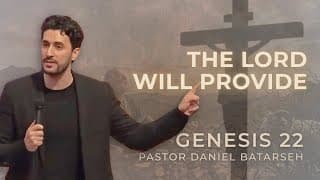
Based on the sermon
The Lord Will Provide | Genesis 22 | Good Friday Service | Pastor Daniel Batarseh (4/3/26)
Watch Full SermonRelated Articles
Nehemiah 6:15-19 — What 52 Days of Rebuilding Teaches About Prayer and Fruitfulness
Pastor Daniel Batarseh · September 11, 2026
Nehemiah 6:15-19 — What 52 Days of Rebuilding Teach Us About Prayer and Persistence
Pastor Daniel Batarseh · September 11, 2026
Moses' Parents: The Faith That Formed a Deliverer (Hebrews 11:23)
Pastor Daniel Batarseh · August 30, 2026