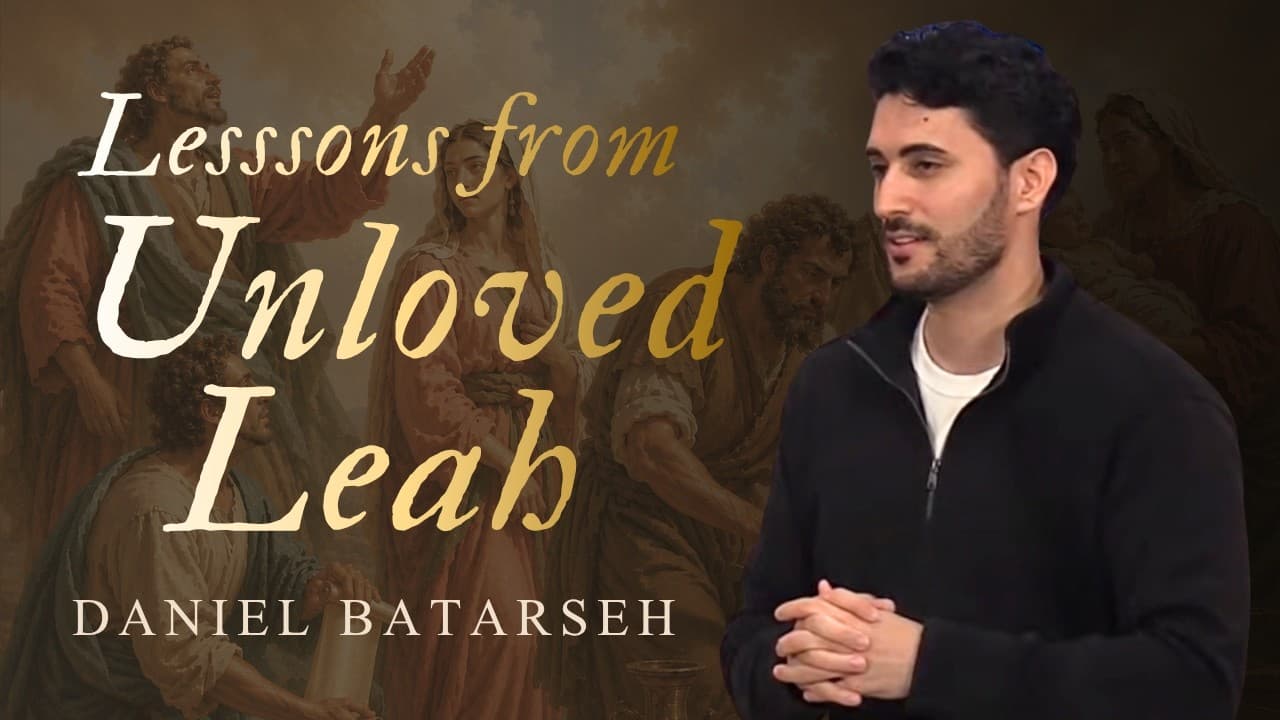
Everyone remembers Rachel. But God chose overlooked, unloved Leah to carry the Messianic line — and her journey from craving Jacob's love to worshiping God alone is a mirror into every restless soul.
When you think of Jacob's wife, you think of Rachel. Beautiful Rachel. Everyone does. But before Rachel, there was Leah — the woman whose own father believed the only way she could get married was through deception, whose husband never once called her "my wife" even on his deathbed, and whose sister envied and resented her rather than loved her. And yet this overlooked, unloved woman became the one God chose to carry the line of the Messiah. Genesis 29:16–35 doesn't just tell us a sad story about a woman who couldn't compete with her sister's beauty. It holds up a mirror to every soul that has ever tried to fill itself with anything other than God — and shows us the exact moment everything can change.
The Woman Whose Father Had to Trick a Man Into Marrying Her
Leah is introduced to us in a way that stings if you slow down long enough to feel it. "Leah's eyes were weak, but Rachel was beautiful in form and appearance" (Genesis 29:17). The Hebrew word translated "weak" is genuinely ambiguous — it can mean tender, soft, or delicate. Some scholars think it's a compliment about the softness of her eyes. Others believe it describes a visual impairment. But the context settles the debate: this detail is set against Rachel's "beautiful in form and appearance." The Spirit of God is telling us that Leah did not measure up to her sister's arresting attractiveness.
And that comparison wasn't just literary. It was Leah's daily reality. Imagine being the sister who never got the compliments when you walked into a room together. The one the boys didn't flock to. The one who watched her younger sister disarm everyone with charm while she stood off to the side.
But the real devastation comes from the three people closest to her. Laban, her father, concocted a scheme to trick Jacob into consummating a marriage with Leah because — and there's no softening this — he believed no man would marry her voluntarily (watch at 36:16). A father, the one person who should affirm a daughter's worth, concluded that deception was the only path to her wedding night. As Pastor Daniel Batarseh put it, holding back visible emotion: "I have a daughter. She's probably the youngest one at this conference. Two months old this week. And already, I wanna tell you something. I cannot fathom doing to my daughter what this man did to his" (watch at 36:16).
And then came the morning after. Whatever the circumstances of that darkened wedding night — alcohol, excitement, the pitch blackness of a tent — when morning light hit, Jacob's reaction was shock, disappointment, maybe disgust. Leah's only recorded experience of being with a man was orchestrated through lies and met with revulsion that it was her and not someone else.
Jacob Never Called Her "My Wife" — Even After She Died
Jacob's treatment of Leah is a slow, decades-long wound that never heals. He loved Rachel more than Leah (Genesis 29:30) — and the text never suggests that gap ever closed. Leah was trapped in a marriage where she knew, every single day, that she was less loved. And in that ancient culture, she couldn't leave. The oath was binding for life.
Consider what happened years later when Jacob learned that Esau was approaching with 400 men. He arranged his family in order of expendability: servants and their children in front, Leah and her children in the middle, Rachel and Joseph safely in the rear (Genesis 33:1–2). If violence came, Rachel would have time to escape. Leah would not. "Just imagine weak-eyed Leah. How did she feel there as she grabbed the hands of her children and made her way to that post?" (watch at 44:49).
But the most devastating detail is one you'd miss if you read too quickly. In Genesis 49:31, Jacob gives his final instructions before death. He says: "There they buried Abraham and Sarah his wife. There they buried Isaac and Rebekah his wife. And there I buried Leah." No "my wife." Abraham's wife gets the title. Isaac's wife gets the title. Leah gets nothing — just her bare name. This is intentional omission. This is how Jacob felt about Leah even after she was in the ground.
And Rachel? You'd hope for sisterly solidarity. Instead, Genesis 30:1 reveals that Rachel envied Leah for her fertility. Nowhere does the text say Leah envied Rachel's beauty — but Rachel, with all her stunning looks, was consumed with jealousy toward her plain sister. And when Jacob finally fled Laban's household, it wasn't Leah who smuggled household idols along. It was the beautiful one who brought false gods into the family.
That detail prompted one of the sharpest moments of the evening: "My dear brother, you're looking for a wife. What are you looking for? You're looking for form? You're looking for a model? Are you bypassing true beauty?... I'll tell you what's more beautiful: a woman who fears God. A woman who will bring heaven into your living room. And Jacob missed it" (watch at 52:19).
God Saw What Everyone Else Ignored
"When the Lord saw that Leah was hated, he opened her womb, but Rachel was barren" (Genesis 29:31).
Stop there. Feel the weight of that sentence. Every person who should have loved Leah — father, husband, sister — failed her. And the first being in the entire narrative to show her acceptance was not a man or a woman, but her Creator. God saw. He recognized. He acknowledged. And then He acted.
But this was far more than divine sympathy. God wasn't just giving Leah a consolation prize. He was selecting an excluded, marginalized, neglected woman to be a matriarch of the nation of Israel. The contrast is stunning: Jacob chose Rachel over Leah because of physical beauty. God chose Leah over Rachel when He wanted to fill a womb and multiply the seed promised to Abraham.
This pattern echoes through history. Fanny Crosby was born virtually blind — a woman you might pity if you passed her on the street. She composed between 8,000 and 9,000 hymns in her lifetime, so many that publishers made her use pseudonyms because they feared readers would lose interest if every hymn bore her name. "Blessed Assurance." "Pass Me Not, O Gentle Savior." "To God Be the Glory." Songs the church still sings were written by a woman the world would have overlooked. God is attracted to the unattractive. He is magnetized to the wounded. He takes pleasure in exalting those the world has tossed aside.
And the proof of Leah's exaltation outlived her by centuries. In Ruth 4:11–12, when the elders blessed Boaz's marriage, they invoked Leah's name alongside Rachel's — "like Rachel and Leah, who together built up the house of Israel." In Laban's eyes, she was less than Rachel. In Jacob's eyes, less than Rachel. In Rachel's own eyes, less than Rachel. But God placed her name right beside her sister's in the mouths of those who pronounced blessing. And from Leah's sons Levi and Judah came the priests and the kings of Israel — and ultimately, the Messiah Himself.
"This Time I Will Praise the Lord" — The Turning Point
The birth accounts of Leah's first four sons are not just genealogical records. They are a window into the agonizing wrestle of a woman's faith.
With Reuben, her firstborn: "The Lord has looked upon my affliction; for now my husband will love me." With Simeon: "The Lord has heard that I am hated; he has given me this son also." With Levi — and notice God isn't even mentioned — "Now this time my husband will be attached to me, because I have borne him three sons."
Do you see the pattern? She acknowledges God as the source of these blessings but treats each child as a means to get what she really craves: Jacob's affection. Years pass between these births. Nine months, nine months, nine months. And the dominant thought consuming her soul is: If I can just give him enough, maybe he'll love me.
We read these verses in thirty seconds. She lived them over the course of years.
And here is where the sermon stopped being about an ancient woman and became about everyone in the room: "Aren't we all capable of what Leah is doing here? We can be recipients of God's blessing and protection and provision — marriage, children, promotion — and we can say, 'Yeah, that's God.' But we're not satisfied in God. We see him as the source of our blessings, but not the ultimate blessing himself" (watch at 1:06:20).
God plus. That's what it is. God plus a husband who finally notices you. God plus the career that validates you. God plus the body that earns admiration. And you will never know contentment as long as it's God plus anything.
Then comes the fourth son. And everything shifts.
"She conceived again and bore a son, and said, 'This time I will praise the Lord.' Therefore she called his name Judah" (Genesis 29:35).
This time. You can almost hear the exhaustion — and the resolve. Nothing worked. Nothing budged Jacob. So Leah made a choice. Not a feeling. A choice. She would stop trying to earn love from a man who would never give it and turn her full attention to the God who had loved her when no one else would.
And then the strangest thing: "Then she ceased bearing." At first glance, it seems like Leah's decision — a sabbatical from childbearing to enjoy her newfound worship. But Genesis 30:9 reveals that she saw that she had ceased bearing, meaning it wasn't her choice. God closed her womb. Temporarily, yes — it would open again later. But why close it at this exact moment?
Because this worship was what God had been after all along. And once Leah genuinely offered it, He paused everything else as if to say: Let's stay here. Let's enjoy this. And there's another layer — God seems to be marking this particular son, Judah, as uniquely significant. Stop here. Pay attention to this boy. Because from Judah's line would come the Messiah — the One who would draw in the unloved, pursue the overlooked, and heal the hearts that no human relationship could ever fill.
As Pastor Daniel Batarseh said in the most striking moment of the night: "Here you have a woman who is unloved in this story, and she becomes the mother of the tribe who would bring forth the Savior who would draw in the unloved. Who would woo the abused. Who would run after those on the sidelines. Who would fish for the ones who seem overlooked and feel despised" (watch at 1:15:13).
What God did for Leah in that moment, He would do through her Son's line for every Leah in every generation.
What to Remember
- The first person to show Leah love was not her father, her husband, or her sister — it was God. If every human relationship in your life has failed you, that does not mean you are unloved.
- Acknowledging God as the source of your blessings is not the same as being satisfied in God. You can say "God is good" every day and still be empty because you're treating Him as a means to something else.
- "This time I will praise the Lord" was a choice, not a feeling. Don't wait for some spontaneous spiritual experience to sweep you into worship. Decide.
- Every polygamous relationship in Scripture brings trouble — not one is presented as a blessing. God's design for marriage has never changed.
- God closed Leah's womb at the exact moment she began to truly worship — not as punishment, but as invitation to stay in that place of fellowship with Him.
- From the unloved woman came Judah, and from Judah came Christ — the One who specializes in pursuing the overlooked and healing hearts no human love can reach.
Questions to Sit With
- If you're honest, what is the "plus" after God in your life right now — the thing you believe you need in addition to Him in order to feel complete?
- Leah spent years interpreting God's blessings as tools to gain Jacob's love. Are you receiving God's gifts but missing God Himself?
- Is there a relationship in your life where you keep giving more, hoping the other person will finally love you the way you need — and it never works? What would it look like to make Leah's choice: "This time I will praise the Lord"?
- Jacob never called Leah "my wife." Have you let someone's refusal to affirm your worth define how you see yourself — even though God has already spoken?
- What would change in your daily life if you genuinely believed that God is magnetized to the wounded and takes pleasure in exalting the overlooked?
Scripture Referenced
- Genesis 29:16–35 — Leah's introduction, marriage, and the birth of her first four sons
- Genesis 30:1–9 — Rachel's envy and Leah's ceased childbearing
- Genesis 31:14–15 — Rachel and Leah's response to their father
- Genesis 33:1–2 — Jacob's arrangement of his family before meeting Esau
- Genesis 49:31 — Jacob's refusal to call Leah "my wife"
- Ruth 4:11–12 — Leah's name invoked in blessing alongside Rachel's
- Psalm 96:1–13 — Opening Scripture reading
- John 15:1–5 — Abiding in Christ as the vine
This summary was generated by AI from the sermon "Lessons from Unloved Leah | Pastor Daniel Batarseh | Maranatha Conference 2026 (Fri. Night)" preached by Pastor Daniel Batarseh at Maranatha Bible Church Chicago. Watch the full sermon →
Preached by
Pastor Daniel BatarsehSenior Pastor
This summary was generated by AI from the sermon transcript.
Based on the sermon
Lessons from Unloved Leah | Pastor Daniel Batarseh | Maranatha Conference 2026 (Fri. Night)
Watch Full SermonRelated Articles

Nehemiah 6:15-19 — What 52 Days of Rebuilding Teaches About Prayer and Fruitfulness
Pastor Daniel Batarseh · September 11, 2026
Nehemiah 6:15-19 — What 52 Days of Rebuilding Teach Us About Prayer and Persistence
Pastor Daniel Batarseh · September 11, 2026

Moses' Parents: The Faith That Formed a Deliverer (Hebrews 11:23)
Pastor Daniel Batarseh · August 30, 2026