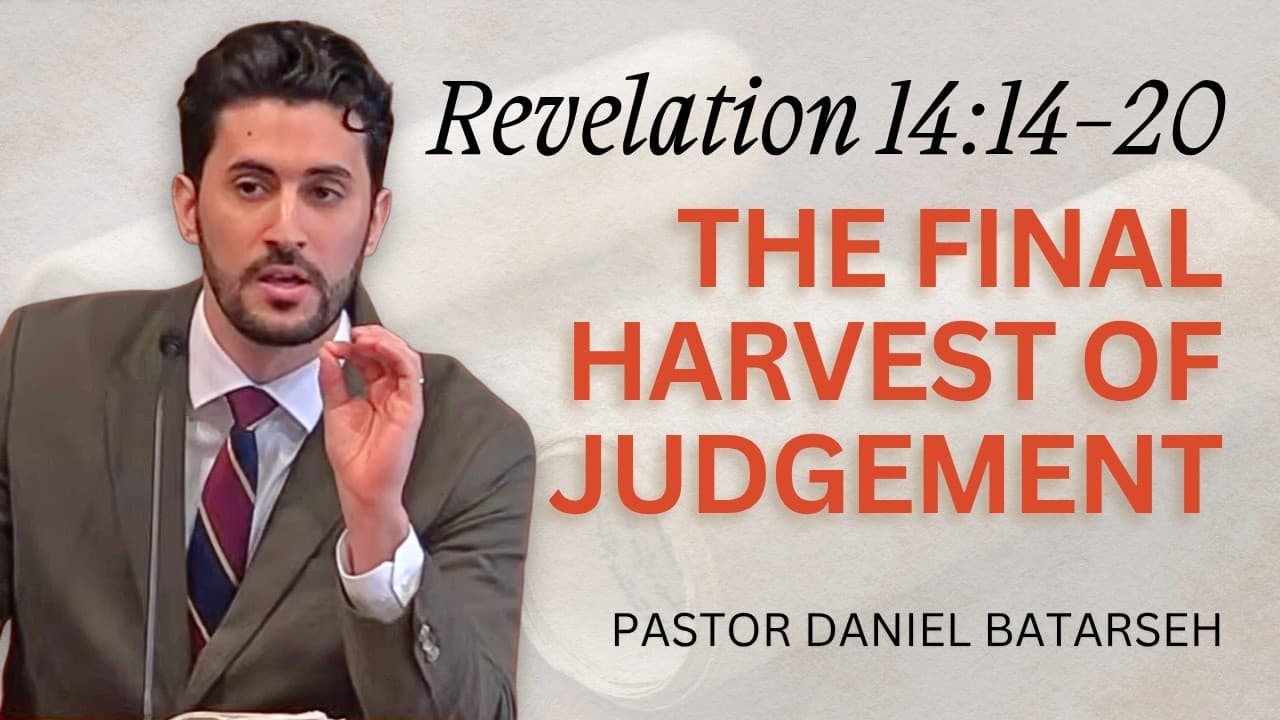
The two harvests in Revelation 14 aren't about gathering the righteous and punishing the wicked. A closer look at the Greek and Joel 3 reveals something far more sobering.
Most people read Revelation 14:14-20 and assume they're looking at two different harvests — one good, one terrible. The grain harvest, they say, is Christ sweeping in the redeemed. The grape harvest is God crushing the wicked. It's a tidy reading. It's also almost certainly wrong.
The word translated "ripe" in verse 15 doesn't mean ready. It means dried up. Withered. Overdue. And the Old Testament passage John is drawing from — Joel 3:12-13 — has nothing to do with salvation. It's judgment from start to finish. What we actually have in these seven verses is not a tale of two destinies, but a preview of two devastating phases of God's final wrath against a world that has exhausted every last measure of his patience.
That changes how you read this passage. It should also change how you live today.
The Word That Overturns the Popular Reading
Here's where careful attention to the original language dismantles a comfortable interpretation. In verse 15, an angel emerges from the heavenly temple and declares to the Son of Man: "Put in your sickle and reap, for the hour to reap has come, for the harvest of the earth is fully ripe." At face value, "ripe" sounds positive — a harvest reaching its full maturation, ready to be gathered in with joy.
But the Greek word here doesn't mean "ready." It means overripe. Dried out. Past its usefulness. It's the word you'd use for something withered beyond recovery, fit only to be discarded. And here's the detail that seals it: this same Greek word appears only one other time in all of Revelation — in chapter 16, verse 12, where the Euphrates River is "dried up" to prepare the way for the kings of the East (watch at 52:00). Same word. Same sense of something desiccated, emptied, finished.
So whatever this first harvest is, it's not being gathered with celebration. It's being gathered for disposal. The grain isn't golden and full — it's brittle and dead. This is not Christ collecting his beloved. This is Christ dealing with a generation that has dried up under the relentless heat of its own rebellion.
Now compare that with the grapes in verse 18. The angel says the grapes are "ripe" — but this is a different Greek word entirely. This one does mean full, complete, ready. The grapes have reached the bursting point. And what does that bursting point represent? Not maturity in righteousness, but the absolute peak of human wickedness. As Pastor Daniel Batarseh put it: "After all the seal judgments, after all the trumpet judgments, after the witnesses and the miracles and the obvious crying out to the lost to be saved — what does this grape harvest teach us? That humanity experiencing all of that will only become more and more evil" (watch at 1:12:01).
Two different words for "ripe." Two different phases of judgment. One comprehensive portrait of a God who has reached the end of a patience that was already incomprehensibly long.
Joel 3 — The Prophecy John Is Expanding
John doesn't invent this imagery. He borrows it. And the source text eliminates any ambiguity about what kind of harvest this is.
Joel 3:13 reads: "Put in the sickle, for the harvest is ripe. Go in, tread, for the winepress is full. The vats overflow, for their evil is great." Notice the structure: sickle, then harvest, then winepress, then overflow. It's almost a perfect summary of what John expands across Revelation 14:14-20. Sickle and grain reaping in verses 14-16. Sickle and grape treading in verses 17-20.
And the context of Joel 3 is unmistakable. This is the Valley of Jehoshaphat. God is sitting to judge all the surrounding nations. There is no salvation scene here, no ingathering of the faithful. Everything surrounding this imagery is wrath (hear this moment).
So what John is doing, guided by the Spirit, is taking Joel's compact prophecy of comprehensive judgment and unfolding it into two distinct movements. The first harvest — the dried, withered grain — previews the seven bowl judgments that will be poured out in Revelation 15-16, the most intense succession of divine wrath the world has ever seen. The second harvest — the bursting grapes trampled in a winepress — previews what Christ himself will do when he physically returns, described in full in Revelation 19.
This isn't two harvests of different kinds of people. It's two phases of one terrible reckoning.
The Sharp Sickle and the God Who Investigates Before He Strikes
One of the most striking details in this vision is what Christ holds in his hand: a sharp sickle. Not just a sickle — a sharp one. The text emphasizes the sharpness repeatedly, and it's not accidental. That sharpness speaks to the surgical precision of divine judgment. No exaggeration. No collateral damage. No overreach. Every verdict perfectly calibrated to the evidence.
This is where an Old Testament scene illuminates the character of the Judge. In Genesis 18:20-21, the Lord tells Abraham he has heard the outcry against Sodom and Gomorrah, and then says something remarkable: "I will go down to see whether they have done altogether according to the outcry that has come to me. And if not, I will know."
Some have tried to use this verse to argue God isn't omniscient — that he needs to come down and check the facts. But that misses the point entirely. God doesn't need to investigate. He chooses to demonstrate that he does. He goes out of his way to show Abraham — and us — that before he renders a verdict, he weighs every matter with excruciating care (watch at 1:01:44). He is never cruel. Never impulsive. Never reckless with his justice.
The sharp sickle means there will be no mistakes when the harvest comes. Christ's discernment is razor-edged. He sees through every excuse, every self-justification, every hidden motive. And he acts accordingly — not one degree more severe than the truth demands.
That should terrify the guilty. And it should deeply comfort the righteous.
"I Gave Her Time to Repent" — The Patience Behind the Wrath
The overripeness of the harvest doesn't just describe the wickedness of humanity. It reveals the heart of God. He waited. He didn't harvest when the grain was ripe. He waited until it was overripe. Dried out. Withered beyond recovery. What kind of judge does that?
A patient one.
Consider the letter to the church at Thyatira in Revelation 2:21. A false prophetess called Jezebel was leading the congregation into sexual immorality and false teaching. And Christ says five devastating words about her: "I gave her time to repent." He didn't strike immediately. He warned. He convicted. He revealed himself. He gave her time.
And then the rest of the verse: "But she refuses to repent of her sexual immorality."
She refuses. The seven bowls of wrath are coming because an entire generation will do exactly what Jezebel did — refuse, refuse, refuse. As Pastor Daniel Batarseh pressed the congregation: "How many times have you heard the gospel presentation from this pulpit alone? How many times down deep inside you know — you know — that your conscience is ringing because what you're doing, how you're living, is wrong. You haven't surrendered... Don't test his patience. Translate his patience as his great love to you and give yourself to him" (hear this moment).
God's patience is not passivity. It is not indifference. It is love straining at the seams, holding back what justice demands, giving one more day, one more conviction, one more gospel presentation. But patience has a horizon. And the overripe harvest tells us that horizon is real.
The Vine of the Earth vs. The True Vine
There's a detail in verse 18 that's easy to skip but impossible to forget once you see it. The angel gathers grapes from the vine of the earth. Not just grapes from the earth — grapes that drew their life, their sustenance, their very substance from the earth as their source.
This is the world's system as a vine. Its philosophies, its ambitions, its promises of fulfillment — they nourish those who attach themselves to it. And the fruit they produce looks full and ripe right up until the moment it's thrown into the winepress.
Now hear Jesus in John 15:1: "I am the true vine, and my Father is the vinedresser." Not just a vine. The true vine. The real source of life, satisfaction, peace, love, wholeness. Every other vine is a counterfeit. Every other source of sustenance will eventually produce fruit fit only for the winepress.
The question this text forces on every person is simple and inescapable: which vine are you attached to? And the answer isn't found in what you say on Sunday. It's found in the fruit your life produces Monday through Saturday. As the sermon made clear: "The way to verify which vine am I linked to is not by verbal confession. It's by the evidence of the fruit in your life. It's observable" (watch at 1:15:59).
Isaiah 63 and the Day of Vengeance in His Heart
The most uncomfortable moment in this sermon came from Isaiah 63:1-4. Isaiah sees a figure marching from Edom in crimson garments, splendid in apparel, mighty to save. Isaiah asks why his garments are red. And the answer is staggering: "I have trodden the winepress alone... I trod them in my anger and trampled them in my wrath. Their lifeblood spattered on my garments and stained all my apparel."
This is the Messiah. This is Jesus. And verse 4 says: "The day of vengeance was in my heart."
But here's the connection that stopped the room. In Isaiah 61:2, the order is: the year of the Lord's favor, then the day of vengeance. That's Christ's first coming — favor first. When Jesus quoted this passage in Luke 4:17-19, he stopped reading right after "the year of the Lord's favor" and closed the scroll. The day of vengeance wasn't for that visit.
But in Isaiah 63:4, the order reverses: the day of vengeance first, then the year of redemption. That's the second coming. Vengeance leads to redemption. Judgment clears the way for the fullness of salvation.
And notice the proportions — in both passages, vengeance is a day. Redemption is a year. God is far more eager to save than to judge. The vengeance is necessary, but it's brief. The redemption is what his heart beats for.
As Pastor Daniel Batarseh declared over the congregation: "The same one who has a sickle in his hand — with those same hands were pierced. And the same one who will use his feet to trample on his enemies — were put together and nailed to a cross. And the same one who has a golden crown in this vision took upon himself a crown of thorns" (hear this moment).
The Judge is the Savior. The hands that will hold the sickle already bear the scars of a cross. And right now — today — those hands are extended, not in wrath, but in invitation.
What to Remember
- The word "ripe" in Revelation 14:15 doesn't mean ready — it means dried up and overdue, the same word used for the Euphrates being dried up in Revelation 16:12. This is not a joyful harvest.
- The two harvests in Revelation 14 are not the righteous and the wicked — they are two phases of judgment: the seven bowl judgments and Christ's personal confrontation with his enemies at his return.
- God's patience is not his passivity. He waits until the harvest is overripe, giving every possible chance for repentance. But patience has a limit, and the dried grain proves it.
- Jesus called himself the true vine because there are false ones. The vine of the earth produces fruit that looks full right up until the moment it's thrown into the winepress. The fruit of your life reveals which vine you're attached to.
- In Isaiah 61, favor comes before vengeance — that's the first coming. In Isaiah 63, vengeance comes before redemption — that's the second. But in both, vengeance is a day and redemption is a year. God's heart leans toward salvation.
- The Judge who holds the sickle bears nail-scarred hands. The feet that will trample the wicked were once nailed together on a cross. Right now, we live in the year of the Lord's favor. That window will not stay open forever.
Questions to Sit With
- If God's patience with you were described as a harvest, would it be ripe — or overripe? What have you been refusing to deal with that his patience has been covering?
- Which vine is actually sustaining your daily life — Christ, or the philosophies, comforts, and ambitions of the world? How can you tell by the fruit?
- Does the idea that "the day of vengeance was in my heart" (Isaiah 63:4) disturb you? Why might it be essential — not contradictory — to the love of God?
- Jesus stopped reading Isaiah 61 mid-sentence at his first coming. What does it mean for you that we currently live in the pause between the year of the Lord's favor and the day of vengeance?
- If you genuinely believed that judgment is as real and physical as this passage describes — blood as high as a horse's bridle for 180 miles — how would it change the urgency with which you share the gospel this week?
Scripture Referenced
- Revelation 14:14-20 — Primary passage: the two harvests of judgment
- Joel 3:12-13 — The Old Testament source for the sickle and winepress imagery
- Revelation 16:12 — The same Greek word for "ripe" / "dried up"
- Revelation 1:13 — "One like a son of man" in Christ's glorified state
- Daniel 7 — The Son of Man descending with the clouds
- Genesis 18:20-21 — God investigating Sodom before judging it
- Revelation 2:21 — "I gave her time to repent"
- Mark 4:18-19 — The thorns that choke the word: cares of the world
- John 15:1 — "I am the true vine"
- John 15:5 — "I am the vine, you are the branches"
- Isaiah 63:1-4 — The Messiah treading the winepress in wrath
- Isaiah 61:1-2 — The year of the Lord's favor and the day of vengeance
- Luke 4:17-19 — Jesus reading Isaiah 61 and stopping mid-verse
- Revelation 19:15 — Christ treading the winepress at his return
- Psalm 135 — Opening scripture reading
This summary was generated by AI from the sermon "The Final Harvest of Judgement | Revelation 14:14-20 | Pastor Daniel Batarseh (3/22/26)" preached by Pastor Daniel Batarseh at Maranatha Bible Church Chicago. Watch the full sermon →
Preached by
Pastor Daniel BatarsehSenior Pastor
This summary was generated by AI from the sermon transcript.
Based on the sermon
The Final Harvest of Judgement | Revelation 14:14-20 | Pastor Daniel Batarseh (3/22/26)
Watch Full SermonRelated Articles

What Revelation 21 Says About Heaven That You've Never Noticed
Pastor Daniel Batarseh · October 11, 2026
What Revelation 21 Says About Eternity (It's Not What You Picture)
Pastor Daniel Batarseh · October 11, 2026

Hebrews 9 and Why Christ's Second Coming Isn't About Sin
Pastor Daniel Batarseh · October 4, 2026