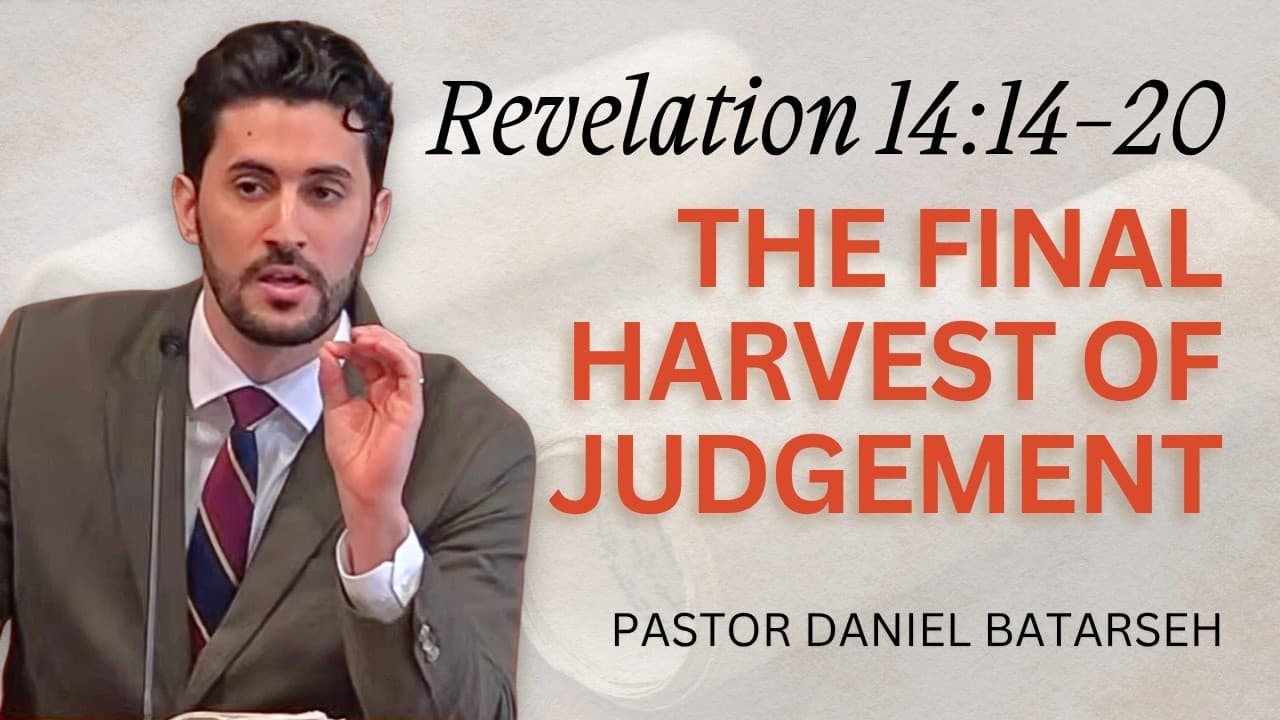
The harvest in Revelation 14 isn't what most people think. The word 'ripe' actually means dried up and withered — and that changes the entire meaning of this vision.
Most people read Revelation 14:14–20 and see two harvests — one good, one bad. The Son of Man swings His sickle and gathers in the righteous. Then an angel swings his sickle and gathers grapes for the winepress of God's wrath. It's a clean, tidy reading. Righteous harvest, then wicked harvest.
But there's a word buried in verse 15 that demolishes that interpretation. The word is "ripe." And it doesn't mean what you think it means.
The Greek word translated "ripe" in verse 15 doesn't mean ready or mature. It means overripe — dried out, withered, past its usefulness. And that single word transforms the entire vision from a tale of two harvests into something far more sobering: a preview of God's final judgment in two devastating phases, both aimed squarely at the wicked.
The Word That Changes the Whole Vision
Here's what trips up most readers of this passage. Verse 16 says the Son of Man "swung his sickle across the earth, and the earth was reaped." Then verse 19 describes an angel who "swung his sickle across the earth and gathered the grape harvest." Two reapings, two different images — grain and grapes. The natural assumption is that one must be positive and the other negative.
But look closer at verse 15. The angel from the temple cries out, "Put in your sickle and reap, for the hour to reap has come, for the harvest of the earth is fully ripe." That word "ripe" — in the original language — carries the meaning of something dried up, withered, no longer of any good use. This isn't a harvest being gathered with joy. This is a harvest being gathered to be discarded (watch at 51:10).
Here's the clincher: that same Greek word appears only one other time in all of Revelation. In chapter 16, verse 12, the sixth bowl judgment dries up the Euphrates River. "Its water was dried up." Same word. The harvest in chapter 14 isn't ripe in any hopeful sense. It's dried up. Withered. Done.
Once you see this, the Old Testament connection locks it in. John is borrowing directly from Joel 3:12–13, where the prophet writes: "Put in the sickle, for the harvest is ripe. Go in, tread, for the winepress is full. The vats overflow, for their evil is great." Notice — Joel mentions both a sickle for a harvest and an overflowing winepress, just like Revelation 14. And in Joel, there is no hint of a righteous gathering. Everything surrounding this imagery is judgment. Pure, unmitigated, holy judgment (watch at 48:54).
So what are these two harvests? They appear to be two phases of God's final judgment. The first — the grain harvest under the Son of Man — previews the seven bowl judgments of Revelation 15–16, the most intense succession of divine wrath in all of Scripture. The second — the grape harvest with its graphic imagery of treading and blood — previews what Christ Himself will do when He returns bodily to confront His enemies.
The Sharp Sickle and the God Who Investigates Before He Judges
There is something deeply personal about the way Christ appears in this vision. He is seated on a white cloud, wearing a golden crown, holding a sharp sickle. The crown and cloud speak of divine authority — this is no mere angel. This is the same "one like a son of man" from Revelation 1:13, the same figure Daniel saw descending with the clouds in Daniel 7. He has every right to judge.
But it's the sickle that arrests your attention. Not just any sickle — a sharp sickle. The text emphasizes this word repeatedly. Why? Because sharpness speaks of precision. As Pastor Daniel Batarseh put it: "Jesus Christ is not dull in his discernment. He's not dull in his perception. He's not dull with his verdicts. Jesus Christ is error free with his justice. He is razor sharp" (hear this moment).
This matters because we live in a world of botched verdicts, biased judges, and miscarriages of justice. Every human system of accountability is riddled with error. But the sharp sickle tells us that when Christ renders judgment, it will be surgically precise. He never exaggerates. He never overcorrects. He never punishes the wrong person.
And here's where an Old Testament story illuminates this truth in a way that's hard to forget. In Genesis 18:20–21, the Lord tells Abraham He's going to investigate Sodom and Gomorrah before destroying them: "I will go down to see whether they have done altogether according to the outcry that has come to me. And if not, I will know." At first glance, this seems to suggest God needs to verify facts — as if He doesn't already know. But that misses the point entirely. God is going out of His way to demonstrate something about His character: before He executes judgment, He takes great care to weigh every matter. He is showing Abraham — and us — that He is never cruel or impulsive (watch at 61:44).
The sharp sickle is not the weapon of a tyrant. It's the instrument of a perfectly just King.
"I Gave Her Time to Repent" — The Patience Behind the Wrath
Perhaps the most convicting detail in this passage is hidden in that word "overripe." The harvest didn't just reach maturity — it went past maturity. It dried out. It withered. And that means God waited. He waited past the point of ripeness. He waited until there was absolutely nothing left to salvage.
This is the patience of God on full display, and it should terrify and comfort us in equal measure.
Consider what Jesus says to the church in Thyatira about the false prophetess Jezebel in Revelation 2:21: "I gave her time to repent." Five words that reveal the staggering restraint of the Son of God. This woman was leading an entire congregation into sexual immorality and false teaching. Most of us would have acted immediately. Christ gave her time. He warned her. He convicted her. He revealed Himself to her. And then — "but she refuses to repent."
As Pastor Daniel Batarseh pressed the congregation: "How many times have you heard the gospel presentation from this pulpit alone? How many times down deep inside you know — you know — that your conscience is ringing because what you're doing, how you're living, is wrong. You haven't surrendered. Don't test his patience. Translate his patience as his great love to you and give yourself to him" (hear this moment).
The seven bowl judgments that this first harvest previews will not fall on people who never had a chance. They will fall on a generation that refused, refused, refused. After seal judgments. After trumpet judgments. After two supernatural witnesses. After angelic proclamations of the gospel from the sky itself. The harvest becomes overripe not because God was slow, but because humanity was stubborn.
The Vine of the Earth vs. the True Vine
The second harvest — the grape harvest — introduces an image that cuts straight to the heart of how we live today. Verse 18 says the angel gathered "clusters from the vine of the earth." Not the vine of heaven. The vine of the earth.
This is a devastating description. These grapes — representing the wicked — drew their sustenance and life from the world's systems, philosophies, and ambitions. They attached themselves to the ideologies of this age and produced fruit accordingly. And notice: the word "ripe" used for these grapes is a different Greek word than the one in verse 15. This one means genuinely full, complete, bursting. Humanity in this final hour will have reached the absolute peak of wickedness — swollen to capacity with rebellion.
The contrast with John 15 is impossible to miss. Jesus said, "I am the true vine" (John 15:1). Not merely a vine. The true one. The real source of life, satisfaction, joy, and wholeness. Every other vine is a counterfeit. And in John 15:5, He adds: "I am the vine, you are the branches." The only way to bear fruit that lasts — fruit that won't be gathered for the winepress — is to abide in Him.
So here's the question that won't let you go: which vine are you attached to? You're drawing life from something. Everyone is. And the evidence isn't in what you say. It's in the fruit your life produces. It's observable. It's undeniable.
The Day of Vengeance and the Year of Redemption
The final verses of this chapter are staggering in their imagery — blood flowing as high as a horse's bridle for 1,600 stadia, roughly 180 miles. Whether that's literal pooling of blood, bodies piled that high, or blood splattering upward to the bridles of horses, the point is unmistakable: when Christ returns, it will be real, physical, and devastating.
But it's Isaiah 63 that provides the most stunning commentary on this scene. Isaiah sees a figure coming from Edom with crimson-stained garments and asks, "Why is your apparel red?" The answer: "I have trodden the winepress alone... I trod them in my anger and trampled them in my wrath." And then this line, from verse 4: "For the day of vengeance was in my heart, and my year of redemption had come."
The day of vengeance is in Christ's heart. That's uncomfortable. But look at the proportions. In both Isaiah 61 and Isaiah 63, when Scripture speaks of vengeance, it's a day. When it speaks of redemption and salvation, it's a year. God is far more eager to save than to judge. The vengeance is necessary — it's the doorway through which the full redemption of His people finally arrives.
And the order matters. In Isaiah 61, which describes Christ's first coming, the year of the Lord's favor comes first, followed by the day of vengeance. In Isaiah 63, which describes His second coming, the order reverses — the day of vengeance comes first, then the year of redemption. At His first coming, Jesus read Isaiah 61 in the synagogue in Luke 4:17–19 and stopped mid-sentence — right before "the day of vengeance." He closed the scroll. That day wasn't yet. He came to save, not to judge (watch at 94:28).
But the scroll will be opened again.
As the sermon drew to a close, Pastor Daniel Batarseh brought these two realities together with an image that will stay with me: "The same one who has a sickle in his hand — with those same hands were pierced. And the same one who will use his feet to trample on his enemies were put together and nailed to a cross. And the same one who has a golden crown in this vision took upon himself a crown of thorns" (hear this moment).
The Judge is the Savior. The hands that will swing the sickle are the hands that bled for you. And right now — today — you are still living in the year of the Lord's favor.
What to Remember
- The word "ripe" in Revelation 14:15 means dried up and withered, not ready — this is a harvest of judgment, not salvation, and it changes the entire interpretation of the passage.
- Christ judges with divine authority, surgical precision, and staggering patience — the harvest goes overripe before He acts, meaning every chance has been given and refused.
- The "vine of the earth" in verse 18 stands in direct contrast to Jesus as the "true vine" in John 15 — every person is attached to one or the other, and the fruit of your life reveals which.
- Isaiah 63 reveals that the day of vengeance is in Christ's heart — not because He delights in destruction, but because judgment is the doorway to the full redemption of His people.
- When Jesus read Isaiah 61 in the synagogue, He stopped before mentioning the day of vengeance. That day wasn't yet. We are still living in the year of the Lord's favor — but the scroll will be opened again.
- God's patience with sin is not God's approval of sin. Translate His patience as His great love, and respond before the harvest becomes overripe.
Questions to Sit With
- If God's patience with your sin is actually evidence of His love — not His indifference — how does that change the way you respond to conviction you've been ignoring?
- Which vine are you actually drawing life from right now? Not which vine do you claim — what does the observable fruit of your daily life reveal?
- Jesus stopped reading Isaiah 61 mid-sentence because the day of vengeance hadn't come yet. What would change about your urgency — for your own soul or for the people around you — if you truly believed that pause is temporary?
- The harvest in Revelation 14 goes overripe before God acts. Is there an area of your life where you've been interpreting God's patience as permission?
- Does the image of Christ as Judge make you uncomfortable? If so, why — and what does that discomfort reveal about your understanding of His holiness?
Scripture Referenced
- Revelation 14:14-20 — Primary passage: the two harvests of judgment
- Joel 3:12-13 — The Old Testament prophecy John draws from
- Revelation 16:12 — The same Greek word for "ripe" / "dried up"
- Revelation 1:13 — "One like a son of man" in glorified form
- Daniel 7 — The son of man descending with clouds
- Genesis 18:20-21 — God investigating Sodom before judging
- Revelation 2:21 — "I gave her time to repent"
- Mark 4:18-19 — The thorns that choke the word: cares of the world
- John 15:1, 5 — Jesus as the true vine
- Isaiah 63:1-4 — Christ treading the winepress in vengeance
- Isaiah 61:1-2 — The year of the Lord's favor and the day of vengeance
- Luke 4:17-19 — Jesus reading Isaiah 61 and stopping mid-sentence
- Revelation 19:15 — Christ treading the winepress at His return
- Psalm 135 — Opening scripture reading
This summary was generated by AI from the sermon "The Final Harvest of Judgement | Revelation 14:14-20 | Pastor Daniel Batarseh (3/22/26)" preached by Pastor Daniel Batarseh at Maranatha Bible Church Chicago. Watch the full sermon →
Preached by
Pastor Daniel BatarsehSenior Pastor
This summary was generated by AI from the sermon transcript.
Based on the sermon
The Final Harvest of Judgement | Revelation 14:14-20 | Pastor Daniel Batarseh (3/22/26)
Watch Full SermonRelated Articles
What Revelation 21 Says About Heaven That You've Never Noticed
Pastor Daniel Batarseh · October 11, 2026
What Revelation 21 Says About Eternity (It's Not What You Picture)
Pastor Daniel Batarseh · October 11, 2026
Hebrews 9 and Why Christ's Second Coming Isn't About Sin
Pastor Daniel Batarseh · October 4, 2026