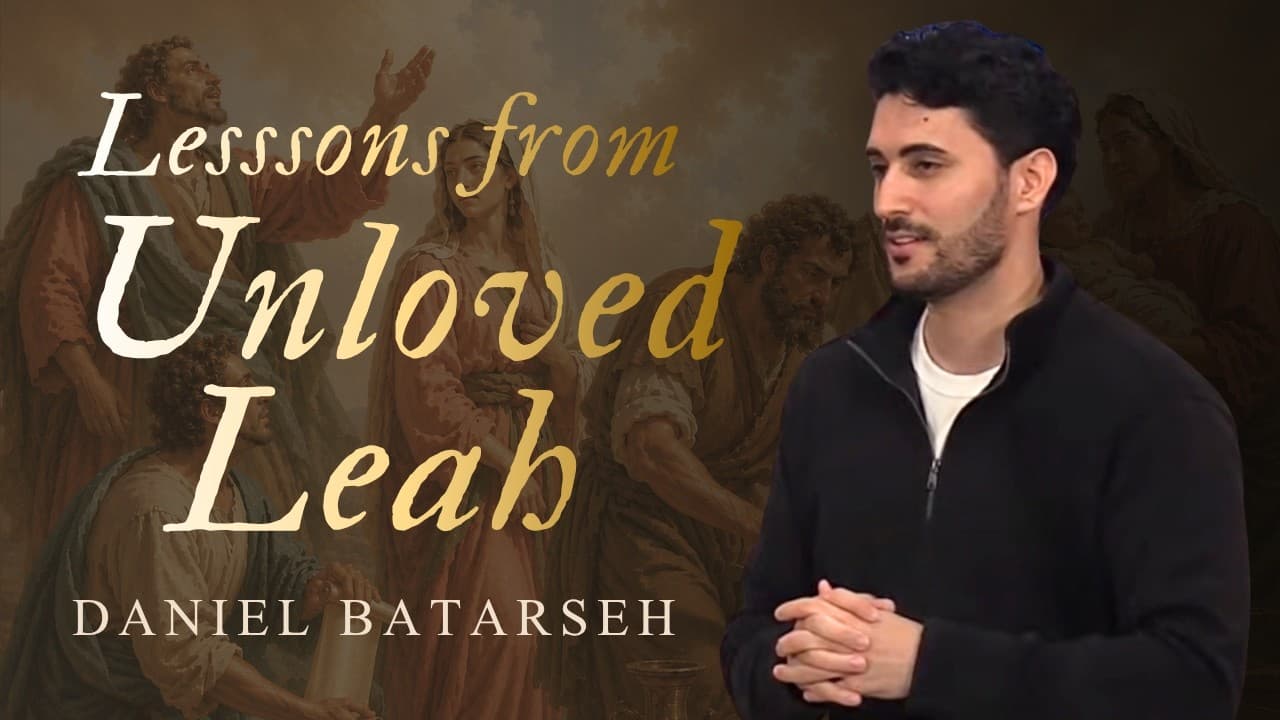
Leah was used by her father, ignored by her husband, and envied by her sister. But God chose her to carry the line of the Messiah — and her story reveals a truth that can heal your soul.
When you think of Jacob's wife, you think of Rachel. Beautiful Rachel. The one Jacob worked fourteen years for. The love story. But before Rachel, there was Leah — the wife nobody wanted, the sister nobody noticed, the daughter whose own father believed no man would marry her voluntarily. And it is through this woman, not the beautiful one, that God chose to bring forth the tribe of Judah, the priestly line of Levi, and ultimately the Messiah himself. Leah's story in Genesis 29–30 is not a footnote in Israel's history. It is a mirror held up to every soul that has ever tried to find wholeness in a person who will never give it to them.
The Only Way She Could Get Married Was Through Deception
To understand Leah, you have to understand the people around her. There are three main characters in her story besides herself: Laban her father, Jacob her husband, and Rachel her sister. Every single one of them treats her poorly.
Start with Laban. Jacob arrives, falls instantly in love with Rachel, and offers to work seven years for her hand. Seven years pass — and they felt like days, the text tells us, because of the intensity of Jacob's love. But on the wedding night, Laban switches daughters. He sends Leah into the dark tent instead of Rachel. Jacob consummates the marriage and wakes up the next morning to discover the deception (watch at 35:06).
Now sit with what this means from Leah's side. Her father — the man who should affirm her worth and protect her heart — concluded that the only way his daughter could get married was by tricking a man into sleeping with her. As Pastor Daniel Batarseh put it with raw emotion: "Your father believed that the only way that you can get married is by tricking a man into consummating a marriage with you... No one is willing to marry my daughter voluntarily. I have to lie. I have to deceive" (watch at 36:16).
And then imagine the morning after. Leah is lying there when Jacob opens his eyes, and what she receives is shock. Disappointment. Maybe disgust. The only recorded experience this woman ever had of being with a man was orchestrated through lies and met with revulsion. That was her wedding night.
Later, both daughters would confirm what kind of man Laban was. In Genesis 31:14-15, when Jacob tells his wives God is calling them to leave, Rachel and Leah respond together: "Are we not regarded by him as foreigners? For he has sold us." Their own father treated them like commodities. But Leah bore the sharper edge of that exploitation. She was the one used as a pawn in a scheme she never designed.
Jacob's Love Had a Permanent Address — and It Wasn't Leah
Genesis 29:30 delivers the verdict without softening it: "He loved Rachel more than Leah." And that sentence governed every day of Leah's married life.
This was not a temporary preference. It was a permanent condition. Every morning Leah woke up knowing she was the lesser wife. Every night she understood that Jacob's heart belonged to someone else — and that someone was her own sister. In that culture, you didn't file for divorce because your husband made you feel invisible. When you made an oath, it was binding for life. Leah was locked in.
The depth of Jacob's disregard shows up in moments you can easily skim past if you're reading quickly. Years later, when Jacob hears that Esau is approaching with four hundred men, he arranges his family in a specific order: servants and their children up front, Leah and her children in the middle, and Rachel with Joseph in the rear — the position of greatest safety (watch at 44:49). If violence came, the servants would absorb it first. Then Leah. Rachel would have time to escape.
Try to picture Leah in that moment, grabbing her children's hands and walking to her assigned post, knowing exactly what her placement meant.
And there's one more detail — so subtle it's devastating. At the end of Jacob's life, in Genesis 49:31, he gives burial instructions to his sons: "There they buried Abraham and Sarah his wife. There they buried Isaac and Rebekah his wife. And there I buried Leah." No "my wife." Abraham's wife. Isaac's wife. Just... Leah. Even in death, Jacob withheld the acknowledgment she craved. This was intentional omission from a man who never let her forget where she stood.
Rachel Had the Beauty — But Leah Had the Character
The introduction of these two sisters in Genesis 29:17 sets up a comparison that most readers take at face value: "Leah's eyes were weak, but Rachel was beautiful in form and appearance." The Hebrew word for Leah's eyes is ambiguous — it can mean tender, soft, or delicate, and scholars disagree on whether it describes a visual impairment, an aesthetic plainness, or even exhaustion. But the contrast with Rachel's striking beauty is unmistakable. The Spirit of God is telling us that Leah did not measure up to her sister's appearance.
But here is what's remarkable: nowhere in this entire account does the text say that Leah envied Rachel for her beauty. You can search for it. It's not there. Yet Rachel — with all her arresting attractiveness — envied Leah for her fertility. "Give me children or I shall die," she cries in Genesis 30:1. Think about that. The beautiful one is the one consumed by envy. The beautiful one is the one who later smuggles her father's household idols when Jacob flees. It wasn't weak-eyed Leah who brought false gods into the family. It was the head-turner.
This prompted a pointed challenge to every man in the room looking for a wife: "You're looking for form? You're looking for a model? Are you bypassing true beauty?... I'll tell you what's more beautiful — a woman who fears God. A woman who will bring heaven into your living room. A woman who will train your children to serve God and love God. That's more beautiful than anything. And Jacob missed it" (watch at 52:19).
Rachel's outburst — "Give me children or I shall die" — is also a warning. Do you think beautiful people are happy because of their beauty? Look at Rachel. She had the husband's love, the stunning face, the admiration of everyone who met her. And she was miserable. Beauty doesn't calm the soul. A husband's love doesn't complete you. Even children — as Leah was about to discover — cannot fill the void that only God can fill.
The Shift That Changed Everything: "This Time I Will Praise the Lord"
Here is where the story turns, and where the real teaching cuts deepest.
When the Lord saw that Leah was hated, he opened her womb (Genesis 29:31). The first person in this entire story to show Leah acceptance and love was not a man or a woman — it was her Creator. Not dad. Not husband. Not sister. God. And he didn't just comfort her; he selected this excluded, marginalized, neglected woman to be a matriarch of Israel. Jacob chose Rachel over Leah because of physical beauty. God chose Leah over Rachel when he wanted to fill a womb.
But watch what happens with each child. With Reuben, Leah says: "The Lord has looked upon my affliction; for now my husband will love me." With Simeon: "The Lord has heard that I am hated, he has given me this son also." With Levi: "Now this time my husband will be attached to me." God is lavishing her with favor, and the dominant thought in Leah's mind is still: I hope my husband will love me. By the third son, she doesn't even mention God. The craving is devouring her.
And here is the tragedy within the tragedy — the person being truly ignored in this story is God himself. He keeps giving. She keeps looking past him. "We can be recipients of God's blessing and protection and provision — marriage, children, promotion — and we can say, 'Yeah, that's God.' But we're not satisfied in God. We see him as the source of our blessings, but not the ultimate blessing himself" (watch at 1:06:20).
That sentence should stop you cold, because it describes more of us than we'd like to admit. God plus a better marriage. God plus that promotion. God plus someone finally noticing us. God plus. And as long as it's God plus something, you will never know contentment.
Then comes the fourth son. And something breaks open in Leah: "This time I will praise the Lord." She named him Judah — which means praise. After years of disappointment, after three sons that didn't move Jacob's heart, she makes a choice. Not a feeling. A choice. She shifts her gaze from the love she can't have to the love that was always there.
And God's response is stunning. "Then she ceased bearing." At first glance, you might think Leah decided to stop trying. But Genesis 30:9 reveals that this was God's doing — he closed her womb temporarily. Why? Because this worship was what God had been after all along. And the son born in that moment of surrender — Judah — would become the tribe through which the Messiah came. The Savior who draws in the unloved, who runs after the overlooked, who heals the hearts that no human relationship can heal — he came from the line of a woman who finally said, "This time, I will praise the Lord."
The Fanny Crosby parallel is striking. Born virtually blind, she composed between 8,000 and 9,000 hymns — so many that publishers made her use pseudonyms so people wouldn't lose interest in other writers. Blessed Assurance. Pass Me Not, O Gentle Savior. To God Be the Glory. Songs the church still sings, written by a woman the world would have pitied. God takes the overlooked and elevates them. He did it with Leah. He did it with Crosby. He does it still.
In Ruth 4:11, centuries after Leah's death, the elders at the gate bless Boaz by saying: "May the Lord make the woman who is coming into your house like Rachel and Leah, who together built up the house of Israel." In Laban's eyes, Leah was less than Rachel. In Jacob's eyes, less than Rachel. In Rachel's own eyes, less than Rachel. But God put her name right beside her sister's. He elevated her. He honored her. And he buried her — not Rachel — in the cave of Machpelah alongside Abraham, Sarah, Isaac, and Rebekah.
What to Remember
- The first and only person who showed Leah genuine love was God — not her father, not her husband, not her sister. The same is true for you.
- Acknowledging God as the source of your blessings is not the same as being satisfied in God himself. Leah proved that for three sons before she learned the difference.
- "This time I will praise the Lord" was a choice, not a feeling. Don't wait for some spontaneous emotion to carry you into worship — decide.
- Every polygamous relationship in Scripture comes with trouble. There is not one example where multiple wives proved to be a blessing. Not one.
- God's standard of beauty and worth is radically different from ours. He chose the weak-eyed wife over the stunning one to carry the Messianic line.
- You can have the husband's love, the beautiful face, the admiration of everyone around you and still be miserable — Rachel proves it. Contentment is not found in what you possess but in whom you worship.
Questions to Sit With
- If you're honest, what is your "God plus"? What is the thing you keep telling yourself you need in addition to God before you can feel whole?
- Is there a relationship in your life where you keep performing — having children, achieving, giving — hoping that person will finally love you the way you need? What would it look like to stop?
- Leah's turning point was a conscious decision: "This time I will praise the Lord." Have you ever made that decision — not as a song lyric, but as a life direction? What's stopping you from making it tonight?
- Jacob withheld the words "my wife" from Leah even at his death. Is there someone whose withholding of love or acknowledgment still governs your emotional life? What would freedom from that look like?
- Who is the Leah in your life — the overlooked person you might be failing to see and honor?
Scripture Referenced
- Genesis 29:16-35
- Genesis 30:1-9
- Genesis 31:14-15
- Genesis 33:1-2
- Genesis 49:31
- Ruth 4:11-12
- Psalm 96:1-13
- John 15:1-5
This summary was generated by AI from the sermon "Lessons from Unloved Leah | Pastor Daniel Batarseh | Maranatha Conference 2026 (Fri. Night)" preached by Pastor Daniel Batarseh at Maranatha Bible Church Chicago. Watch the full sermon →
Preached by
Pastor Daniel BatarsehSenior Pastor
This summary was generated by AI from the sermon transcript.
Based on the sermon
Lessons from Unloved Leah | Pastor Daniel Batarseh | Maranatha Conference 2026 (Fri. Night)
Watch Full SermonRelated Articles

Nehemiah 6:15-19 — What 52 Days of Rebuilding Teaches About Prayer and Fruitfulness
Pastor Daniel Batarseh · September 11, 2026
Nehemiah 6:15-19 — What 52 Days of Rebuilding Teach Us About Prayer and Persistence
Pastor Daniel Batarseh · September 11, 2026

Moses' Parents: The Faith That Formed a Deliverer (Hebrews 11:23)
Pastor Daniel Batarseh · August 30, 2026