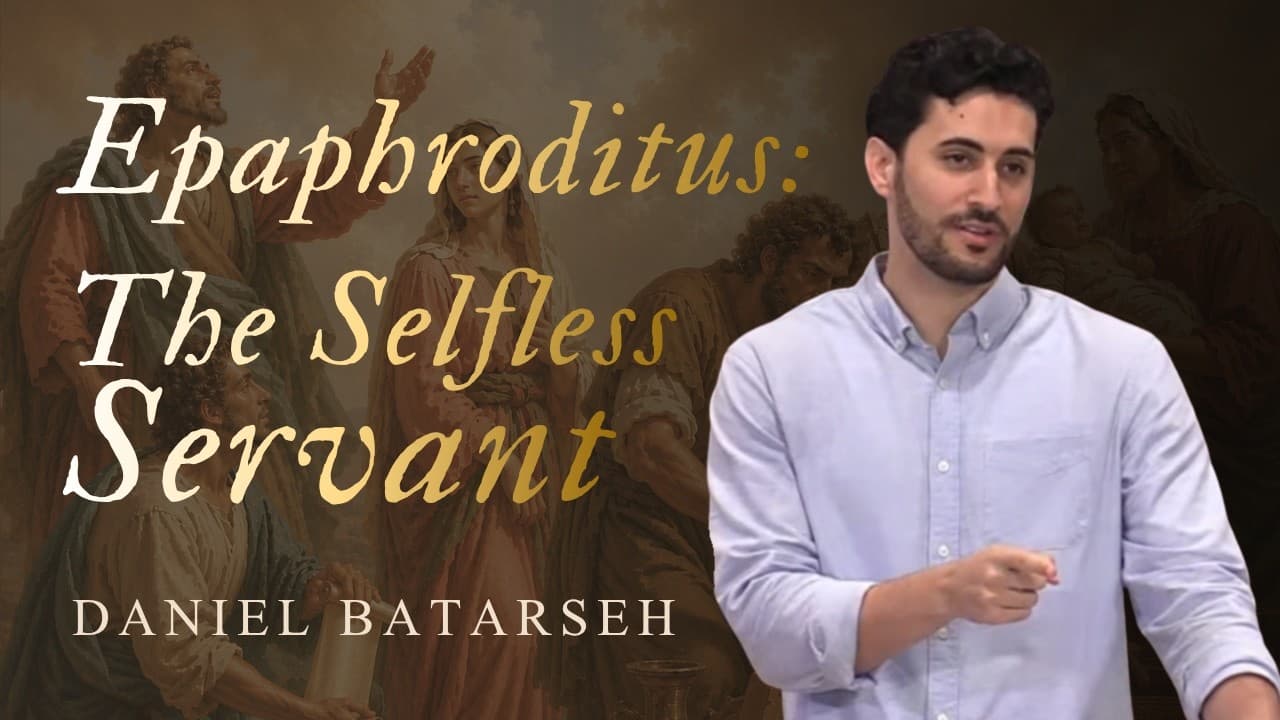
Epaphroditus wasn't upset that he was deathly ill — he was upset that his church found out and worried about him. His story in Philippians 2:25-30 redefines what selfless love actually looks like.
Most people read Philippians 2:26 and assume Epaphroditus was homesick. He was far from home, gravely ill, and wanted to go back to his people. That reading makes perfect sense — and it completely misses the point. Epaphroditus wasn't distressed because he was sick. He was distressed because his church found out he was sick. The anguish keeping him up at night wasn't his own suffering. It was the thought of his brothers and sisters in Philippi losing sleep over him. That single detail, tucked into a six-verse passage most Christians skip, reveals what the mind of Christ actually looks like when it takes up residence in a human heart.
Pastor Daniel Batarseh brought this man to life during a morning session at the 2026 Maranatha conference, and the room got very quiet when the implications landed.
Five Titles and Not a Single Sermon on His Résumé
Epaphroditus appears by name exactly twice in the New Testament — both times in Philippians — and yet Paul stacks five titles on him in a single verse. Look at Philippians 2:25: my brother, fellow worker, fellow soldier, your messenger, and minister to my need. Five descriptions. No record of a sermon he preached. No miracle attributed to his hands. No theological treatise bearing his name. Just selfless love, lived out in obscurity, and recognized by an apostle.
The first three titles belong to Paul — this is how he sees Epaphroditus. And the language matters. Paul does not say "my worker" or "my soldier." He says fellow worker, fellow soldier. The apostle who saw the risen Christ in blazing glory, who wrote half the New Testament, who planted churches across the Roman Empire — that man looks at Epaphroditus and says, "We're equals." No hint of hierarchy. No condescension dressed up in spiritual language.
This is what real spiritual authority looks like. Paul understood his position existed for one purpose, and he stated it plainly in 2 Corinthians 10:8: the Lord gave authority "for building you up and not for destroying you" (watch at 41:14). A true leader in the church makes the people under their care feel more confident in their walk with Christ, not less. You know you're under genuine Christian leadership when you walk away from a conversation feeling edified — more assured that what you do for the Lord actually matters.
The other two titles — your messenger and minister to my need — belong to the Philippian church. Epaphroditus was their ambassador. They chose him to carry their financial gift to Paul in prison and to stay with the apostle for an indefinite period, serving his daily needs. And that selection tells us everything about this man's character. The church knew Paul. They knew he was not someone you could be flimsy around. If your devotion was shallow, Paul would let you know. And yet there was no hesitation: Send Epaphroditus. No concerns about his temper. No whispered reservations about his language when he got comfortable. No questions about his integrity handling money on a long journey. He was the real deal.
That raises a searching question for every one of us: If your church needed to send one person to represent them — to embody their love, their maturity, their faithfulness — would you be on the short list? Or would the conversation sound more like, "Well, he's a genuine believer, but it doesn't take much for him to get angry. Not sure he's the best fit"?
The Word That Links Epaphroditus to Gethsemane
Here is where the text becomes staggering. Verse 26: "For he has been longing for you all and has been distressed because you heard that he was ill."
Read that again slowly. He was distressed — not because he was deathly sick, not because his church didn't know about his condition, but because they did know and he understood what that knowledge was doing to them. He couldn't send a text message. He couldn't call. There were no quick updates. Just distance, delay, and the gnawing awareness that the people he loved were suffering because of him.
As Pastor Daniel Batarseh pointed out, the Greek word translated "distressed" here is extraordinary. It appears only two other times in the entire New Testament — both describing the same event. Mark 14:33: Jesus in the Garden of Gethsemane, where He "began to be greatly distressed and troubled" (hear this moment). The Holy Spirit takes the word used for Christ's anguish before the cross and applies it to what Epaphroditus felt when he learned his church was worried about him.
This was not casual concern. This was deep turmoil. It was written on his face. It kept him awake. And what produced it? The emotional well-being of other believers. As Batarseh put it: "Who thinks like this? A man who has the mind of Christ. Who acts like this? A man who does not have his own interests as his top priority but the interests of others" (watch at 54:09).
This is the lived reality of what Paul commands earlier in the same chapter — Philippians 2:4-5: "Let each of you look not only to his own interests, but also to the interests of others. Have this mind among yourselves, which is yours in Christ Jesus." Epaphroditus doesn't just believe the theology. He is the theology.
A Symphony of Selflessness That Nobody Could Solve
What makes this passage even more remarkable is that Epaphroditus isn't the only selfless person in the story. Watch what happens when you pull back and see the full picture.
Epaphroditus is distressed about the church's worry. Paul, who is in prison and could desperately use a companion, sees the anxiety on all sides and says, "I am the more eager to send him therefore, that you may rejoice at seeing him again and that I may be less anxious" (v. 28). Paul gives up the one friend he has in Rome — his brother, his fellow soldier, the man who could run errands, bring meals, pray beside him — because the Philippians' joy matters more to him than his own comfort.
And the Philippian church? They didn't want Epaphroditus back. They wanted him to stay with Paul. They sent him for Paul.
So you have Epaphroditus worried about the church. Paul worried about the church. The church worried about Paul. Everyone thinking about the other. Nobody thinking about themselves. And for a moment, nobody can figure out what to do because each party keeps deferring to the other.
"Do you see the symphony here of selfless love?" Batarseh asked the room. "Do you see what a Christian congregation should look like? Do you see what Christian marriage should look like? Do you see what Christian friendships should look like? Everybody is thinking about the other. And they can't figure it out for a little bit" (watch at 56:33). The line landed with quiet force: "Selflessness is the key to knowing heaven on earth."
This isn't idealism. This is what the mind of Christ produces when it actually takes hold of a community. And Paul said it's yours — attainable, available, possible through the power of the One who modeled it perfectly.
Sorrow Upon Sorrow in the Epistle of Joy
There's a tension in verse 27 that most commentaries gloss over, but the sermon pressed directly into it. Paul writes: "Indeed he was ill, near to death. But God had mercy on him, and not only on him but on me also, lest I should have sorrow upon sorrow."
Pause. This is the book of Philippians — the epistle of joy. "Rejoice in the Lord always; again I will say, rejoice." This is the same Paul who wrote, "For to me, to live is Christ, and to die is gain" (Philippians 1:21). If death is gain, wouldn't Epaphroditus dying be good? And yet Paul admits plainly: if this man had died, he would have known compounded, severe grief.
The phrase "sorrow upon sorrow" isn't shedding a tear or two. It describes a season of crushing sadness. And Paul — the man who tells everyone else to rejoice — says God spared him from it.
This is the honest Bible. Death is unnatural. Every healthy soul knows it. When someone you love is sick, it's painful. When you lose them, it's devastating. And Paul shows us that it is "absolutely fine to know such emotions and still trust God and still strive for greater things" (watch at 64:00). Christians may grieve — deeply — but they don't stay there. Sorrow does not have the last word. But it doesn't mean you don't feel it.
The practical warning here cut to the bone: "You barging into a funeral and telling somebody who's lost somebody, 'Rejoice in the Lord always' — that's not being spiritual. That's being insensitive." There is a time for Romans 8:28. There is a time for the hope of resurrection. But when someone is shattered, the most Christlike thing you can do is weep with them. Paul admits this. And if it's freeing for an apostle, it should be freeing for us.
Notice, too, how Paul interprets God's mercy here. There's no indication of a miraculous healing — no laying on of hands, no handkerchief, no supernatural event. Epaphroditus recovered through God's sovereign, providential care. And Paul calls it mercy. More than that, he says God had mercy on him also — because the continued friendship and fellowship of a man like Epaphroditus was itself an expression of divine compassion. If you have someone in your life who inspires you to follow Christ, who brings you comfort, who helps you stay the course — that person is God's mercy to you. Don't miss it.
The Gamblers: How Epaphroditus Inspired a Movement
The word "risking" in verse 30 — "risking his life to complete what was lacking in your service to me" — carries the meaning of deliberately exposing oneself to danger. Epaphroditus calculated the cost before he left. He knew the journey to Rome was treacherous. He knew proximity to a prisoner carried its own risks. And he went anyway, not accounting for his own life.
That Greek word gave birth to a name. In the third and fourth centuries, a lay brotherhood arose in Alexandria, Egypt, calling themselves the Parabolani — derived from the same root word Paul uses here for "risking." They were known as "the gamblers" or "the risk-takers." When epidemics swept through the Roman Empire and civil authorities fled, when family members abandoned their own sick to die in the streets, these men walked toward the danger. They collected the sick, tended their wounds, buried the dead, and preached the gospel to anyone who would listen. The watching world was stunned. Who are these people?
And one of their primary inspirations? The testimony of a man most modern Christians can't pronounce. Epaphroditus — the lovely one — whose willingness to gamble his life for Christ sparked a movement of radical, sacrificial love that outlived him by centuries.
His story invites the same question for us. Not necessarily on the mission field or in a plague ward, but in whatever context God has placed us: What would it look like to show no regard for your own life for the cause of Christ? In your marriage? In your church? In the way you lead? The ministry opportunities will come. But God is looking first for the right heart.
As the sermon closed: "No record of a sermon that he preached. No record of a miracle that he performed. Just selfless love." That's what made him lovely. And that's what's available to every one of us who has the mind of Christ.
What to Remember
- Epaphroditus's distress wasn't about his own illness — it was about the worry his illness caused others, revealing a selflessness so deep that the New Testament uses the same Greek word for Christ's anguish in Gethsemane.
- True spiritual authority builds people up; if those under your leadership feel smaller, less confident, or used, something has gone terribly wrong.
- Paul admitted he would have known "sorrow upon sorrow" if Epaphroditus had died — even in the epistle of joy. Grief and faith are not opposites; Christians grieve deeply but don't stay there.
- God's mercy doesn't require a miracle. Waking up this morning, having a faithful friend, receiving providential healing — these are mercy, and they deserve gratitude.
- The people God uses most visibly are not always the ones who preach or perform miracles. Sometimes they're the ones whose character is so consistent that an entire church says without hesitation, "Send him."
- Selflessness is the key to knowing heaven on earth — in marriage, in friendship, in church life, in leadership.
Questions to Sit With
- If your church needed to send one person to represent them in a difficult, long-term assignment, would anything about your character, your attitude, or your consistency disqualify you from being considered?
- When was the last time you were genuinely more troubled by someone else's anxiety than by your own hardship? What would it take for that to become normal rather than exceptional?
- Paul called the continued life and friendship of Epaphroditus an act of God's mercy toward him. Who in your life is God's mercy to you — and have you ever told them that?
- Have you ever weaponized a Bible verse at someone who was grieving — offering theology when they needed tears? What does Paul's honesty about "sorrow upon sorrow" free you to do differently?
- The Parabolani risked their lives in plague-ridden cities because one man's example in Scripture moved them. What "risk" is the Spirit pressing you toward that you keep calculating your way out of?
Scripture Referenced
- Philippians 2:25-30 — Primary text: Paul's commendation of Epaphroditus
- Psalm 23:1-6 — Opening reading
- Hebrews 4:14-16 — Christ as sympathetic high priest
- Philippians 4:18 — Paul's receipt of the Philippians' gift via Epaphroditus
- Philippians 2:4-5 — The command to have the mind of Christ
- 2 Corinthians 10:8 — Authority given for building up, not tearing down
- Mark 14:33 — Jesus distressed in Gethsemane (same Greek word as Phil. 2:26)
- Philippians 1:21 — "To live is Christ, to die is gain"
This summary was generated by AI from the sermon "Epaphroditus: The Selfless Servant | Philippians 2:25-30 | Pastor Daniel Batarseh | Maranatha 2026" preached by Pastor Daniel Batarseh at Maranatha Bible Church Chicago. Watch the full sermon →
Preached by
Pastor Daniel BatarsehSenior Pastor
This summary was generated by AI from the sermon transcript.
Based on the sermon